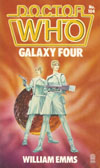
Galaxy Four
|
(Doctor Who Story No. 18, starring William Hartnell)
- written by William Emms
- directed by Derek Martinus
- produced by Verity Lambert
- featuring library music tracks
- 4 episodes @ 25 minutes each:
| 1. |
| Four Hundred Dawns |
| 2. |
| Trap of Steel |
| 3. |
| Air Lock |
| 4. |
| The Exploding Planet |
|
Story: Materializing on a desolate alien planet,
the Doctor, Steven, and Vicki are soon rescued from
enigmatic robots by a race of young female soldiers
called Drahvins. The Drahvins have been in a fight for
survival against the hideous Rills and their "Chumbley" machines
ever since each side crashed here, and the Drahvins
are desperate to find a way off the planet before its
decaying orbital conditions cause it to explode. Will the
Doctor and his friends be able to help the Drahvins without
getting caught in the cross-fire? How much are the Drahvins
willing to say about what the Rills are really after?
|
|
Blu-ray / DVD Features include:
- One digitally remastered complete original episode (#3), plus surviving clip from episode 1
- New animated recreations of all four episodes,
synchronized to the original television sound. (Colour & BW options)
- Photographic Reconstructions of episodes 1, 2, and 4
- Plus extra features, with Peter Purves (Steven) and Maureen O'Brien (Vicki):
- Audio commentaries
- Making-Of Documentary
- "Finding Galaxy 4" documentary
- Photo Gallery
- Pop-up Production Note Subtitles
- DVD-Rom PDF Material
|
In March 2013, a substantial amount of video material from this story
was released on
"The Aztecs" - Special Edition
DVD, which
included the newly rediscovered episode three - "Air Lock",
and both the 5-minute and 10-second clips from episode one,
all presented as part of a 64-minute recreation of the entire story.
The recreation is composed mostly of a montage of telesnap and
still frames accompanying the original television soundtrack,
but it also features many shots of the Chumbley machines achieved with
very satisfying full-motion 3D CGI models.
More details & buying options for "The Aztecs" Special Edition DVD's
|

|
Buyers' Guide Review
by Martin Izsak
|
|
(A more in-depth analysis, containing "SPOILERS" and intended
for those who have already seen the program, can be accessed
here.)
|
As written, this is a very excellent and exceptional story,
having all the elements I like to see in a Doctor Who adventure.
Its production is a good distance from being perfect, but all
things considered, season three can boast opening with a decent
sci-fi story that is more interesting, serious, and climactic than
anything season two put out. Verity Lambert's last real story as
producer is something of a triumph.
The distinctive library music tracks build a light
but nevertheless alien atmosphere for the lonely dying planet
on which this adventure takes place. The music is okay
for the most part, successfully alien and even brilliant in
some places, and generally works. Knowing these particular tracks
as well as I do, I don't think the team always managed to find the
most appropriate sections to back every scene, often selecting bits
that were too serene instead of some of the more suspenseful
or action oriented sections that were available, but this
doesn't detract much from the story.
The TARDIS seems to have made
a good materialization on television, although the novelization
is unfortunately deprived of that. The rest of its essential
features and those of the main characters are well demonstrated
in the opening sequence.
One couldn't ask for anything better. Fear of the unknown has no
power to stop the three regular characters from exploring outside
the ship and beyond as well, as they eagerly jump into danger
and first contact situations. They'll also tackle heroics
in satisfying fashion before they're
finished with this place. All the right stuff, in the right
order, starting the season off to boot.
The major theme of the story
works as an objective observation, but subjectively
are all the right things demonstrated by dialogue and performances?
In this area, the novel is more polished than the televised
version. There is much more to be said about this, but to avoid
spoilers, I'll save all that for the
in-depth analysis version of this review.
Judging by sound alone, the Drahvins themselves seem to act a little
stiffly, which is not altogether out of character for them.
The existing 5-minute film clip reveals additional visual nuances
that make the performances significantly more believable.
However, they are meant to be emotional beings,
and the fear and gut-level response to the Rills that motivates them
is still not quite all that it should be.
That said, getting a complete episode plus many stills from
the other episodes unveils much of what wasn't conveyed by voice alone,
and the Drahvins actually become much more believable.
Stephanie Bidmead, playing the Drahvin leader Maaga, puts in a very
compelling performance that outclasses many of the "strong" women
seen in later years of the show, including New Millennium Who,
and that performance is chiefly responsible for selling many of the story's
important moments. Good stuff.
One of the things that really helps sustain this story is
the mystery surrounding the Rills and their robots,
something that is executed with exceptional levels
of audio/visual atmosphere.
The sounds you will almost
certainly remember long after hearing this story are those of the
Chumbleys. Brian Hodgson has assembled one of his most effective
montages to date, effectively bringing to life these creations,
alien, mysterious, somewhat threatening,
somewhat reassuringly ordered and patterned.
And even with certain bits of information held back for later, the
characters are allowed to present themselves true to form throughout
the story, no elaborate manoeuvres required, and there is much
gripping conflict all the way through for all concerned. Thus the
story seems to be much better written than
"The Rescue" (story no. 11) and
"The Sensorites" (story no. 7),
and drives its own point home better.
Galaxy Four generally has better written action as well,
and the Doctor's your man in this one as the central, heroic
character. Though Steven and Vicki have excellent contributions
to make as well, the Doctor is
much more of the habitual, reasonable, lead problem-solver
in this one, and it's a vast improvement over his
usual season two antics.
This story delivers well, keeping
the level of drama high, interesting and logical all throughout
as the final episode builds to a satisfying climax.
Sadly, not everything is improved by having new visuals of the
story. The biggest letdown by far is the design of the Rill spacecraft,
which suggests at every turn that the budget for year 2's recording block
had run out. Thankfully though,
the Rills themselves work well, and we somehow only manage to see
as much of them at any time as the script intends.
Opportunities for including modern CGI effects for many of the bigger
events of the conclusion are not pursued in the 2013 DVD abridged version,
as it sticks more closely with what the original might have been like.
The Drahvins' weapons
operate on flash-charges which is about as good as you get on Doctor Who
before superimposed lasers started much later. The Chumbleys get little
puffs of steam for their weapons, but this effect
does at least get a more impressive debut in part one.
Sound effects for laser blasts are particularly lame this
time around, a quiet and dull bit of white noise that is
practically inaudible whenever something else is going on.
Improvement here could have lifted the excitement level of
the drama's conclusion considerably.
In terms of new visuals, what really impresses most is some of the creative
work of director Derek Martinus, both in getting really enjoyable
performances out of all the actors, and in often showing action that
was in no way suggested by the sound alone. And of course, CGI Chumbleys
allow a lot of their action to be on screen, and possibly more effective
and glitch-free than had been the case in the original footage. In cases
where action could not be visually recreated, we get subtitles explaining
it for us, as had been done with the 2000 A.D. VHS recreation of
"The Tenth Planet" (story no. 29), as opposed
to the less enjoyable narration in the VHS abridgement for
"The Ice Warriors" (story no. 39).
The presentation on the 2013 DVD does leave something to be desired
in lumping the whole story together as a single menu item of 65 minutes
in duration. Thankfully, it is split up with 16 chapter points, in which
episode three can be seen complete with its own individual titles and credits
in chapters 7 - 12. No division between episodes one and two can be easily
identified here, but then episode one never did have a great cliffhanger
anyway. Episodes two and three have much stronger cliffhangers, which
are easy to enjoy in this DVD version.
All things considered, "Galaxy Four" is a top notch season
three story, and a great example of the Hartnell era at its best.
I'm still secretly hoping that more of this one gets rediscovered on film
earlier than many other missing Hartnell episodes. Had this story been a
part of season two, it would have easily have come out on top
as the best story, no contest. However, as a part of
the more turbulent season three,
there are a number of other excellent stories ready to give it
a good run for its money.....
Galaxy Four
(starring William Hartnell)
This story is not known to exist in its original format
(4 black-and-white 25-minute TV episodes) in its entirety.
A new full-length animated version has now been bundled with
the previous photo reconstruction version that incorporated all known surviving footage:
Blu-ray / DVD Features include:
- One digitally remastered complete original episode (#3), plus surviving clip from episode 1
- New animated recreations of all four episodes,
synchronized to the original television sound. (Colour & BW options)
- Photographic Reconstructions of episodes 1, 2, and 4
- Plus extra features, see top of page for full list.
|
|
Doctor Who: "The Aztecs" Special Edition
2 DVD discs
NEW for 2013 March
|
Coverage on Galaxy Four includes:
- An abridged recreation of episodes 1 and 2 (28 min.)
featuring telesnap and video stills accompanied by the original TV soundtrack,
plus numerous new 3D CGI shots of the Chumbley machines.
This also includes:
- 8mm off-screen clip from Episode 1 with full sound
(TARDIS interior, approx. 10 seconds)
- 5 minute original full-motion clip from Episode 1 (Four Hundred Dawns)
as the Doctor & crew discover the Drahvin
spacecraft & meet Maaga.
- Episode 3: "Air Lock" (24 min. 19 sec.)
- A 12-minute recreation of episode 4, in the same style as that for episodes 1 & 2.
More details & buying options for "The Aztecs" Special Edition DVD's
|
This makes the previously available sources of video material
from this story less important:
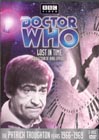 |
Doctor Who: Lost in Time - Patrick Troughton
2 DVD discs
(also included in Lost in Time Boxed Sets) |
Coverage on Galaxy Four includes:
- 5 minute clip from Episode 1 (Four Hundred Dawns)
as the Doctor & crew discover the Drahvin
spacecraft & meet Maaga.
This full clip can be found as part of
"The Missing Years" documentary, on the
second Patrick Troughton disc.
More details & buying options for "Lost in Time" DVD's
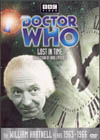 |
Doctor Who: Lost in Time - William Hartnell
1 DVD disc
(also included in Lost in Time Boxed Sets) |
Coverage on Galaxy Four includes:
- 8mm off-screen clip from Episode 1 with full sound
(TARDIS interior, approx. 10 seconds)
More details & buying options for "Lost in Time" DVD's
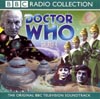
This 2 CD set features the complete audio tracks
of all 4 television episodes of this story:
- The CD Audio version features narration by
actor Peter Purves (who also played Steven Taylor)
to help listeners follow what used to be visual aspects
of the story. This version spans both discs
and is playable in any normal audio CD player.
Comments on this article are welcome. You may contact
the author from this page:
Contact page
|