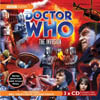
The DVD's include:
The VHS videos include:
The TARDIS sound during episode one's landing appears to be quite muffled and distorted, but we unmistakably get the one last great higher-pitch wheeze followed by a thud that signified the end of a satisfying materialization all through the 70's and 80's on Doctor Who. Douglas Camfield brought it to you first, masked under too much echo and possibly at the wrong speed as well. Oh well. More luck at getting it perfect next time.
CharacterizationsSally Faulkner manages to make Isobel quite ditzy, but not altogether very watchable unfortunately. More hair than face, more flightiness than charisma. Not much of a substitute for Professor Travers or Anne. Packer is not the most inspired of characters either, although Peter Halliday does a fair job of portraying him.The story picks up a bit once Tobias Vaughn is introduced. Kevin Stoney plays the part superbly: cool, suave, and under control for the most part, yet capable of explosions of greater magnitude as well. Then of course John Levene's Sgt. Benton turns up, and we meet Nicholas Courtney's always enjoyable Brigadier Lethbridge-Stewart. His introduction of his promotion and the formation of the UNIT organization add extra interest to the usual dynamics of a UNIT story, which work particularly well this time around. Jack Watling's Professor Travers has been replaced by Edward Burnham's Professor Watkins. Burnham puts in a good performance, much more serious and believable than his more eccentric role in Tom Baker's first story, "Robot" (story no. 75). The cyber-planner is back, looking better than in "The Wheel in Space" (story no. 43), but not sounding so great this time around. Peter Halliday, already playing Packer, was not the best choice for vocalizing all things cybernized in this story. At least the few lines spoken by real Cybermen sound a bit better. The planner, while still not being the best of ideas to begin with, seems to serve a much better role in this story where it can be mistaken for just a communication device rather than any real kind of "leader". The Cybermen themselves finally look good as they gain the full set of rings on the sides of their heads. Much better. Their introduction seems a bit out of place though, as if it was planted there artificially. Perhaps it was originally meant to occur earlier in the story, before "The Invasion" was expanded in length.
"Missing in Action"Wendy Padbury and Frazer Hines both take holidays during this story, in episodes 3 and 8 respectively. The timing seems a bit premature, as they've only just come back from a holiday break between recording blocks, but in each case their absences fit into the plot seamlessly. In particular, Jamie's sidekick role is more than adequately filled by the Brigadier, Benton, and the host of UNIT troops.Benton's role is quite minor early on, although he still manages to make an appearance of some kind in most episodes. Captain Jimmy-Boy is the one who's got the Brigadier's ear in this one, not the worst of characters by any means, but he and Isobel manage to get less and less interesting as a substance-less bit of flirting develops between them, detracting from the main story. To their credit, they get a good scene at the end of episode six, neatly counterpointing the horrific audio-visual imagery of the cliffhanger. Not enough to stop me cheering when Jimmy-Boy goes flying off near the end, and Sgt. Walters disappears, allowing Benton to move forward and take a much more major role in the playing out of the final episode. UNIT sees a lot of Camfield location action in episode four, but unfortunately episode four doesn't get to be seen these days (not in its original format anyway) with it still ranking amongst Doctor Who's list of lost episodes. Episode Six also has an action beat, but this ended up happening off-screen as Camfield ran out of time to film it. Today's viewer has to wait for episode eight to see a good UNIT battle, which is actually extremely satisfying. Although a rather lame re-use of the Dalek negative effect is used for the Cybermen throughout most of the story, as it was in "The Wheel in Space", the final episode's battle scenes see the Cybermen switch over to much more effective hand-held armaments, which deliver a far more satisfying punch. Good job! Also absent from the usual cyber story is the traditional round of coffee, giving way to tea and a patti-cake biscuit. UNIT may be an international organization, but the familiar contingent led by Lethbridge-Stewart is defined as British as ever here (which is just the way we like it!)
The story thankfully wraps itself up without attempting a between-story cliffhanger, allowing a mood of satisfaction during its finish.
DVD FeaturesThe story's presentation on DVD is spectacularly satisfying, especially since we get to see and hear it at full length. The animated episodes remain lively and unique, such that even when similar plot movements get repeated during the first four episodes, they have an element of freshness about them which probably wouldn't be there without the new visuals.The animation works best at bringing out authentic-looking backgrounds, creating atmosphere (particularly for the very moody episode one), and in realizing faces with expression. Patrick Troughton has a very active and expressive face in real life, and although the animators may not have captured all the nuances that there would have been in the actual episodes, they manage a very satisfying likeness that is remarkably expressive here. Troughton is probably their biggest success here, and one they can be most proud of. Zoe and the Brigadier are also very well done, while Vaughn and Packer are decently successful. Isobel was never my favourite character, so I regard the animators' recreation of her as fairly accurate when the same bizarre flavour recurs for me again here. One character I was disappointed with in animated form was Jamie - who looks a bit too much like just any old average bloke, and doesn't exhibit Frazer Hines' charm visually. The animation also seems a bit challenged to portray the bigger action sequences of episode four as well as we might have liked - probably due to a limit of time and budget, although what we get still makes the story work. Most of the other DVD features are top-notch, from the various combinations of contributors on the round-robin commentary, to an excellent making-of documentary, to a thorough examination of the animation process and the collection of audio recordings by fans that make such recreations possible. And for those of us who love Don Harper's music tracks, we get to hear many (but sadly not all) in clean form on the photo gallery montage, including the infamous spy guitar track ("The Company") at full length. Awesome! All this makes "The Invasion" one of the most important Troughton-era DVD releases anyone could get.
This story is now available on DVD, VHS video, and audio CD:
DVD Coverage on The Invasion includes:
Comments on this article are welcome. You may contact the author from this page:
|