Genesis of the Daleks
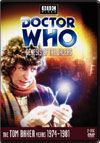 |
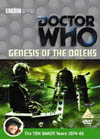 |
 |
DVD NTSC
Region 1


|
DVD PAL
Region 2


|
VHS Video
NTSC

PAL

|
|
(Doctor Who Story No. 78, starring Tom Baker)
- written by Terry Nation
- directed by David Maloney
- produced by Philip Hinchcliffe
- music by Dudley Simpson
- 6 episodes @ 25 minutes each
|
Story: Attempting to beam back up to the Ark in Space
and the TARDIS, the Doctor, Sarah, and Harry instead find
themselves in the midst of the ancient war between the
Kaleds and the Thals on the planet Skaro. The Time Lord who
intervened in their travels gets the Doctor to agree to alter the
development of the emerging Dalek race, hoping to make them
less of a threat to the universe in the future. But the Doctor
will have to both wrestle his conscience and pit his wits against
the brilliant and cunning crippled chief Kaled scientist Davros,
who has no end of tricks up his sleeve.
|
|
DVD Extras include:
- Audio commentary by Tom Baker (The Doctor),
Elisabeth Sladen (Sarah Jane Smith),
Peter Miles (Nyder),
and director David Maloney.
- "Genesis of a Classic" making-of documentary (62 min.) adding
commissioning producer Barry Letts,
commissioning script editor Terrance Dicks,
producer Philip Hinchcliffe,
actors
Michael Wisher (Davros),
James Garbutt (Ronson),
Dennis Chinnery (Gharman),
Guy Siner (General Ravon),
Roy Skelton (Dalek Voice),
Dalek Operators John Scott Martin and Cy Town,
sound designer Dick Mills,
lighting director Duncan Brown,
visual effects designer Peter Day, and
make-up artist Sylvia James.
- "The Dalek Tapes" - a history of the Daleks' appearances
in the original television series (53 min.)
- Pop-up Production Note Subtitles
- Photo Gallery sound effects montage (8 min.)
- Blue Peter model making segment, March 1975 (7 min.)
- Doctor Who 1976 Annual as a PC DVD-ROM .pdf file
Buyers' Guide Review
by Martin Izsak
|
|
(A more in-depth analysis, containing "SPOILERS" and
intended for those who have already seen the program,
can be accessed here.)
|
At first, I scoffed at the notion that this might be the greatest
Doctor Who story ever. After all, it does nothing on screen in any capacity
to demonstrate that key element of the series known as the TARDIS, which
does not feature at all beyond the title graphics. But as the stories
get ranked, and one compares the merits of the best of the best across
the various years and eras, "Genesis of the Daleks" continues to come out
on top again and again. It is just so packed with a healthy variety of
really good elements. Perhaps this is the best Doctor Who story ever.
It has its imperfections, but what Doctor Who story doesn't? In the end,
the sheer strengths in the content of the writing, combined with all
the mythology, performances, and audio/visual cinematic style that the
production manages to imbue it with, make a compelling case for awarding
this story the top position. It is certainly at the top of season twelve!
Andrew Pixley's archive feature on this story in Doctor Who Magazine
(not to mention the comprehensive making-of documentary on the DVD),
indicates that writer Terry Nation was at first going to use his commission
for another Dalek story to write yet another formulaic sequel.
God no! Who needs that?
Fortunately, he got encouraged both by the outgoing producer/script editor
team of Barry Letts and Terrance Dicks, and by incoming producer/
script editor team of Philip Hinchcliffe and Robert Holmes to do
something grander, until Nation himself was able to cite this story
as his favourite amongst all his Doctor Who works.
Entrances....
Originally, the TARDIS was to have appeared at the beginning of this
story, in some sort of limbo garden for the meeting with the Time Lord
messenger. I'm still unsure whether or not I would have liked this
better. Decent visual materalization(s) with proper sound? Scenes
in the TARDIS interior, juxtaposed with exterior scenes as the characters
go through the TARDIS doors? Using the TARDIS to go from garden
to Skaro instead of the far less interesting time-ring? One would
probably need it all to outdo the excellent opening sequence that
eventually got filmed:
We open immediately on Skaro, setting the scene with memorable
imagery. The location footage in the first episode is really nicely done,
an essential element for establishing the setting.
Tom Baker's Doctor then gets a beautiful and unusual entrance
as he emerges from the fog, unsure of where or when he is, and more
importantly why, just like Sam Beckett at the beginning of any good
Quantum Leap episode. The audience is allowed to clue in to the
situation along with the Doctor, as a Time Lord fills everyone in on
what is going on. Not unlike Al the hologram from Quantum Leap
either.
Why it Works...
The two best stories of
season one have now merged in this one:
We have a time-travel conundrum reminiscent of
"The Aztecs" (story no. 6), only
this time the Doctor has taken Barbara's place as the one aiming
to fashion a new history, and his mission will pit him against
"The Daleks" (story no. 2)
on their home turf once more. Wisely, his original
position on time travel and becoming involved with history
from "The Aztecs" has caved in after all,
and he's learned to go with his heroic impulses instead. Barbara
has at last won her argument, but good. A new history?
"That's feasible," he reasons.
The first two episodes feature a lot of formulaic Terry Nation
plot elements, with Sevrin taking one of Nation's typical
archetype roles.
We've also got a lot
of capture and escape routines, and some travel through menacing
environments with primitive creatures waiting to prey on our main
characters. But "Genesis" keeps the pace up on these segments,
and already begins laying the groundwork and background for the
political thriller with heavy moral overtones that it will soon
become. As usual, we have to wait for the end of the first
episode for our first view of a Dalek, but this works quite well
considering that the Daleks are only prototypical at this stage,
and also that we get an additional entrance by the great
half-dalek Davros as well.
"Perfect! The Weaponry Is Perfect! Now We Can Begin...."
More congratulations are due the production team with this story.
Although the traditional full-screen negative-image effect is still
applied to the targets of Dalek weapons fire, neatly maintaining a
nostalgic continuity, this is now finally augmented by
a decent visual beam effect, in a nice cyan colour too. At last! In fact,
this is practically the first decent visual beam effect ever produced on
Doctor Who thus far. The only notable exception that comes to mind
is Morris Barry's
"The Moonbase" (story no. 33)
in which visual beams were necessary
to show the gravitron deflect the weapons fire of some heavy outdoor
cyber-artillery, and apparently only achievable with a special
film sequence prepared well in advance. Now, major Doctor Who monster-characters
can use a decent effect in their everyday walk-and-stalk shoot-em-ups
in the video-tape studio.
To paraphrase Davros, this was a moment that lived long in history.
Avoiding the Usual Writing Pitfalls
By episodes three and four, the ante has been upped, and the political
aspects of the story reach their height. Beginning with Ronson, the Doctor
is very forthcoming and truthful about his origins, his opinions,
his reasoning, and his intentions - practically the opposite of many
a David Whitaker script. Also, just when you might think he'll be stuck
wrestling fake clams in the cave for most of an episode to formulaically
pad the scripts, no, he instead convinces others
over to his side with a refreshing swiftness
and believability, practically the opposite of the endless philosophical
head-butting of the typical Malcolm Hulke script. Now the story
proceeds from this more interesting place to a form of political
stake-raising and .... (hmmm, don't want to give too much away for
those who haven't seen it; those who have can read the spoilers
here.)
"A fascinating idea!"
Of all the confrontations
between the Doctor and Davros in this story and the sequels, the one
that develops in this story is by far the most civil, as
both are keen to explore each other's character, and both make genuine
attempts to convince the other of their point of view. Wonderfully
refreshing!
The Doctor does miss a good opportunity though.
(Ah, but that's another spoiler. If you've seen the program,
read my In-depth Analysis version here,
and I'll tell all.)
The moral arguments that mount throughout the story are a bit on the
simplistic side, but
carry with them an air of truth both in the way they are delivered,
and in the varying degree of importance the characters are placing
in them. And it all builds to a powerful and disturbing climax.
The Doctor is still given quite a bit to do in the final episode.
As with "The Aztecs", there's enough action and energy to make the
concluding episode very satisfying, philosophical, and unforgettable.
Although Dudley Simpson's music for season twelve has been vastly
superior to his efforts during the previous two years, his score for
"Genesis of the Daleks" still manages to disappoint me, most specifically
that it is a lost opportunity for Simpson to create more definitive new
themes, and one for the Daleks in particular.
Many of the action sequences give Simpson's music centre stage,
and he comes up with a good style for the music: appropriately harsh
instrumentation (very reminiscent of Malcolm Clarke's later Dalek music)
and a bit of beat and rhythm.... but where's the thematic hook, the melody,
the unforgettable anthem? Even the Grainer-esque pulses from
"The Evil of the Daleks" (story no. 36),
curiously enough never used in any further
Simpson Dalek scores, would have worked better, but that too was
lacking a memorable melodic voice.
|
Heathcliff Blair's re-recordings of
Simpson's music help me to further appreciate Simpson's work,
especially on "Genesis". There is more underlying thematic versatility
in the score than casual viewing of the TV story usually reveals, but
that's part of the trouble - it's too sophisticatedly subtle, and the
various ever-changing themes never quite state themselves boldly enough
to stand out and be easily remembered.
I do enjoy three particular cues from "Genesis", and they are
all near the end of the final episode. One is a wonderful juxtaposition
of the fourth Doctor's theme with Dalek style music (sadly not
included on Blair's CD),
and then the final two cues, the last of which ends on
an absolutely perfect note. Awesome! :-)
|
Music by Dudley Simpson
Eight re-recorded tracks feature on:
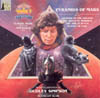 |
Audio CD -
Pyramids of Mars
Classic Music from the Tom Baker Era
Heathcliff Blair
|
More info & buying options
|
|
David Maloney has worked his usual magic on this one. Looking at
the elements separately, it is hard to say exactly what the director
has done to make it so special, but put everything together as a whole,
and the story carries a power and weight unique in the series. Mysteriously
beautiful.
What more should one say? No one can truly tell you how classic
"Genesis of the Daleks" is. You just have to see it for yourself.
This story has become available on DVD and VHS video.
Click on the Amazon symbol for the location nearest you
for pricing and availability:
|
|
|
DVD NTSC Region 1
for the North American market:
in the U.S.
in Canada
|
DVD PAL Region 2
for the U.K. |
VHS Video
NTSC
for North America
PAL
for the U.K.
|
Comments on this article are welcome. You may contact
the author from this page:
Contact page
|