City of Death
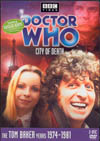 |
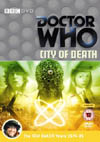 |
 |
DVD NTSC
Region 1


|
DVD PAL
Region 2


|
VHS Video
NTSC

PAL

|
|
(Doctor Who Story No. 105, starring Tom Baker)
- written by Douglas Adams, David Fisher & Graham Williams
under the name "David Agnew"
- directed by Michael Hayes
- produced by Graham Williams
- music by Dudley Simpson
- 4 episodes @ 25 minutes each
|
Story: Paris, 1979.
The Doctor and Romana abandon their holiday
to investigate a series of cracks appearing
in the fabric of time itself, and soon uncover
an overly elaborate scheme to steal
the Mona Lisa. What is the true purpose of
Count Scarlioni's machinations? Will the
Doctor's interference put all of Paris under
threat? And will Private Investigator Duggan
ever learn the true value of art?
|
|
DVD Extras include:
- Audio commentary by Julian Glover (Count Scarlioni),
Tom Chadbon (Duggan),
and director Michael Hayes.
- "Paris in the Springtime" making-of documentary (44 min.) adding
Catherine Schell (The Countess),
co-writer David Fisher,
co-script editor Anthony Read,
"The Pirate Planet" director Pennant Roberts,
fan professionals Steven Moffat and Robert Shearman,
and previously-shot interviews with the late co-writer / script editor Douglas Adams.
- Raw BW studio footage (20 min.) featuring bloopers, deleted and extended scenes
- Pop-up Production Note subtitles for main feature
- Pop-up Production Note subtitles for raw footage
- "Prehistoric Landscapes" (2 min.) - more unused model footage
- "Chicken Wrangler" (3 min.) - more comedic raw film footage
- Photo Gallery (9 min.)
- "Eye on Blatchford" (13 min.) - spoof featurette
- DVD ROM 1980 Doctor Who Annual .pdf
- Bonus Douglas Adams interview Easter Eggs
Buyer's Guide Review
by Martin Izsak
|
|
(A more in-depth analysis, containing "SPOILERS" and intended
for those who have already seen the program, can be accessed
here.)
|
"City of Death" can quite easily be ranked as the most fun story of
season 17. It is visually exciting, quite humorous,
and also presents an interesting sci-fi concept - Art theft and
fraud through time-travel and alien gadgetry. It's original, and
more importantly, in the end it is used to express the thematic question:
What is genuine quality in art?
Character-wise, we are dealt a lot of stereotypes with little
dimension: The brutal body-guard, the absent-minded scientist, the
thumping police detective. Thankfully though, the story has the finest
cast of the season which more than compensates. Julian Glover and
Catherine Schell play their roles as Count and Countess with absolute
conviction, making their characters extremely watchable and enjoyable.
Peter Halliday makes his role as a rather simple 16th century
swordsman enjoyable and believable through a great deal of understatement.
David Graham and Tom Chadbon, though threatening to go over
the top,
remain highly entertaining nonetheless. A cameo by John Cleese and
Eleanor Bron also remains a highlight to look forward to in the final
episode.
The TARDIS takes a backseat to the introduction of the characters;
as their mode of time travel, it becomes something the villain needs to
discover about them, and members of the audience unfamiliar with the
TARDIS will have to wait until the later half of the story to discover
it with him, when the police box proceeds to demonstrate its ability
to materialize in many different times and locations and deliver the
satisfaction that may have been missing earlier. Even then, the interior
features as only a single still frame (probably pulled from
"The Creature From the Pit" [story no. 106]
or some other
previously shot footage), used to construct a shot of the Doctor looking
at the scanner screen. And since K9 has been banished to the TARDIS interior
for the story, he also does not appear.
The Doctor and Romana are instead presented to viewers as mysterious,
educated travelers, whose affinity for matters of time, not to mention
ability to travel through it, slowly leaks out through the dialogue as
the story unfolds. This very different approach works quite well in this
particular story, and makes for a nice change.
This story is also able to boast a tour-de-force from incidental
music composer Dudley Simpson, whose highly memorable Paris touring
theme leads an exceptional score. Also of note musically is a wonderful
piece for the prehistoric Jagaroth spaceship scene that helps cement in place
the bookend nature of the story's structure, and some very enjoyable
Renaissance music complete with a period rendition of the fourth Doctor's
theme.
The strengths of this script clearly lie in its sense of investigating
mysteries, its humour, and its art appreciation theme. Its biggest flaws
show through after the mysteries are fully revealed and the on-screen
plot needs to shift to action. (The spoilers required to prove my points
can be read here.)
Too much plot-time is then wasted wandering around Paris, and indeed chasing
through
a number of imaginative and visually stimulating settings, while the Doctor
himself is reduced to a Doomsayer, nattering on and on like a broken record.
It becomes slightly reminiscent of
"The Time Monster" (story no. 64)
and half a dozen other
Jon Pertwee tales,
although thankfully never becomes quite as irritating
under Tom Baker's delivery. The real disappointment is his lack of having
anything concrete to do.
Another problem with the story is the farcical level of importance
placed on not changing history, which if not carefully checked, threatens
to dredge up the old anti-heroism plaguing the
William Hartnell era.
The Doctor should know better by now, but seems to have forgotten what
little he learned during
"Inferno" (story no. 54):
"Yes, of course, of course.... An infinity of universes....
ergo, an infinite number of choices....
So free will is not an illusion after all!"
That season seven story seemed to indicate that although
the Time Lords may have conquered Time and Space, they still have
something to learn about freedom of choice, and in this particular
story, the Doctor seems to need to relearn that as well.
Feeling comfortable with my own view of choices in time-travel,
I find it very difficult to root for the Doctor and party in the final stages
of this story.
More worthy of development might have been an attempt
to see the Jagaroth safely off of our prehistoric planet, and back to their
own interstellar political spheres.
But in the end, it must be said that director Michael Hayes
manages to bring a lot of fun together into this piece, and even where it
may be lacking in delivering great action to the adventure, there is a lot
of creative camera work to emphasize the drama, and eye candy from the
scenic shoots in Paris and the electronic effects wizardry of
Dave Jervis in the studio.
Ian Scoones' superb model work is
yet another definite highlight of the story.
"City of Death" is highly enjoyable, typically sits
well with most Doctor Who fans, and ranks fairly highly with me also.
This story has become available on DVD and VHS video:
|
|
|
DVD NTSC Region 1
for the North American market:
in the U.S.
in Canada |
DVD PAL Region 2
for the U.K. |
VHS Video
NTSC
in the U.S.
PAL
for the U.K.
|
Comments on this article are welcome. You may contact
the author from this page:
Contact page
|