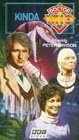
Kinda
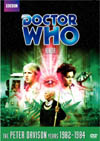 |
 |
 |
DVD NTSC
Region 1


|
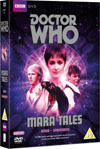
DVD PAL
Region 2
"Mara Tales"
Box Set


|
VHS Video
NTSC

NTSC

PAL

|
|
(Doctor Who Story No. 119, starring Peter Davison)
- written by Christopher Bailey
- directed by Peter Grimwade
- produced by John Nathan-Turner
- music by Peter Howell
- 4 episodes @ 25 minutes each
|
Story: On the planet Deva Loka,
the Doctor and Adric discover several space
colonists who are worried about
their comrades who have not returned from
their explorations of the jungle outside.
Meanwhile Tegan, still outside, falls under
the spell of a creature that invades her mind
through the dream state, and unbalanced states
of mind begin to crop up everywhere. What is
the full extent of the dangers on the planet?
And how do the silent, telepathic local tribespeople,
known as the Kinda, fit into the puzzle?
|
|
DVD Extras include:
- Audio commentary by Peter Davison (The Doctor),
Janet Fielding (Tegan),
Matthew Waterhouse (Adric),
Nerys Hughes (Professor Todd).
- "Dream Time" making-of featurette (34 min.) with
Fielding, Hughes,
Simon Rouse (Hindle),
Adrian Mills (Aris),
designer Malcolm Thornton,
writer Christopher Bailey,
script editors Christopher H. Bidmead,
Antony Root, and Eric Saward,
and the late director Peter Grimwade.
- "Peter Grimwade - Directing with Attitude" featurette (23 min.)
- colleagues remember his life and work.
Contains spoilers for seasons 18-21.
- Optional CGI Effects sequence (part four only)
- CGI Effects comparison (2 min.)
- Isolated Music Score by Peter Howell
- Deleted Scenes (15 min.)
- Photo Gallery music montage (5 min.)
- Pop-up Production Note Subtitles
Buyers' Guide Review
by Martin Izsak
|
|
(A more in-depth analysis, containing "SPOILERS" and intended
for those who have already seen the program, can be accessed
here.)
|
This story is different from most other Doctor Who offerings,
dealing more with unbalanced states of mind than the usual technological
sci-fi challenges, and successfully placing its emphasis on strong
acting performances rather than ground-breaking visuals. Peter Davison
finally begins to come into his own particular Doctor in this story,
and the whole thing becomes a studio-bound mild success.
The cinematic style of "Kinda" seems to emphasize an anti-tech
outlook on life, something carried over into its sequel the following year.
The usual simple special effects for the TARDIS like materialization and
the juxtaposition of the impossible interior/exterior relationship are
completely bypassed in this story, by starting the tale off just after
the TARDIS has landed, and oddly ending it just before the take-off that
the audience is later well-primed for. There is also a complete absence
of visual beam weapons fire. I found all this terribly disappointing
on my first viewing years ago.
In fact, despite featuring two groups of space explorers on an alien
planet, about the only piece of technology that gets a spotlight on it
and a bit of an explanation is the T.S.S. machine, and even then perhaps
only because the writer is using this device to emphasize
and exaggerate the unbalanced states of mind of its various users
throughout the story.
The introductions in this story focus more on display of character than
plot-entrances, and work well enough. A later scene of the Doctor meeting
the explorers from the dome fills in the remaining gaps later on.
The early portions of the story actually resurrect the base defence
story beats that formulaically worked so well in the
Patrick Troughton years,
as the crew in the dome build suspense through the fear of the unknown
and the mysteries that they have on hand. As this is contrasted with the
very bizarre experiences that Tegan is having, and what few Kinda
tribespeople we see early on have no lines of dialogue, a high level
of anticipation is created for the future revelations in the story.
Part Two manages to escalate thanks to more mystery and unanswered
questions, and neatly sidesteps
most of the usual boring prisoner dynamics.
Each episode also seems to flow better when viewed immediately after
its predecessor, in keeping character motivations clear and providing
a continual drive for them throughout the story. Viewed separately,
starting each episode cold, it's harder to get back into the characters
and regain a sense of what they're working towards.
Peter Davison's Doctor proves to be very lively and jovial in this
story, while allowing his vulnerability and the limits of his experience
to come to the forefront. It is at times puzzling to see him so much at
a loss to understand or emulate Adric's simple magic tricks, or to admit
so freely to being an idiot at one humorous point. Sadly we don't really
see here the older, experienced man inside him, nor is there any glimmer of
Tom Baker's brooding nature, which is nicely refreshing in this particular
case. His inquiring scientific mind is very active and on the ball,
however, and he proves capable of understanding and accepting the Kinda
culture faster than anyone else. He still puts in a very good showing
before the adventure is over.
This story is famous for putting Nyssa "in the cupboard", as Sarah
Sutton herself put it, as apparently there wasn't enough to do in the
adventure to occupy all three companions. It is interesting to note that
Tegan also has virtually nothing to do in episode three, and only appears
in one or two token shots allowing her to retain a credit on the episode.
Adric has more to do than either of the women, and once more he makes a point
of getting on the "bad guys" good side. This proves to have its advantages,
as usual, and is better thought out on Adric's part than what he did in
the previous adventure.
But surprisingly, the character who best fulfills the usual functions
of the Doctor's companion on this adventure is the dome scientist Professor
Todd, who sticks with him throughout, asks all the right "please explain
the plot, Doctor" questions, and responds to events and alien cultures in
ways that reflect the reactions one might expect from the audience. She's
also well enough versed in science and technology to rival Nyssa or Romana.
Perhaps Todd is the real reason why Nyssa was left in the cupboard for the
adventure.
Hindle and Sanders prove to be a bizarre pair of characters, but are
played very well by the actors. The dynamics here border on the kind
of Candy-Horror stylizations that later became popular during
Sylvester
McCoy's era of Doctor Who, but Kinda works better than many of those
offerings through its strong anchoring in the real world and the obvious
stresses that have led to the characters' states of mind. Note that
Hindle and Sanders do not wear bizarre make-ups or costumes, and that they
inhabit an easily understood and believed set. Hindle also has a line
about his boyhood which, when coupled with his opening scenes versus the
stern Sanders, makes his character very believable and in many ways
sympathetic.
|
It is a pity that Kinda is Peter Howell's only musical contribution
to season nineteen. He turns out an excellent score as usual, full of
fascinating instrument sounds and highly effective cues, magnetically
pulling the viewers deeper into the bizarreness and alien wonders
of the story. It's a joy to listen to.
|
Music by Peter Howell and
Special Sound by Dick Mills
"TSS Machine Attacked" (1:07) is available on:
|
|
Peter Grimwade also deserves some honours as a director for bringing
this difficult script to life so successfully. Although the most important
piece of the puzzle may have been getting the actors and their performances
to gel so well, he once again impresses me especially with his editing
choices during the finale, when the limited effects budget could have been
a far bigger let-down had it not been handled correctly.
DVD owners now have an alternate version of this sequence to enjoy, which
is a definite improvement in believability and enjoyment. New CGI effects improve
the believability of the sequence and make it a few levels more creepy. And as always,
the new CGI is offered as an option, and DVD owners can watch part four with the version
of effects that they prefer.
I also have to say that I like the way the jungle set is lit. It is far
more believable day lighting than what we got in many Hinchcliffe era jungles
like that of
"The Face of Evil" (story no. 89).
The anti-tech stylizations must give way during a sequence with the
TSS machine in the final episode. Visual beams are called for, and what we
get is very pathetic - flash charges arcing towards the floor, reminiscent
of the limp weapons fire seen in
"Revenge of the Cybermen" (story no. 79).
Thankfully this is limited, and doesn't do the story too much harm, although
opportunities for obvious positive marks are thus lost.
The plot must take a hit for leaving at least two glaring holes....
but as these are potential spoilers, I'll only point them out in the
In-Depth Analysis version of this review.
All in all, "Kinda" is a fascinating Doctor Who adventure, well put
together, and an enjoyable story from a time when Doctor Who was still
at its original height.
This story is available on DVD and VHS video.
Click on the Amazon symbol for the location nearest you
for pricing and availability:
|
|
|
DVD NTSC Region 1
for the North American market:
in the U.S.
in Canada
|
DVD PAL Region 2
"Mara Tales" Box Set
for the U.K.
|
VHS Video
NTSC
in the U.S.
NTSC
in Canada
PAL
for the U.K.
|
Comments on this article are welcome. You may contact
the author from this page:
Contact page
|