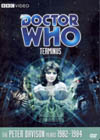
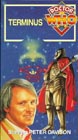
DVD Extras include:
A Functioning First EpisodeSurprisingly, the first episode is the best of the bunch, and largely works as a whole. It is quite firmly grounded in exploring the unknown, which this time around really feels unknown, atmospheric, and creepy. At the time when I first saw it, it was exactly the variety I had been hoping for, to balance the brighter, more heavily populated stories that had preceded this one.The story opens by giving us plenty of the deep TARDIS interior, and a rare glimpse at daily life aboard the Doctor's vehicle while in flight. Tegan and Turlough get the best bits of this for sure, and continue to have many rewarding character interactions scattered throughout the rest of the story. The police box and the usual materialization starting off an adventure are put to the side in favour of a completely new way of getting our main characters into the adventure. Well, we certainly won't be marring a classic by leaving the usual good stuff out, and in fact the new methods employed here are fascinating and worthy of being explored as much as they are. Dave Chapman's original video effects during this sequence are one of the story's grandest achievements, however the new CGI effects prove their worth also by reconstructing very convincing vistas of TARDIS corridors for the effect to work on. Both versions are great.
Collapse of Philosophy and PlotAn unusually high sense of alien creepiness takes over the story for the rest of the first episode, as well as the beginning of the second, mostly due to the large number of unknowns in the environment, helping to sustain tensions. However, once the story has all its major elements in play, it proceeds to fall apart and never really recovers. One problem seems to be the way the characters' interactions are plotted, where attempts at drama feel extremely poor and artificial.As with his previous story, "Warriors' Gate" (story no. 114), writer Steve Gallagher tackles some interesting philosophical ideas, and this time around they are much, much more understandable. Sadly, he still doesn't seem to be able to take an informed or inspiring position on what he brings up, some of which grates very distastefully against more useful approaches that I have since taken to heart. One such philosophy that fails to be questioned anywhere reflects soon-to-be outdated concepts of Western medicine, namely that disease is an external invasion that needs to be destroyed with weapons like radiation. In this sense, "Terminus" becomes a polar opposite of the philosophy and healing power demonstrated two stories earlier in "Snakedance" (story no. 125). Any further discussion of underlying philosophy will give away the story, such as it is, so I'll refrain from including that here. However, after you've seen "Terminus", or if you've already seen it, go to the in-depth analysis version of this review for the full expanded debate. Now, I love some of atmosphere surrounding some of the "bigger" discoveries in this adventure. In particular, there's some great imagery that triggers the imagination of the audience in ways that no amount of explanation should try to overwrite. Space for the audience to fill in the gaps, or at least to choose for themselves which of several offered theories might be the truth, would have returned the status of art to this story. I just can't buy the sole explanation that is offered here. The extras reveal interesting things about the script development, suggesting that even here too much tinkering went on by people higher up in the production's pecking order. By the time the tinkering has caused this story to center on something completely different, the relatively short segments from the original idea seem tacked on and out of place.
Character Functions and Other RolesAndrew Burt works inventively to create a lot of really nice character moments for Valgard, when he is allowed to interact normally with other characters. Sadly, these moments are few and far between when the whole plot is bent out of shape and Valgard's character becomes one of the worst casualties. Many more of the guest cast do manage to put in some good and sympathetic performances, making the best of what they were given to work with. Peter Benson manages to make a really enjoyable success out of Bor, possibly the best character in the story, and he has a lot of really entertaining exchanges with Peter Davison. Good stuff.Director Mary Ridge proved her talent for making great British sci-fi TV in many a Blake's 7 episode, including its heart-stopping finale, prior to her sole effort for Doctor Who here. Sadly, the challenges piling up against her here proved to be too many to overcome. But lack of communication of vision between various department heads seems to have triggered many of the nasty surprises that came at her, and with producer John Nathan-Turner able to provide extra studio time to complete things, I don't think she should be immune from criticism over the final, disappointing result. Roger Limb delivers a mostly listless, uninspiring score for this story, where most of the best memorable bits are liberally borrowed from previous stories. While this is all good, it's what Limb manages to come up with as "original" material to fill in the remaining gaps that creates most of the flak for his score: the same light & buzzy Radiophonic instruments he's been using since day one playing seemingly random stuff that inspires no specific emotion in his listeners. Why even bother dubbing it on? To be fair, I do think some good stuff was achieved near the end of episode one. While this score represents the last of the uninspiring overdose of Limb's music that has spanned four of the last seven stories, it is interesting to note that we now get a good long break from him until he largely redeems himself in "The Caves of Androzani" (story no. 136) over a year later. Interestingly, his final cue of Terminus part one seems to foreshadow the style he will later blossom into. Sarah Sutton's Nyssa gets a mostly drab and wimpy role for the bulk of this story. Her redeeming bits, apart from her opening scenes in the TARDIS, are all packed into episode four, where Nyssa is finally given her due as a character, and about time too.
But hold on, because fortunes are about to change radically in the next adventure....
This story is available on DVD as the second adventure of the Black Guardian Trilogy. Click on the Amazon symbol for the location nearest you for pricing and availability:
Comments on this article are welcome. You may contact the author from this page:
|