The Christmas Invasion
 |
 |
 |
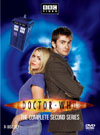
DVD NTSC
Region 1
14-episode
box set


|
DVD PAL
Region 2
14-episode
box set


|
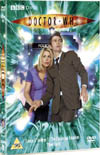
DVD PAL
Region 2
plain 2-episode volume

|
|
(Doctor Who Story No. 171, introducing David Tennant)
- written by Russell T. Davies
- directed by James Hawes
- produced by Phil Collinson
- music by Murray Gold
- 1 episode @ 60 minutes
|
Story: The new tenth Doctor crashes the
TARDIS in London on Christmas Eve before passing out.
Mickey, Rose and Mrs. Tyler try to attend
to his regeneration trauma, while Prime Minister
Harriet Jones collaborates with U.N.I.T.
to assess the threat of a gigantic spacecraft
attracted to the Earth by a recent Mars probe
satellite.
|
|
DVD Extras (box sets only) include:
- Picture-in-Picture commentary by writer Russell T. Davies,
producer Phil Collinson, and executive producer
Julie Gardner.
- David Tennant's Video Diaries
- Billie Piper's Video Diaries
- "Children in Need" special prequel scene (7 min.)
- Doctor Who Confidential featurette: Fear Factor
(contains a behind-the-scenes look at the finale of "The Christmas Invasion"
with Davies, David Tennant (The Doctor),
fight co-ordinator Kevin McCurdy,
and DW Magazine editor Clayton Hickman.)
- Deleted Scenes
- Outtakes
|
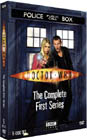
The PREVIOUS DVD box set also includes:
- Doctor Who Confidential featurette: Backstage at Christmas (9 min.), with
David Tennant (The Doctor),
Noel Clarke (Mickey),
producer Phil Collinson,
director James Hawes, and
special effects supervisor Mike Crowley.
|
Buyers' Guide Review
by Martin Izsak
|
|
(A more in-depth analysis, containing "SPOILERS" and intended
for those who have already seen the program, can be accessed
here.)
|
Most Doctors get a bad break in the substance of their first story.
Writers usually approach such tales by catering to the transitioning
curiosities of the long-term audience
that already knows the show, instead of designing a classic that can
hook new viewers into a blossoming new era. Russell T.
Davies brilliantly sidestepped the usual problems during Christopher
Eccleston's debut nine months earlier, largely by avoiding regeneration
altogether, delivering an introduction
worthy of re-launching the show. But now for David Tennant's debut,
Davies proves to be innocent of his earlier wisdoms, and bogs this
story down with all the old typical problems, plus the newly added ones
of an unsyndicatable episode length and the stigma of a story
that station managers might only deem suitable during one special
time of the year. Arrgh!
First frustration: the setting. After failing to stretch
beyond Earth's orbit and take us to an alien planet all throughout
the previous season, we head straight back to London, again,
using a recycled (but nice) establishing shot. On the plus side,
we get to see familiar faces like Rose's mum and, even better, Mickey.
The TARDIS makes an unusually entertaining entrance, but fails to
demonstrate its regular materialization anywhere else in the story
despite several obvious missed opportunities. Thankfully the
interior/exterior relationship is showcased well later on in the story.
Too bad the decrepit interior design hasn't been replaced yet.
"While you were sleeping..."
Next major frustration: the Doctor spends 2/3 of this story
in bed, recovering from regeneration. Two thirds! The
Man of Sleep
is back but good in this one! Never a good idea in any story,
even worse for a season opener, or an era opener. The Man of Sleep
can and should be avoided after regeneration, as the first stories of
Patrick Troughton,
Tom Baker,
Colin Baker, and
Sylvester McCoy
aptly demonstrate. "The Christmas Invasion" also suffers
the companion problem to the Man of Sleep - as the Doctor's
closest female friend proceeds to waste screen time and viewer
attention by blubbering and bawling her eyes out over him.
I don't know why they still write such scenes. It's very
unattractive, as far as hooking new viewers is concerned,
and us older, wiser fans know the emotion is wasted anyway;
the Doctor always recovers. The BBC has too much invested
in him to allow any other end result.
Napping for two-thirds screen time brings about the equivalent
of the missing Doctor syndrome not seen since the sixties - the
big question there being whether or not the companions and supporting
characters can keep the story moving in his absence. This time they do
make some progress, with Rose and Mickey having some nice character
moments, and a Mars Probe specialist
collaborating with returning friendly face Harriet Jones and the
new staff of U.N.I.T., but there isn't quite enough good stuff
to justify the amount of screen time these segments get.
More time is wasted with another pathetic new twist on the blubbering
companion idea - this time with Harriet Jones whining and begging
for the Doctor during a national address on TV. This is one of the
worst ideas any writer has ever inflicted on the program. She's
the Prime Minister, for heaven's sake! No leader whines on public
television for a single interdimensional vagrant she's only met once
before, and Jones should be far more prepared
to rely on the other options she has at hand. Scenes like this
make me believe that one might be able to excise 15 minutes of this
story's worst material without losing a single frame of Tennant's
debut performance, and have a better story in the end that can be
syndicated right along with the other 45-minute episodes of the
new series.
U.N.I.T. seems to feature in this story more because logic
demands it than anything else. The cast charm that the old U.N.I.T.
regulars used to bring to the series during the
Jon Pertwee Era
isn't here, largely because U.N.I.T. is staffed by a new generation
now. Although one might be tempted to think that a new U.N.I.T. cast
might slowly assemble during these newer episodes, Davies doesn't
seem to be making any progress towards that here. Pity.
Other plot fillers include traditional Christmas sights and sounds
turning horrific. There doesn't seem to be any thematic weight or
point to it other than trying to freak out the audience, so it won't
earn any points with me there.
But enough bashing; this story has a large host of good points
as well. The alien menace manages to pose a very unique threat
to keep things interesting. The linguistic challenges in the
story also add a very nice touch. Also, both the interior and
exterior of the alien craft provide a host of exciting,
cultural, atmospheric visuals for the story. It's almost
an acceptable substitute for an alien planet. (But I'll not
be letting you off the hook that easily, Mr. Davies! We still
desperately need much more of the real deal!)
Noel Clarke gives another thoroughly enjoyable performance
as Mickey Smith, his character continuing to enjoy more solid
footing with each new appearance. Penelope Wilton also gets
to give us many exquisite moments as Harriet Jones, and is
a most welcome addition to the growing roster of regular
supporting characters.
|
Billie Piper and Camille Coduri turn in their usual decent
work as the Tylers, and Sean Gilder makes the role of the alien
leader work nicely.
However, the absolute best part of this story is undoubtedly
David Tennant. Awesome! I don't think we've had a Doctor this
good since the collective reign of the first five. Tennant is
magnetically engaging in practically every scene and mood he
plays in here, and manages to be on par with Tom Baker in
balancing off-the-wall humour with the more serious,
stake-naming moments of gravity. This is a Doctor who is not
to be missed! And Russell T. Davies deserves due credit as well
for writing such excellent scenes for the new Doctor, filled
with all the right content.
Some of the ending moments seem a little too melodramatically
happy, but the many excellent twists & turns that continue to occur
keep things very entertaining. We also get to see some very excellent
portions of the deep interior of the TARDIS as the Doctor selects his
new costume from the wardrobe room.
|
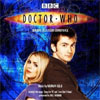
Music by Murray Gold
"UNIT",
"Harriet Jones, Prime Minister",
"The Doctor's Theme",
"Sycorax Encounter",
"Rose's Theme",
the opening of "Westminster Bridge",
variations on "New Adventures",
and an alternate version of
"Song for Ten" are available on:
|
|
A bit Arthur Dent
David Tennant's costume will do, and is a good improvement on the
previous one. It gives Tennant the authority most classic Doctors commanded,
which is something Christopher Eccleston's costume sorely lacked. Sadly
though, the new costume does little to indicate the Doctor's eccentricity,
as he can now blend in all too well with the modern corporate establishment.
The new production team needs to start thinking about anachronisms
and foreign/alien cultures a bit more, and give the Doctor more of the
look of a gentleman of the universe rather than just one of modern England.
In the end this is a decent story. If one can muddle through
the boring bits earlier on, the conclusion more than makes up for it,
and delivers a thoroughly enjoyable adventure.
This story has become available on DVD.
Click on the Amazon symbol for the location nearest you
for pricing and availability:
|
|
|
DVD NTSC
Region 1
14-episode boxed set
for the North American market:
|
DVD PAL
Region 2
14-episode box set
for the U.K.
|
DVD PAL
Region 2
plain 2-episode volume
U.K. format only
|
Note: The full season sets
contain commentaries, behind-the-scenes
featurettes, and other extras.
The smaller volumes only feature the plain episodes.
Comments on this article are welcome. You may contact
the author from this page:
Contact page
LYRATEK.COM
|
Read the Buyers' Guide Review for the next story:
"New Earth"

|
|