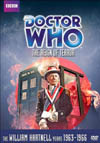
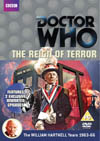
The DVD Packages include:
The VHS Packages include:
Episode One - A Land of FearThe TARDIS only just makes its second visual materialization in the history of the show here, and once again does so without Brian Hodgson's classic sound effect to many fans' disappointment. Clearly the standard we're accustomed to in modern times had yet to be developed and put into practice....This story also marks the TARDIS crew's first return to Europe since the pilot episode, and nicely plays off of Ian and Barbara's excitement in thinking they might be near home. The tale kicks off with a humorous bit of banter between the TARDIS crewmembers, which neatly drives their initial explorations. This section is particularly well done, giving us as good as any opening from a typical Terry Nation story, and managing to do better than the opening of "The Sensorites" (the previous story). However, interest in the story manages to trail off somewhat as we encounter some adult guest stars, none of whom are particularly memorable. At this point, the story really doesn't appear to be headed anywhere except cliché capture and escape routines, while writer Dennis Spooner's trademark humour makes itself scarce. The drama does not seem to match the rest of season one in strength, and is more reminiscent of the more watered-down variety to be encountered in season two - not surprising as Spooner will become season two's script editor. But "The Reign of Terror" is just getting warmed up..... A good situation is crafted for the cliffhanger, and nicely shot, although there is too much footage used to give it the pace and punch that it needs.
Episode Two - Guests of Madame GuillotineWith Ian, Barbara, and Susan quickly relegated to standard capture/escape routines for the entire episode, it's up to the Doctor to provide the action for this half-hour, and he sets himself into it admirably, declaring his heroic intention to mount a rescue. He faces this episode's main challenge with characteristic charm, wit, and cunning. We also get the first real location shots ever on Doctor Who, although it isn't really Hartnell in those wide shots, it's a double. For the most part, the double is convincing, giving us classic footage of the first Doctor at his most Edwardian, surrounded by his favourite period. However, in one shot he gets a bit TOO lively and happy-go-lucky, managing to look a bit more like the second Doctor Patrick Troughton.....
Stanley Myers provides decent and appropriate music for this
six-episode story. It all works, but doesn't quite blend into
the background as effectively as Norman Kay's music earlier in the
season, or Dudley Simpson's music during much of
the next sixteen years of Doctor Who. The best and most iconic bits
of Myers' score are here in episode two, taking center stage on
the audio track while the otherwise silent location film clips
of the Doctor's journey are shown on screen. Great stuff.
This appears to be the only Doctor Who story Myers' did music for,
although I also enjoyed his more modern compositions for
a TV movie (mini-series?) of Ray Bradbury's "The Martian Chronicles"
starring Rock Hudson and
Robert Beatty (General Cutler from
"The Tenth Planet" [story no. 29] ).
"William" Russell finally gets his turn at a holiday, and thankfully this is done with pre-filmed inserts instead of a complete disappearance, allowing him to continue to interact with main guest characters and remain integral to the plot. In fact, with three good inserts, he is much better served than Barbara and Susan. "We'll just stay where we are."Barbara and Susan are given little more than story padding for content during most of this episode. Not a great showing for either of them.The guest characters appear to be improving, with Le Maître and the Jailor making significant impressions, and the roadside foreman (played by Dallas Cavell who would return to Doctor Who many times) having a good single episode role.
Episode Three - A Change of IdentityA few of the better guest characters from the previous week continue on in this episode, while several interesting new ones are added, and only here does the story really begin to gel and gain a sense that it is leading somewhere interesting. Barbara and Susan move beyond the story-padding they were stuck in last week, but sadly without displaying their more interesting traits as characters.William Russell continues to get a ton of good screen time via pre-filmed inserts - so much so that he nearly upstages his co-stars, who are also divided up by circumstance and only appear in a few scenes each episode. William Hartnell's Doctor continues to enjoy a bit of a "reign of humour", now between the Doctor and his companions' jailor, as the Doctor acquires a false identity and the appropriate costume and documents to boot. This particular trait of the Doctor - to act with an authority that he hasn't been given - is seen to crop up many times in Doctor Who, but this really is the first time he does this for us on screen. It usually results in entertaining scenes, and this first example is no exception. It's a great pity so much of these shenanigans are lost with episodes four and five.
Episode Four - The Tyrant of France
The rest of the characters shuffle about in this episode without displaying much in the way of a clear purpose that the audience can invest in. Ian has a bit of a puzzle to solve figuring out who's who, but neither he nor anyone else seems to care too much whether the mystery is solved or not. Barbara and Susan also seem to shuffle about in between the guest characters just begging for another capture and escape routine in which to while away the time. The guest characters, while not being too bad in themselves, seem to spend a lot of time waiting for something to happen, as though they mustn't develop at all until it's time for another cliffhanger.....
AnimationThe animation that we get on the DVD bringing episodes four and five back to life is pretty good on the whole. All the characters get decent recreations of their likenesses, and a lot of good work has been done to keep the visuals alive and interesting, and ensure that this increasingly gripping story is told with clarity. In fact, there's quite an amazing three-dimensional quality to the artwork, as we often see characters and faces changing perspective slightly as they move.But this movement becomes a bit distracting after a while, revealing something of a downside here. On one hand, you can't quite take your eyes off of the characters as they talk, as the constant movement seems to imply a promise that the face will express some emotion that is relevant to the scene. But I think quite often it's the case that the animators are just cycling through the same bunch of preset frames over and over again, and these animated faces aren't really varying their performance as much as the actors did on the day. This perhaps becomes a case of what Star Trek director Nicholas Meyer warned against when TV and cinema try to do too much for the audience instead of leaving room for them to fill in part of the experience with their own imagination and interpretation. It is in fact easier to get a more emotive and interesting picture of William Hartnell or Jacqueline Hill or Robespierre in one's head emoting powerfully for each scene when looking at a suggestive still picture, than when one of these constantly bobbing heads rivets your visual senses to the screen and then only delivers a bland "filler" version. If any one key thing is missing from this DVD animation exercise, perhaps it is the courage to hold still on a great, artistically chosen frame. Instead there seems to be an underlying nervousness preventing the picture from staying still at any point, lest people might think the animation was done on the cheap. So, we end up suffering a lot of editing cuts between close-up after close-up, with some of the quick cuts between close-ups disguising the movements of the characters in or out of rooms, or chairs, or coats, or whatever - to save money on creating complicated in-between frames. It's bizarre because the rest of the story wasn't really shot that way at all. Ultimately, I think I would have preferred a good number of sections of scenes to be played out in long-shot, where the animation director might have had the courage to let five lines or so be exchanged over a single shot, with all the characters in it, a shot with some artistic lighting, just a bit of lip movement, and maybe someone's head turns slightly at some point. And then the close-ups might mean more when you do cut to them. And for close-ups, perhaps we don't need so many tween frames and various perspectives all for one bland expression. We should have more expressions with fewer frames each. Let's hit the emotional points first, and worry about 3D effects later. This is something discussed on the main documentary "From Scrolls to Screen" on "The Animatrix" DVD's (watch from about 11 to 13 minutes in), where Japanese animators seemed to have a better knack than Americans for finding the most emotive, visually interesting pose, and holding that frame on screen, thus turning their tween-frame budget limitations into an artistic strength. There's a lesson there that could really have taken this project up another notch. Still, this is pretty good, and has a lot of additional atmospheric highlights dotted around to surprise us here and there. Most importantly of all, critical pieces of the story are now visually alive once again, bringing the adventure as a whole back into a better balance for us viewers.
Episode Five - A Bargain of NecessityThis is by far the most politically interesting episode yet in the story. There is quite a complex action piece near the beginning involving a lot of characters (not the easiest thing to follow when CD audio narration has to make up for a missing picture, so again let's be thankful that the animation worked well here). The story has been needing this sort of action and intrigue to give it a bit of life, and it seems to pay off well by making the guest characters much more interesting in the aftermath. It also gives Ian and Barbara something interesting to debate, although not enough historical detail comes through in their dialogue to get the audience to pick either side politically.The guest characters develop very well during this episode, as does the situation that the Doctor is involved in. Sadly Susan continues to be extremely short-changed in terms of having quality things to do, and this does hinder the Doctor's ability to get involved in other geographical areas of the story. On the whole this is a good episode. It almost feels like the story held back a bit too much until this episode begins, and now has little time left to show us all the fascinating turns of events at this point in history....
Episode Six - Prisoners of Conciergerie
Ian and Barbara are quite excited to meet Napoleon, and the scene is quite interesting, but the Doctor's priority is rescuing his granddaughter. I'm sure he has already had the pleasure of advising old "Boney" on several matters, as Jon Pertwee's Doctor will later refer to. William Hartnell has a very enjoyable scene with the jailor, and succeeds in his main mission with wit, style, and charm. This is perhaps the best example of the Doctor winning the day with an excellent portrayal at the end of any first season story. Ian and Barbara both get a shocking glimpse of the momentous events that nearly, but not quite, sweep them away with the tide. Their French friends bid them adieu in a very poetic and well-directed style. A nice montage of a map and a horse carriage brings us back to the TARDIS in the forest. The music has improved throughout the episode. It is appropriate for the time period and the culture, but won't quite outdo most of the other first season scores. The short TARDIS interior scene also carries much weight, and is brilliantly shot with moody lighting - like the twilight at the end of a busy and tiring day. Concepts of their ability to influence and change history are being tossed in the air and knocked back and forth - it still troubles Barbara, although she feels wiser after the Aztec fiasco, and the Doctor and Susan feel they have the answers and delight in telling her so. Well, their answers are better crafted for teaching the history that we can read today in books than they are for a show about an adventurous, heroic traveller in time and space. The Doctor has come a long way in character development this season, but has more to do before his true inner hero will begin a reign of its own.
Final ThoughtsWell, this adventure was definitely off to a slow start, but managed to gradually build momentum until blasting through its final two episodes full speed ahead. And unlike previous stories set in the past, this one milks an impending historical event for a lot of the power leading up to its climax. And it seems to be following the edict to teach history more closely than any other season one story. Perhaps it should have been just four episodes long, so some of the padding and repetitive situations could have been trimmed, but even these portions succeed in painting a picture of the times, accurate or not as the case may be. Most thankfully, even though our four main characters have little to aim for in this story other than just getting back to the TARDIS, they never really dwell on this during their adventure. They're much more in the moment, simply exploring and dealing with where they are, and this eventually leads to a good bit of local involvement as well. This is most refreshing.While "Marco Polo" (story no. 4) may feature stronger acting and directing scene for scene, it can't really begin to match "The Reign of Terror" for involving the main characters and engaging them with local society. "The Reign of Terror" is definitely far superior in its two final episodes than "Marco Polo" was in its final two, and I think "The Reign of Terror" comes out on top as an overall story as well, since it definitely held my interest better. Season One then ends with a remarkably beautiful and poetic final shot, in which the Doctor states his philosophy and whets our appetite for his continuing adventures. Excellent! Roll on season two.....
International Titles:Deutsch: (Die französische Revolution)
Season One Rankings:Best Story: (listed from favourite to least favourite)
Best Director:
Best Writer:
Best Musician:
DVD Coverage on The Reign of Terror includes:
The four existing episodes from this story were released in 2003 on VHS video tape....
Comments on this article are welcome. You may contact the author from this page:
|