The Myth Makers
|
This story is not known to exist in its complete original format
(4 black-and-white 25-minute TV episodes).
|
|
 |
 |
|
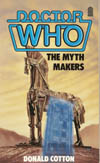
Paperback Novelization


|
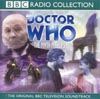
CD Audio - 2 discs

|
|
(Doctor Who Story No. 20, starring William Hartnell)
- written by Donald Cotton
- directed by Michael Leeston-Smith
- produced by John Wiles
- music by Humphrey Searle
- 4 episodes @ 25 minutes each, all missing:
| 1. |
| Temple of Secrets |
| 2. |
| Small Prophet, Quick Return |
| 3. |
| Death of a Spy |
| 4. |
| Horse of Destruction |
|
Story: The Doctor is mistaken for Zeus
when he lands amidst a group of warring Greeks,
who soon pressure him to help them find a strategy
for conquering the nearby city of Troy. But the
Doctor and Steven have their own reasons for wanting
to get into the city, as Vicki and the TARDIS
have been taken inside its walls as well....
|
|
In-Depth Analysis Review
by Martin Izsak
|
|
WARNING: This review contains "SPOILERS", and is intended for
those who have already seen the program. To avoid the spoilers,
read the Buyers' Guide version instead.
|
This story is quite a different experience in its CD audio form
than in its printed form.
The CD audio reveals that the televised story was a fairly
engaging historical story with some energy to it,
sporting a mixed bag of humour that sometimes worked but often flopped.
The novelization takes the humour to new heights of success
while severely disjointing the plot,
and amounts to a very strange joke that lasts
the equivalent of four episodes long.
There's not too much more to be said about it that that.
If you're in the mood for humour,
though, the book is definitely entertaining.
The Novelization - Is There A Doctor in the Horse?
|
|
The entire novel is written from the point of view of
"Homer", the most famous historical author of the Trojan Horse story
and the Iliad, who does not seem to have been "Homer" in the
actually television episodes, but just one of the many
minor characters who only appears very occasionally.
This makes for a very confusing telling of the story,
as the "Homer" character cannot possibly be present to
witness all scenes as they happen over the considerable,
barrier-defended geography on which this story takes place.
He has no contact with the Doctor during the last quarter
of the book, which virtually creates a Doctor-less final episode
in the novel where no such insult existed on television.
Those who have been reading my reviews for some time know
that I give major minus marks to episodes with no Doctor.
In fact, the two major items of series development that
heighten my interest during the final episode are not given
their due either, namely Vicki's exit from the series including
her final scenes with the Doctor and Steven, and Katarina's
introduction to the series including her first scenes with
Steven and the Doctor and their escape in the TARDIS. As
far as novelizations go, one has to look to the more powerful
and eagerly anticipated "Dalek Masterplan" books for the
definitive word on Katarina's entrance.
|
The one thing this novel does really have going for it
is the heavy dose of laughs, allowing it to remain heartily
enjoyable all the way through. This has its own sore point
though; it's not a good idea to try to make a joke out
of a graphic description of Homer losing his eyes - that
is simply a disgusting display of lack of good taste on the
writer's part, and perhaps further proof that Homer does not
have the point of view necessary to properly tell this story.
One can close this book with a hearty chuckle, but its climax
and conclusion are most disappointing nonetheless.
Further review source: - BBC Audio soundtrack on CD
|
|
The novelization and the soundtrack seem to swap their
high and low points around 180 degrees from each other. Firstly,
this story is meant to start off with the TARDIS giving the Doctor
a grand enough entrance that Achilles and Hector mistake him for
Zeus, a point that works excellently in the book. On TV, not
only is the TARDIS sound effect completely absent, but Achilles
and Hector are too preoccupied with each other to notice any
silent trick dissolves, if indeed there even was one. I suspect
there wasn't, and that the story was done on the cheap.
All motivation for mistaking the Doctor for Zeus is thus lost,
and the story is seriously lacking because of it.
|
Next to the humour. The soundtrack still has its moments,
but isn't anywhere near as effective as Cotton's pure prose.
His written character insights were most often hilarious, but
on the soundtrack we have to settle for learning about characters
by hearing their friends whine and nag and complain about them
most of the time, which spoils the mood too much and turns it
ugly. King Priam, Paris, and Cassandra are a particularly
irritating trio for dredging up this sort of thing. The laughs
are not what they should be.
Story structure is a grand improvement over the novel,
though. Things are once more back to normal for a good
Doctor Who story. A bit too much of the prisoner dynamic
takes place for my taste, and the motivation for renaming Vicki
seems very thin.
The final episode benefits most - all that was missing from
the novel is here, and is quite excellent. Most surprisingly,
Odysseus has been developed into a major thorn in the Doctor's
side, and the Doctor nicely gets the better of him in their
final scene. How could one think of novelizing the story
without this rewarding tidbit?! Vicki's exit works, and Katarina
gets her due. Well done.
Alas, poor Troilus. Vicki doesn't exactly deal with him
very truthfully, or manage to send him into much safety. They make
the best of their situation after the fact, but I think they could
have done a lot better in preparation.
This story has another added distinction, being a
Doctor Who story that had music composed for it (by Humphrey
Searle) and performed by a full orchestra. Sounds as though the
music should be really excellent, right? Not really. This was
no Jerry Goldsmith project! Dudley Simpson and others often achieve
just as good as "The Myth Makers" score or better with only a handful
of musicians, not to mention all those who worked by themselves with
synthesizers or whatever, and for an excellent orchestra sound, BBC
Stock music is often more effective, particularly Morris Barry's
selections for
"The Tomb of the Cybermen" (story no. 37).
It doesn't take too much
musical ingenuity to supply or enhance the right mood for a
scene, but you can spend a lot of excess musical ingenuity in
complicated ways to get the scene wrong, which seems to happen
early on here. The backing for sword fighting scenes does much
to make them seem more silly.
For the most part, season three's historical stories were nowhere near
as good as
those of the first two years, and that drop in quality begins to show here.
However, as season three historicals go, this one does still have a good
sense of energy from the performances, not to mention a conclusion with
some long-term impact on the continuing show, thus helping it to stand out
as one of the better historicals of season three.
International Titles:
Deutsch: (Die Mythosmacher)
Magyar: "A mítoszkészítők"
- A titkok temploma
- Kis próféta, gyors visszatérés
- Egy kém halála
- A pusztítás lova
Русский: "Создатели мифов"
- Храм тайн
- Маленький предсказатель и быстрое возвращение
- Смерть шпиона
- Конь разрушения
Italiano:
- Il tempio dei segreti
- Piccolo profeta, ritorno veloce
- Morte di una spia
- Il cavallo della distruzione
Français: (Les faiseurs de mythes)
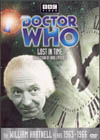 |
Doctor Who: Lost in Time - William Hartnell
1 DVD disc
(also included in Lost in Time Boxed Sets) |
Coverage on The Myth Makers includes:
- 8mm off-screen clips from Episodes 1, 2 & 4 with full sound
More details & buying options for "Lost in Time" DVD's
This 2 CD set features the complete audio tracks of all
4 television episodes of this story in one format:
- The CD Audio version features narration by
actor Peter Purves (who also played Steven Taylor)
to help listeners follow what used to be visual aspects
of the story. This version spans both discs
and is playable in any normal audio CD player.
Comments on this article are welcome. You may contact
the author from this page:
Contact page
|