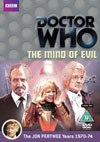
The Mind of Evil
 |
 |
 |
DVD NTSC
Region 1


|
DVD PAL
Region 2


|
VHS Video (BW)
NTSC
A

NTSC
B

NTSC

PAL

|
|
(Doctor Who Story No. 56, starring Jon Pertwee)
- written by Don Houghton
- directed by Timothy Combe
- produced by Barry Letts
- music by Dudley Simpson
- 6 episodes @ 25 minutes each, now re-colourized
|
Story: The Doctor and Jo investigate
a new method of reforming criminals at Stangmoor
Prison, whilst U.N.I.T. has the unfortunate task
of disposing of a decommissioned missile while
also providing security for a peace conference.
Where will the Master's next target be?
And what is the dark secret at the heart of
the Keller Machine?
|
|
DVD features include:
- All six episodes restored to full colour.
- Audio commentary by
director Timothy Combe,
producer Barry Letts,
script editor Terrance Dicks,
actors Katy Manning (Jo Grant),
Pik-Sen Lim (Captain Chin Lee / wife of writer Don Houghton),
Fernanda Marlowe (Corporal Bell / wife of William Marlowe [Mailer] ),
and stunt arranger Derek Ware.
Moderated by Toby Hadoke.
- Making-of featurette (23 min.), with
Letts, Dicks, Combe, Lim, Marlowe, and
Nicholas Courtney (Brigadier Lethbridge-Stewart).
Shot on location at Dover Castle in 2009.
- "Now and Then" location featurette (7 min.)
- Behind the Scenes - 24 hours in the life of Television Center (from 1971, 24 min.)
- Pop-up Production Note Subtitles
- Photo Gallery (5 min.)
In-Depth Analysis Review
by Martin Izsak
|
|
WARNING: This review contains "SPOILERS", and is intended for those
who have already seen the program. To avoid the spoilers, read the
Buyers' Guide version instead.
|
This is the one that blew the budget on season eight, providing
us with all the location footage and action that makes a great
UNIT story, but forcing preceding
"Terror of the Autons" and
following "Claws of Axos"
to make do with more Colour Separation Overlay (the BBC's version of
chromakey / blue screen) and cheaper, smaller sets.
The first half of the story gives
us some of the best of what season eight has to offer, but the second
half, while still delivering a lot of good stuff, has lost the
ability to trigger the audience to anticipate it, what with the
Man of Sleep
and his assistant playing prisoner for most
of it, and the threat of the Keller Machine getting older and
mouldier by the minute.
The cast members get their best introductions of the season in
this one, starting with the Doctor and Jo discovering the prison
castle and exploring its people and concepts thoroughly in a number
of witty scenes. A few lines from Jo neatly lead into the appearance
of the Brigadier, where he and Captain Yates and Captain Chin Lee
are all easy to get to know and understand, and the issues and plots
that will occupy the UNIT portions of the story are laid out as clear
as a bell. Clear as a Corporal Bell in fact.
The Brigadier's office in this story is about the best office he
ever gets on the program, much nicer than the Doctor's lab from the
previous story. It's a pity, and a budget curiosity, that UNIT
never seems to live in the same rooms from one story to the next,
always moving and/or redecorating. The only exception I can really
see happens between
"Planet of the Spiders" (story no. 74) and
"Robot" (story no. 75), where the
Doctor's lab is carefully laid-out in the same fashion on both
sides of his regeneration.
Episode One works extremely well. The dialogue is rich, and
the dual mysteries work well, with hints of interconnectedness
thrown in to make the juxtaposition of scenes flow smoothly.
Also the sci-fi element of the Keller machine is fresh and
satisfactorily explored here, combined with the social aspect
of the issue of reforming criminals.
Episode Two gives us our first glimpses of the Master and
Sgt. Benton, each being highlighted well in their introductory
sequences. Thus, "The Mind of Evil" turns out to be the best story
around to introduce the main cast of six regulars for the middle
Pertwee Era. Benton gets great exposure for his first scenes, but
has relatively little to do afterwards, until he takes charge and
finally proves his worth late in episode five and throughout episode
six.
The Master gets some of his best character development in this
story, much better than that of
"Terror of the Autons" (story no. 55).
He remains
the mysterious "other" during episode two, having great influence
in stirring the plot from behind the scenes without needing to be
directly involved himself. His disguises and aliases make sense
in this one, and rather than wait for the climactic conclusion to
have a face to face with the Doctor, the two Time Lords get to square
off together quite often all throughout the story. Some scenes
still bleed old worn-out "prisoner vs. captor" routines, but even
those scenes are still more believable than the "Terror of the Autons"
confrontations. Additionally, the cooperative side of the Doctor's
relationship with the Master comes out, giving credence to the rumour
that they were old friendly rivals back in the Academy on their home
planet. "The Mind of Evil" rounds out the Master's character; he just
wouldn't be the same without this last-minute rewrite incorporating
traits previously assigned to the original earthly version
of Emil Keller.
|
Also, throughout episodes two and three, Dudley Simpson completes
the composition of an entire suite of music for the Master which will
follow him throughout the season. His famous theme, based on bits
from the previous story, comes together here for the first time,
along with many more soon-to-be-popular Master tracks. The
"hypnosis" track returns in a new and slightly reworked version,
and his stylish sting from the previous story is about the only bit
of unaltered music used. The electronic style this time around is
held back and more subdued, concentrating more on recognizable
musical harmony and less on strange new sound.
The sound of the Keller machine is a unique and recognizable
contribution, and Simpson complements this with an equally memorable
theme for the Keller machine, the two working together to maximize
the suspense of the deadly machine for numerous scenes including no
less than four of the five cliffhanger endings. Simpson also brings
back his UNIT theme from
"The Ambassadors of Death" (story no. 53)
to good effect,
although the rendition of it here is far more primitive and cheesy.
All these elements combine to give "The Mind of Evil" the most
influential score of the entire Pertwee Era, but it has its share
of flaws - tracks like the very first one in episode one that sound
very silly and distracting.
|
Music by Dudley Simpson, sound by Brian Hodgson
"The Master's Theme",
"Dover Castle",
"Keller Machine Theme", and
"Keller Machine Appears/Vanishes"
are available on:
|
All of the above tracks, plus
"Hypnosis Music"
are also available on:
|
|
The contributions of Pik-Sen Lim are also very much worthy of
note. Not only does she play Captain Chin Lee to near perfection,
her position as the writer's wife allowed her to suggest the whole
idea of the peace conference, and supply dialogue and pronunciation
coaching in several Chinese dialects. These elements are the icing
on the cake for an enthusiast of cross-cultural bonding like myself,
and the peace conference angle gives Jon Pertwee's Doctor an
unparalleled opportunity to be a proactive peacemaker and heroic
investigator during these early middle episodes. "The Mind of Evil"
just wouldn't be near as excellent without it, as episodes four and
five soon demonstrate.
Episode Three continues to be great stuff, but in hindsight has
one serious flaw. The mysterious absence of the Prison Governor
in the second half of the story has its explanation in an episode
three scene where Mailer apparently shoots him dead as he reaches
for the alarm - it is so poorly directed and acted out, however,
that it is easily missed and dismissed as just another pointless
bit of action involving an "extra". The Governor is far too major
a character to be dealt so poor a death scene, and the script is
equally to blame in not giving any character a single line of
grief for him after the fact, choosing to waste time on silliness
instead.
And the silliness mounts quickly in early episode four. Not
only is Jon Pertwee's Doctor reduced to his weakest state of
"Man of Sleep" yet on the program, but Jo is given nothing more to do
but blubber over him, while the audience is forced to either watch
or abandon the show in disgust. "Blubber" scenes like this are
the lowest quality recurring dynamic in Doctor Who stories, even worse
than missing Doctor episodes, so "The Mind of Evil" earns some huge
minus marks here. We all know the main character isn't going to die
in the middle of his adventures, so writers be warned: Don't waste our
time! Idle threats bore! The Doctor's energetic escape later in the
episode is equally fruitless in relieving his heroic impotence, as he
manages to accomplish nothing more than checking on the progress
of the villains' plans before getting recaptured, much the same
pointlessness that Pat Troughton's Doctor suffered in episode five of
"The Power of the Daleks" (story no. 30).
"If that's the best you can do, Doc, it really ain't good enough."
The Doctor also winds up spending all of episode five as the
villains' prisoner as well, and two and a half back-to-back episodes
of a prisoner dynamic spell doom for the story, cancelling out its
plus marks for the peace conference / Chinese angle and bringing the
story as a whole back to average level for a season eight adventure.
No wonder that the chap who made himself a colour copy later wiped
all but five minutes of his tapes, thinking the story was not very good.
All is not lost for episodes four and five, despite the damage
done to our interest in the Doctor, for the villains continue to
develop themselves and escalate their plans well. The fallible
side of the Master is shown, as he struggles to keep both Mailer
and the Mind Machine under control. UNIT proves to be a poor excuse
for military might in episode four, and Richard Franklin leads the
charge in the hammiest of the story's action scenes. Thankfully
however, UNIT gets its act back together for episode five, showcasing
the power of what it can do when it gets itself good and organized.
The battle of Stangmoor prison is one of the most creatively directed
and effective of UNIT's shoot-outs, but something else is wrong. It's
easy to root for UNIT when they're up against alien monsters, robotic
machines, or other fantastic enemies, especially when the fate of the
world is clearly at stake. But in this case, they're just shooting up
a bunch of frightened real people whose only ambition is to escape the
deadly Keller Machine, and the agonized screams and pained faces of
dying prisoners, featured often during the shootout, only emphasize the
growing disturbing aura surrounding UNIT. And on learning that the
missile threatening world peace isn't there, the Brigadier can say
little more than "oops". Their heads rolled for your "oops", Brig.
Not UNIT's finest hour after all, in my book.
The Doctor has also managed to become part of the prisoner
sympathy problem. He tells Jo that the whole point of them hanging
around Stangmoor (which leads to their re-capture) is to deal with
the Keller Machine, yet when the Master asks him to do just that,
he refuses with the excuse that it's only killing off his henchmen.
Way to go, Doc. Not only does he become the callous anti-hero in
that moment (and look particularly lazy at it), but he has to flip
around 180-degrees from his previously stated goals to achieve it.
Talk about digging in your heels to drag the plot out to its required
length of screen time.
Episode Five's saving grace is the scene of the Doctor and
the Master finally working together to confine the Keller Machine to
a coil of electromagnetic confusion. It may sound like just another
load of techno-babble to some, but there's a lot of real science and
terminology behind
the theory employed here,
making it quite believable
to those in the know. Besides this exposition of science is the
exposition of a nicer, more intriguing side to the relationship
between the Doctor and the Master,
and an exposition of the best version (in my opinion) of Simpson's
Keller Machine theme. We also see the full set of the Doctor's
horrors, and watch him walk through all his fears to achieve his
goal. You can actually recognize the Dalek this time around.
Great stuff. And even though he may be suffering the prisoner
dilemma, his tale about Sir Riley's potatoes and the Tower of London,
combined with a choice piece of medieval-sounding music
("Dover Castle", available on CD above), bring yet
another stylish touch to the story.
Episode Six picks up tremendously from the previous two, but
still has its problems. The Doctor gets right back into
problem-solving mode and gets quite crafty with his plans,
giving us an
exciting ending that pulls plenty of surprise punches. The countdown
to the final explosion is a bit of dead air-time, though it's better
than that of "The Invasion" (story no. 46).
The Master's motives are still a bit on the grey and fuzzy side
of things here. Exactly why is it good for him to plunge the world
into war? He's not exactly all set to make a lot of money and gain
financial power on supplying arms to all parties, or on sinking them
into his eternal debt from desperate war expenses. If the mind creature
came from another planet, and the Doctor had disabled
the Master's TARDIS
between "Terror of the Autons" and this adventure, then the Master must
have brought the creature with him to the circus and had some idea of
what he wanted to do with it as far back as then. Now if he still had
an army of Autons ready to help him take over the world by force AFTER
plunging it into war, that would make much more sense. Mailer's gang
just isn't going to cut it. Looks like the poor Master played his cards
in the wrong order or something. An epic 10-part story combining the
previous one with this one, and re-sequencing the order of some of the
events, might also have
solved a lot of motivational problems for his character as well.
So he settles for re-enabling his TARDIS and escaping, the dynamics
of which appear a bit contrived, and rather lamely depend on easily
forgotten events from the previous story. We don't get to see his
take-off, or even get a good look at the interior of his TARDIS when
we see him phone from it - the stupid panel behind him here and the
one from "Terror of the Autons" episode two make it look like it's just
some RV camper on the inside. The Jon Pertwee era has yet to feature
a TARDIS interior properly, so the concept is doubtlessly still
lost on recently acquired viewers. Shoddy.
"The Mind of Evil" is a good story, but sadly most of the best
bits are in the first half, so a viewer's lasting impression of it
may easily be a disappointing aftertaste.
     Final Line:  "He's free to go anywhere in Time and Space, while
                   I'm stuck here on Earth..... with you, Brigadier!"

     Rating:  very mediocre, an attempt at humour that doesn't really work.
International Titles:
Deutsch: "Die Maschine des Bösen"
Magyar: "A gonosz elméje"
Français: (L'esprit du mal)
Русский: "Разум зла"
This story is available in colour on DVD, or in black and white on VHS video.
|
|
|
The VHS video also features a short sequence explaining the necessary
ingredients for the colour restoration process, with approximately
five minutes of recolourized footage from "The Mind of Evil".
|
DVD NTSC Region 1
for the North American market:
in the U.S.
in Canada
| DVD PAL Region 2
for the U.K.
| VHS Video (black and white)
NTSC
A
in the U.S.
NTSC
B
in the U.S.
NTSC
in Canada
PAL
for the U.K.
|
Comments on this article are welcome. You may contact
the author from this page:
Contact page
|