Special Edition and Region 2 DVD Extras include:
First Impressions:The TVOntario ad emphasized the idea that Romana was getting married in the upcoming story, an old, over-used, and uninteresting plot element of TV shows everywhere which, regrettably, even the fantastic nature of Doctor Who had been unable to avoid crutching itself on. Perhaps that image lasted with me longer because I didn't get to see the actual story until many, many years later.And so, as with so many other Doctor Who stories of the 60's and 70's, my first impression of "Androids of Tara" came through the novelization. But this story did not disappoint as much as many others did when finally viewed in the original TV format, thanks in large part to the electronic effects division having caught up with my imagination and memories of other 80's Who stories.
Tara In-depthA.J. Mitchell does a great job on electronic effects in this story. One tricky shot that comes to mind has the camera panning across a row of guards who all succumb to K9's stun ray. Tricky, because beam effects usually work easiest with static characters, static gun muzzles, and a locked-off camera. Mitchell moves K9's beam to keep it positioned effectively all throughout the shot. If only all effects were as well done.Introductions are quite straightforward and easy to follow. The TARDIS gets everything it needs: satisfying materialization, interior/exterior exposition, and even the appearance of the wardrobe room and cupboard. The Doctor, Romana, K9, and their mission are laid out with crystal clarity, topped with a tasteful and enjoyable dash of humour. Guest characters are only revealed as our travelers meet them, thus ensuring that the audience gets an excellent introduction to them as well. The story is unique in that the segment is found and converted in the first few minutes, and appears in its natural form throughout the rest of the story. This is an excellent touch. Too often we've only seen the pieces briefly before they get stuffed in the 'fridge'. The segments get a bit of extra scrutiny in this one, helping to whet the appetite and build anticipation for discovering their mysterious uses and full potential at the end of the season..... The maligned monster featuring in the opening of the story suffers from a lack of motivation more than anything else. Watch it jump out and spread its arms wide, as if to say: "Blahhh! Aren't you scared?" It fails to demonstrate that it wants to do anything scary, like eat Romana, or defend itself, its territories, and/or its secrets with deadly force. If either the writer or director or fur-clad stuntman had taken time to work out a motivation, it wouldn't matter how much the costume resembles a man in a suit. It's all the wide-armed begging for the other person's frightened reaction that makes it seem such a silly, obviously-human ham in a suit. The exterior location is gorgeous, so much so that director Michael Hayes has said (on the DVD commentary), "You could point the camera anywhere and get a decent shot." And, it seems, he did just that. The location footage often drones on, displaying one beauty shot after another, and not moving the story onwards at any great pace. Watching it the first time through, it works well enough, but on subsequent viewings the slow pace and dramatic inertia drag the story down towards the bottom of the season's rankings. Dudley Simpson steps up during some of these sequences, having the sound-space to himself, and delivers an appropriately medieval-sounding harpsichord theme for the Taran aristocracy and their horsemanship. Unfortunately, not all such sequences get as lively a musical track. The score is ultimately not one of Simpson's most memorable ones, but it remains tasteful all the way through, and manages to incorporate a few bits of the Fourth Doctor's Theme here and there as well. After an extremely industrious start, Romana becomes trapped in poor prisoner dynamics that are reminiscent of the William Hartnell era. If only she could escape her persistent captors and get back to the TARDIS with the mercury-fluid-link-cum-Tarranium-cum-segment, they could be off to their next adventure, right? Well, it never quite feels as bad as all that, thanks to a few doubles of Romana popping up in several places, thanks to her concerns being larger than just herself and her own segment-finding mission, and thanks also to the fact that the Doctor is kept very active and busy throughout the whole tale. Gone are the days when the main characters obsessed about their (inevitable) return to the TARDIS; if they're going to be forced to stay, the stories fare better when they allow the characters to sink their teeth into local affairs, and treat their setting as though it's the most interesting place in the universe for the time being. The entire cast gives fun and enjoyable performances. The only real problem comes at the very end, when the Doctor and Grendel cross swords. Tom Baker declines to take the duel seriously at first, making it hard for viewers to continue to take the threat posed by Grendel seriously at all anymore. For the sake of a few cheap laughs that don't really entertain anyone, the whole story is in dire danger of falling completely flat. The only way of making sense of it is to come to the conclusion that Grendel's real goal is to achieve the flamboyance of power, rather than power itself, and the Doctor has seen through the act and is cleverly throwing it back in his face. Still, that's quite a pretzel of logic I've conjured up to help myself enjoy the show. The director hasn't really done much to suggest it to the general audience for their appreciation, so I'm afraid the end just doesn't work as well as it should.
International Titles:Magyar: (A Tara bolygó androidjai)Français: (Les androïdes de Tara)Русский: (Андроиды из Тары)This story is the 4th adventure in season 16's Key To Time quest. It has become available on DVD and VHS video. Single Story versions:
Comments on this article are welcome. You may contact the author from this page:
|
|||||||||||||||||||||||||||||||||||||||||||||||||
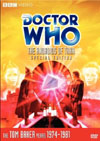
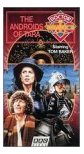


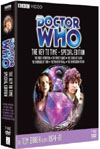


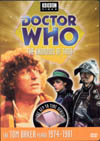
 in the U.S.
 in Canada

 in the U.S.
 in Canada