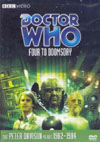
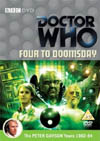
Four to Doomsday
 |
 |
 |
DVD NTSC
Region 1


|
DVD PAL
Region 2


|
VHS Video
NTSC

PAL

|
|
(Doctor Who Story No. 118, starring Peter Davison)
- written by Terence Dudley
- directed by John Black
- produced by John Nathan-Turner
- music by Roger Limb
- 4 episodes @ 25 minutes each
|
Story: The TARDIS crew discovers a large
spacecraft due to reach Earth in four days.
Carrying representatives from several lost
and ancient races of the Earth, the seemingly
good-humoured alien Monarch in command of the
craft soon reveals delusions of god-hood
and ominous plans for the remaining humans on Earth.
|
|
DVD Extras include:
- Audio commentary by Peter Davison (The Doctor),
Sarah Sutton (Nyssa),
Janet Fielding (Tegan),
Matthew Waterhouse (Adric),
and director John Black.
- Raw Studio Footage from Peter Davison's 1st day (27 minutes)
- December 1980 Peter Davison interview from "Saturday Night at the Mill" (14 min.)
- Photo Gallery music montage (6 min.)
- Pop-up Production Note Subtitles
- Theme Music Video (3 min.) with stereo and Dolby Digital 5.1 sound options
In-Depth Analysis Review
by Martin Izsak
|
|
WARNING: This review contains "SPOILERS", and is intended for
those who have
already seen the program. To avoid the spoilers,
read the Buyers' Guide version instead.
|
I've always been mildly surprised at the amount of disdain floating
around for this story, which I find to be one of the most enjoyable and
rewarding of season 19. I'm even more surprised that I've never found
anyone else that recognizes what must have been the biggest influence
on it. This is, in fact, a thinly-disguised small-screen version of
Walt Disney's "The Black Hole" (1979), also one of my favourite movies.
Either that, or both "The Black Hole" and "Four to Doomsday" were copying
some other identical source.
I'm not sure why the production saw fit to open by panning across
a drawing of a spacecraft, which might have worked better had it clearly
been an ancient hieroglyphic. But two very excellent shots of a model
spacecraft then follow to establish the setting satisfactorily, CSO'd
onto a proper starry sky. Nice. Once inside, we get an atmospheric
shot of a very interesting and mysterious lab, in which the TARDIS
materializes.
This story gets full marks for its introduction of the TARDIS
and the series' main characters. The relationship between the interior
and exterior is made clear through the scanner screen and the liberal
movement of our four travelers in and out of it during episode one.
The four characters also manage to successfully recreate the atmosphere
of family exploration not really seen on Doctor Who since the black and
white episodes of the sixties. Very excellent.
Their environment thankfully gives them plenty to explore, firstly
with its floating monopticons, technological mysteries, and wonderfully
atmospheric sound and lighting. "Four to Doomsday" also boasts a delightful
display of culture, with several ancient and "lost" civilizations of Earth
mixing bizarrely with high-tech Urbankan architecture and functionality.
Perhaps most importantly, Peter Davison solidified in this story
as the Doctor, not quite so much as "the fifth Doctor" in whatever way
makes the fifth one different from all the others, but as THE Doctor,
who is the same inside throughout all his adventures. He displays the
characteristics that were sadly missing or subdued in
"Castrovalva" (story no. 117),
and becomes the resourceful problem solver who can see through a situation
and set things right heroically. This is the point at which I realized,
on first viewing, that Peter had taken over from Tom Baker for good,
and that I was going to enjoy it.
Paralleling "THE BLACK HOLE"
|
|
The sheer number of parallels in character and plot between this
story and Walt Disney's "The Black Hole" are staggering, and can help one
appreciate "Four to Doomsday" even more. The U.S.S. Palomino / TARDIS
discovers the large and seemingly empty U.S.S. Cygnus / Urbankan Ship and
docks, and the TARDIS / Palomino crew come out and investigate. The
large ship turns out to be commanded by the outwardly friendly Monarch
/ Dr. Reinhardt, who is gradually revealed to have mad delusions of
Godhood, the means of oppressing those around him, and schemes involving
grand misguided scientific experiments. During the middle of the story,
both the Cygnus and the Urbankan ship are discovered to be populated
with robots that were once real people.
Bigon gets the "Old B.O.B." role, the insider on the larger ship
extremely keen to spill the beans and let the whole backstory out. Nyssa
gets the part of Dr. Kate McRae, the brave heroine, bitter over the loss of
her father, who gets taken to be robotized and needs rescuing. Tegan
takes over the Ernest Borgnine role of Harry Booth, having the strongest
emotional reactions to the discoveries, and making a final frightened
bolt to leave in the TARDIS/Palomino all by him/herself.
Once again, everybody picks on Adric and his actions in this one.
I didn't, because I could see he clearly had the Dr. Alex Durant role,
to be captivated by the words of Monarch/Reinhardt and become eager to follow
in his footsteps.
Once you've seen Anthony Perkins play the role, you believe it.
The three heroic roles of Captain Holland, Charlie Pizer, and the
robot V.I.N.CENT. are all rolled into our good Doctor, while the role
of the iconic robot villain Maximillian is split into the two Ministers
by Monarch's side: Enlightenment and Persuasion, complete with the final
showdown in the airlock and some exposure to empty space that stretches
credulity.
|
To be fair, many chunks of dialogue in the Doctor Who version of
this story weigh in on the clunky and awkward side,
while the cast isn't quite sure what to do with it.
Scenes concerning Adric's loyalty and Tegan's hysterics suffer
accordingly. And while the action beats deliver many interesting
set-piece scenes filled with the Doctor's ingenuity and a smattering
of visual beam effects, the beats themselves don't really follow each
other logically or escalate the way one might hope.
But the plusses of this story continue to win me over. Stratford
Johns gives an absolutely enjoyable and genuine performance under his
bizarre green make-up. The exploration beats sustain themselves very
well over the first episodes. The high-tech setting sprinkled with loads
of ancient cultures is exquisite. Visual laser beams abound, another
great plus (thank you Dave Chapman).
|
Music is another big plus in this story. Roger Limb delivers what
is probably his best score ever, from his signature opening, to the
plethora of mysterious exploration cues that work tremendously well,
to Nyssa's hypnotism, and to the final unique "Spacewalk" action cue.
The story also features many excellent source music pieces, emphasizing
the various cultures, with the Mayan tracks being particular favourites
of mine.
|
Music by Roger Limb and
Special Sound by Dick Mills
"Exploring the Lab" (1:48) and
"Nyssa is Hypnotized" (1:00) are available on:
|
|
Mostly this story simply offers Peter Davison's Doctor numerous
chances to be heroic, knowledgeable, firm and confident in his beliefs,
and to sink his teeth into those aspects of the role and establish himself.
For that it works beautifully.
The TARDIS gets some extra movement near the end of the story, but
very sadly the room full of moving bodies must have convinced someone
to go on the cheap and omit the usual trick dissolves, when an extra layer
or two of CSO would be all you'd need to fix it. Most disappointing.
The final climactic act is a bit too sudden and violent for my
personal tastes as well, although it still works. The final wrap-up scene
also feels a bit rushed.
All in all, this is a good and often overlooked story. Watch it
back to back with "The Black Hole" and draw your own comparisons for
extra enjoyment.
International Titles:
Deutsch: "Vier vor Zwölf"
(oder "Vier vor Weltuntergang")
Magyar: "Négy nap múlva végítélet"
Français: (Quatre jours avant l'apocalypse)
Русский: "Четверо в Судный день"
(While there has been considerable speculation on the exact meaning of
the English title (four TARDIS crewmembers? / four races on the ship?),
the Hungarian and French translations are
a bit more specific in nailing the idea down to "four days".
Meanwhile,
on their recent DVD release,
the Germans are contradicting the story's timeline a bit
by implying there are only four minutes left before incoming danger.)
This story is available on DVD and VHS video:
|
|
|
DVD NTSC Region 1
in the U.S.
in Canada
|
DVD PAL Region 2
for the U.K.
|
VHS Video
NTSC
for North America
PAL
for the U.K.
|
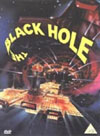
Walt Disney's "The Black Hole" has several incarnations on DVD:
|
|
 |
|
DVD NTSC Region 1
for the North American market:

|
DVD PAL Region 2
for the U.K.:

|
|
Comments on this article are welcome. You may contact
the author from this page:
Contact page
LYRATEK.COM
|
Read the In-depth Analysis Review for the next story:
"Kinda"

|
|