Planet of the Ood
 |
 |
 |
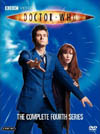
DVD NTSC
Region 1
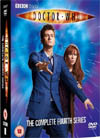
14-episode
box set


|
DVD PAL
Region 2
14-episode
box set


|
DVD PAL
Region 2
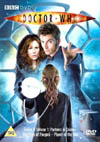
3-episode volume

|
|
(Doctor Who Story No. 196, starring David Tennant)
- written by Keith Temple
- directed by Graeme Harper
- produced by Susie Liggat
- music by Murray Gold
- 1 episode @ 43 minutes
|
Story: The Doctor and Donna arrive on an ice planet,
where a corporation shipping Ood servants to the rest of the
galaxy is suffering an outbreak of violent rebellion.
What is the new cause of the "red-eye" syndrome amongst the
Ood? What is "The Circle" that the Ood refer to in riddles?
And what family-inherited corporate secrets has Mr. Halpen
got locked away in a disused storage building?
|
|
DVD Extras (box sets only) include:
- Audio commentary by director Graeme Harper
and actor Roger Griffiths (Commander Kess).
- Doctor Who Confidential featurette: Oods and Ends (13 min.) with
Harper,
David Tennant (The Doctor),
Catherine Tate (Donna Noble),
Tim McInnerny (Halpen),
executive producer Russell T. Davies,
producer Susie Liggat,
choreographer Ailsa Berk,
stunt co-ordinator Abbi Collins, and
effects supervisors Paul Kelly, Tim Barter & Dave Houghton.
- Deleted & Extended Scenes (5 min.) - introduced by Davies
- Trailers & Teasers
In-Depth Analysis Review
by Martin Izsak
|
|
WARNING: This review contains "SPOILERS", and is intended for
those who have
already seen the program. To avoid the spoilers,
read the Buyers' Guide version instead.
|
Finally we get back to outer space, and an alien planet. Excellent.
And clearly done without breaking the budget on a host of excess effects.
Not so hard was it? Graeme Harper is back to direct, and with help from
a highly successful returning species, this tale had a good shot at
becoming the best story of the season so far. It's not nearly as good as
"The Impossible Planet" (story no. 178) though.
Not everything is a resounding success here either. Much of the banter
between the Doctor and Donna surrounding their initial landing on the planet
contains a lot of corny build-ups that take a bit too long, making each
of the fairly well-working payoffs a bit too predictable. The TARDIS
materialization is skimped on, again. (Come on, guys, it shouldn't be
that hard to at least do it right more often than forgetting it!)
At least the idea of the craft and the interior/exterior relationship
is portrayed well enough.
The Ood weird us out yet again, give us some mystery, and facilitate
some decent action story beats. And Silas Carson, who also had at least
two recurring roles in each of the Star Wars prequel trilogy films,
returns to give the Ood their perfect voice. All good.
Closer examination may reveal a certain lack of creativity
in how the Ood are handled though. The red-eye phenomenon seems to
have to stretch credulity to find a new reason to give us the same thing
we witnessed in "The Impossible Planet". Why not give us a new phenomenon?
Ah well, it still works.
More disappointing is the whole idea of the Ood as unnatural slaves,
because "The Impossible Planet" had been more subtle. As presented then,
they all belonged to a group/hive mind, or collective, and sought to serve
others as their greatest need. Rose and the "Friends of the Ood" then
react as a lot of ego-centered free-will maniacs do when hearing about such
things - they can only *perceive* it as "slavery". I preferred to give
the Ood enough cultural and biological freedom to embody a different
view of themselves and the universe and what interaction is normal.
It makes the universe a more interesting place to believe that differences
that huge are possible, and comprehension is difficult.
When we humans actually do encounter alien species publicly, watch out!
Some of them may resemble the Ood with regards to collective thinking
and constantly serving the greater good, while perhaps our egos make us
a greater aberration to nature and evolution.... all a subtle question
of perspective, very philosophically fascinating.
And so it is sad
that Keith Temple has now spearheaded a whole cast and crew that cemented
the whole "Ood are actually unwilling slaves" theory in stone.
Ah well, it still works.
In particular, the Ood have some new surprises up their sleeves,
equally weird, some of which are nicely built up with suspense and
mystery.
It's a nice touch for the Doctor to realize that this planet,
the Ood Sphere, is in the same system as the Sense Sphere,
since the Ood do resemble
"The Sensorites" (story no. 7)
in both external appearance and many mannerisms,
and both are misunderstood by humans. Nice connection.
However, I'm not sure that it's too believable that a species
would carry a hind brain in their hands all the time, or that such
a species would be regarded as suitable for one-handed manual labour.
Ah well, what we get still works.
So now we have action in the far future on an alien planet.... using bullets?
Come on, where are the LASERS?! This is very reminiscent of Harper's
old series stories
"The Caves of Androzani" (story no. 136) and
"Revelation of the Daleks" (story no. 143),
where everyone walked around with pistols and machine guns.
Disappointing both then and now, as it makes things less sci-fi,
and emphasizes the violent qualities of what is being shown.
I find it less enjoyable as a result.
This is also a story that leaves the audience very unsure of who
to root for during these struggles as well, as Donna so eloquently
states at one point. The humans here are no angels, but not so
different from us First (and Second?) world nations who,
as the Doctor so rightfully points out in one excellent bit of dialogue,
put our money into shoes and clothing produced by hard labour
in Third World countries. Meanwhile, the Ood are going mad,
inciting violence, and frothing at the mouth. Not quite the best
anti-slavery solution one could hope for.
Ah well, it does still work.
I think we get very nice use of CGI during the action with the warehouse
crane-claw thing. Far more believable than the ridiculous creature in
"The Lazarus Experiment" (story no. 187)
last year. Kudos. ...And forming a perfect cliffhanger should
this story ever need to be split into two episodes for the classic
half-hour format. Nice.
|
Murray Gold seems to be scoring this episode more from synthesizers
than the orchestra that dominated the last three stories. While there
is definitely some cool new stuff here, it's not quite as interesting
as last year's score for "42" (story no. 188),
none of which made it to the year's official CD. This time, the most
thematically centered pieces of music from "Planet of the Ood"
make it to CD, slightly re-mixed and now titled
"Songs of Captivity and Freedom". Good stuff. As with last year's
"Boe" from "Gridlock" (story no. 185),
some extra piano lines give the TV version a nice extra bit of energy,
although the CD presents the composition uninterrupted at its full length,
while on TV much editing took place to match the music to the events
on screen.
Ah well, both versions work in their own way! And variety is nice.
The Doctor's influence on this adventure, however, is mostly
honorary. It seems likely that events would have turned out more
or less the same even if he hadn't arrived and taken part. As was the
case back in "Warriors' Gate" (story no. 114),
(which by the way, Graeme Harper had temporarily taken over directing),
the Doctor spends the bulk of his time here just trying to figure out
what is going on and what everything means. At least this time he is given
a climactic final act to perform.... although this is handed to him on
a silver platter by other characters who could equally have done the same
thing themselves. Ah well, it still works.
|
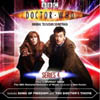
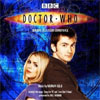
Music by Murray Gold
"Songs of Captivity and Freedom" and
alternate versions of "Donna's Theme"
are available on:
|
|
An alternate version of "Doomsday"
is available on:
|
|
The final departure scene is a nice touch, putting needed closure on
this episode, hinting at how it might link with the rest of the season,
and opening up a Pandora's Box of riddles about what is yet to come.
The TARDIS gets a stunning vista in which to dematerialize -
a poster moment for the season for sure. Yes!
So, while "Planet of the Ood" had good chances to remain the best story
of the season so far, it is far from the greatest thing we've ever seen.
What is strange is the way this production team will spend oodles of money
and effort on more common Earthly settings while watching every penny
and curbing every creative idea while out in the galaxy. For what we got
here, tons of corporate offices, industrial space, jail cells, and a bit
of fake snow around a quarry and factory grounds, we could easily set
90% of the season's stories on half-decent alien planets, and more
successfully feel like the TARDIS had actually taken us
somewhere in the galaxy. A large part of this story's triumph is
in delivering so well on this simple expectation, where other adventures
insist on ignoring it. A decent outing, creating anticipation of more
good stuff to come.....
International Titles:
Deutsch: "Immer zu Diensten"
Magyar: "Az oodok bolygója"
Français: "Le Chant des Oods"
Русский: "Планета удов"
Italiano: "La canzone degli Ood"
The Germans had an interesting take on this episode, calling it "Always at Your Service".
The Hungarians and Russians stuck with very literal translations of the title,
while the French and Italians decided that the Oods' song was more interesting
than their planet.
This story has become available on DVD.
Click on the Amazon symbol for the location nearest you
for pricing and availability:
|
|
|
DVD NTSC Region 1
14-episode boxed set
for the North American market:
in the U.S.
in Canada
|
DVD PAL Region 2
14-episode boxed set
for the U.K.
|
DVD PAL Region 2
3-episode volume
U.K. format only
|
Note: The full season sets
contain commentaries, behind-the-scenes
featurettes, and other extras.
The smaller volumes only feature the plain episodes.
Comments on this article are welcome. You may contact
the author from this page:
Contact page
|