Marco Polo
|
(Doctor Who Story No. 4, starring William Hartnell)
- written by John Lucarotti
- directed by Waris Hussein (episodes 1-3 & 5-7),
and John Crockett (episode 4).
- produced by Verity Lambert
- music by Tristram Cary
- 7 episodes @ 25 minutes each, all missing:
| 1. |
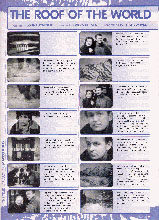
| The Roof of the World |
| 2. |
| The Singing Sands |
| 3. |
| Five Hundred Eyes |
| 4. |
| The Wall of Lies |
| 5. |
| Rider From Shang-Tu |
| 6. |
| Mighty Kublai Khan |
| 7. |
| Assassin at Peking |
|
Story:
When the TARDIS malfunctions on the icy heights of the
Himalayas in 1289 A.D., the Doctor and his friends are
forced to join one of Marco Polo's later caravan journeys
into China, taking the TARDIS along with them until it
can be repaired. But is the accompanying warlord Tegana
really an emissary of peace from Kublai Khan's old enemy
Noghai? If not, what is he really after?
|
|
Buyers' Guide Review
by Martin Izsak
|
|
(A more in-depth analysis, containing "SPOILERS" and intended
for those who have already seen/heard/read the story, can be accessed
here.)
|
These days, about the best one can do to get a proper appreciation
of this lost story is to listen to the full seven episode
soundtrack on CD. It's even better if one can open
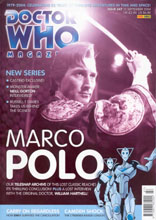
Doctor Who Magazine issues 342 - 347, and follow along
with the telesnap photos of the finished Waris Hussein episodes
while listening. These are more recent luxuries.
Previously, fans who had missed the original broadcast
(often by not being born early enough)
could only judge this story by its official
novelization from John Lucarotti for Target Books, a somewhat
condensed affair that wasn't particularly effective at
highlighting and conveying the production's strengths,
managing to feel as though it were still too long,
and somehow surprisingly boring.
I believe the story should become infamous for
committing one cardinal, critical error, which
no version of the story available today has successfully
de-emphasized properly.
This mistake is all in defining the goals of the regular
characters. As portrayed in the book, they would have loved to
simply dematerialize in the TARDIS and move on to their next
adventure, but the TARDIS is suddenly out of power, and then it is
kept away from them by Marco Polo's caravan and the Chinese. Result:
the audience is also interested in only seeing the characters get
back into the TARDIS and move on to their next destination,
especially those of us who like Doctor Who for its science fiction
elements which are not active in this story.
To an extent, almost every season one story features a challenge
preventing our regulars from moving on in the TARDIS as soon as
they might like,
but "Marco Polo" is particularly bad because it attempts to make
this the main thrust of the drama until it occupies 50% or more
of the characters' screen time over seven episodes.
What this story desperately needs is for one or more of the
main characters to take interest in Marco's journey - to the extent
that the plot will revolve around that interest, much as Barbara
managed to do in
Lucarotti's upcoming Aztec story,
resulting
in much essential, philosophical conflict between her and the Doctor.
In this story, the regulars just don't care and don't want to be
there, and as a result, neither does the audience. In fact,
Marco Polo himself is not all that interested in his own journey
either, since he has already made the trip many times at this point
in his life, and he would much rather be at liberty to remain at
home in Venice!
On most other counts, this is still a fairly rich story,
containing dramatic substance of other flavours where more
worthy conflicts and interests are concerned.
Animated map graphics alone,
narrated by Marco himself, do much to captivate my
interest. Apparently, this was also one of William Hartnell's
own personal favourite stories.
It certainly is full of interesting character moments,
usually acted out quite powerfully.
Tristram Cary may be more famous for his very strange
electronic music that debuted in
"The Daleks" (story no. 2),
but he proves here how versatile he is using more traditional
instruments to create an exciting, exotic, and thoroughly enjoyable
score that remains appropriate in scene after scene.
I'm particularly fond of the cue backing most of Marco's
journal entries.
Many oriental treasures went missing here when the BBC destroyed its
original copies of this story, and it is a shame
it wasn't in colour also, as the costumes and sets are
brilliant and full of life. The variety of settings,
dangers, intrigue and incidents along the way is nearly enough
to match
the following "Keys of Marinus" story,
but the curiosity
and purposeful, quest-like atmosphere is missing, and an aura of
"let's not be here" is too often on display as a poor substitute.
|
|
Episode One - The Roof of the World
This first episode is not bad, and turns out to be one of the better
ones from the story. Both the regular characters and the guests are
all introduced very well, and the story, such as it is, gets a fairly
complete setup. We don't get a visual TARDIS materialization or any
real view of the interior, but the machine is certainly explained well
enough throughout the episode. Many of the earliest scenes are not too
unusual for a Doctor Who story, but the mechanics and challenges
of Marco's journey later bring a uniqueness to this tale that has
never quite been duplicated since.
Episode Two - The Singing Sands
This episode has its moments, but is far from great.
It's probably best if I save my entire discussion of it for the
In-depth Analysis version of this review.
Come back and read it after you've listened to the story on audio CD.
|
Episode Three - Five Hundred Eyes
The third episode is a significant improvement over the previous one,
only spoiled by the occasional outburst of Mark Eden's Marco Polo
turning into a control freak and the typically overheated response
from our four time-travellers.
We can be thankful though that William Hartnell's Doctor is very
busy and heroic in this episode.
Here he is, solving problems of crossing the desert,
outwitting an adversary without anyone realizing it except
the adversary and the audience,
and becoming a central figure exploring the Cave of Five Hundred Eyes
on a rescue mission. Excellent job.
The Cave is one of the story's highlights, and features some excellent
design work on the carved faces. More traditional Doctor Who plot points
seem to be at work here, and are exceptionally well executed. A good
cliffhanger leads us to anticipate more of the same next week, with the
stakes raised a bit higher again....
Episode Four - The Wall of Lies (directed by John Crockett)
Episode Four isn't too bad while it is wrapping up events in
the Cave of Five Hundred Eyes, rich as that setting is with
intrigue.
The episode tanks soon after,
and the story palpably feels as though it is dragging at this stage,
unable to come up with a conflict we haven't already seen, and failing
to move through to a conclusion as it should. It really is just
perpetuating more of itself without good reason....
John Crockett must be enjoying Tristram Cary's music in this episode,
as he will later pinch some of the cues used here and add them to
Richard Rodney Bennett's score when he comes to direct
"The Aztecs" (story no. 6)
several weeks later....
Episode Five - Rider From Shang-Tu
There is a decent beat at the beginning of this episode
- at last some
decently motivated action reminiscent of most good Doctor Who stories.
As the episode progresses, the moronic desire to leave the story
takes over, which when retardedly thwarted, makes one wonder why one is
still watching.
Further good bits include explanations of this culture's
high speed communications to the
travelers and thus the audience, and some really nice character moments.
But this episode in particular can't rise above the escape drive
that isn't going anywhere, and is all much-ado-about-nothing
for the most part. The audio quality is noticeably more challenging
on this episode than many others as well.
"Marco Polo" really proves to be a tale
of little progress here.
Episode Six - Mighty Kublai Khan
This turns out to be one of the better episodes of the story, although
it takes some time to show its quality.
What eventually really works here is the beginning of a larger hook
into the local intrigue that has been afoot all along,
not to mention the launch of a separate strand of the story.
This is the kind of development
that the story so badly needed.
Final portions of the episode prove entertaining once again....
We haven't had anything this worthy of exploration on this long trek
since the Cave of Five Hundred Eyes.
The stakes are successfully raised here,
creating anticipation of a good final episode next week.
Episode Seven - Assassin at Peking
The momentum building up to the last episode's cliffhanger isn't
really sustained here, as the writer seems keen to revert back to the
old formulas he's been padding the story out with since episode two.
Not all the development has been lost, but the restraint feels awkward
and unnatural.
William Hartnell's Doctor continues to get many good scenes.
Most of our guest characters get decent resolution for the various plots
and arcs they are involved in.
But the story feels like it simply
coasts through these final turns of events after having run out of gas
and time, and the "solutions" that succeed in the end seem
under-motivated, less interesting, and not as well-thought-out
as earlier solutions that failed.
This episode is still one of the better ones of the story, but let's
face it: With the characters as misguidedly motivated as they have been
all through this, "Marco Polo" does not turn out to be all that great
a story in the end. The third episode is my favourite, as the Doctor,
the conflicts, and the philosophical thrust of the story are in better
form there than anywhere else in the tale.
"Condensation, do you understand?"
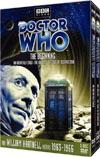 |
Doctor Who's "The Beginning" DVD box set goes beyond just the first
three Doctor Who stories, to offer a condensed version of
"Marco Polo" as well. It's a very similar experience to
listening to the audio soundtrack while leafing through the
telesnap photos, but it attempts to cram the entire story into a
time frame barely longer than one of its original seven episodes.
Mind you, "Marco Polo" is probably at its best after significant
trimming, but so much has been trimmed here that inevitably many
of the story's best moments have been lost.
And for my tastes, the bits that were included were not always
the best choices. First and foremost, the desire to jump in
the TARDIS and abandon the story has GOT to GO, along with any
drama attempting to prevent it.
All in all, the 31-minute DVD presentation is not too bad,
managing to give viewers a decent sampling of what the original
story was like, and it does leave out a good number of the worst
scenes. Much of what I liked from the second half of my favourite
episode "Five Hundred Eyes" is completely missing, ultimately my
biggest beef with this version. However, it might have been left
out due to the lack of any telesnaps from the John Crockett episode
that came after, which would be needed to resolve the situations
that arise.... if so, fair enough. Scenes such as
Barbara forcing Ian to talk to Marco really
didn't need to be included though. And perhaps a testament to
the lacklustre conclusions in the complete final episode,
resolution for several of the main characters' issues
has also
been left out of this DVD version, even after it included scenes
to highlight those issues earlier on.
|
Journey to Cathay, or The Scenic Route to Marinus?
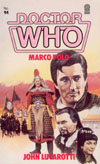 |
Some 20 years after the story's original broadcast, an official
novelization was published,
authored by the story's original writer John Lucarotti.
Many things changed for better or worse, some scenes were
reduced to footnotes, other sections were expanded or more
eloquently described, and in some cases, events were completely
altered.
The sections of the story that previously formed episode two
on television received the best improvements, with the Doctor
becoming an active, interesting, and even heroic participant,
taking over some of what previously had been Ian's role on TV.
The major adversary's participation in the final two episodes is
changed fairly radically as well, becoming far more believable, but
at the same time far less dramatically compelling.
Noticeably expanded are the cultural descriptions for everything
from Italy to India to China/Cathay and all points in between,
most of which cuts to the heart of the intended teaching of
history and geography at which this story excels. In particular,
we get a lot of descriptions of food here,
which the TV version had not begun to comment on.
But most damaging of all is the increased ease and frequency with
which the writer emphasizes our four time-traveler's desire to abandon
the journey to Cathay and move on in the TARDIS to their next
destination, which we fans know will be the planet Marinus
in the next story. Adventurous scenes that successfully built
anticipation for other things on TV usually appear in the book
undermined by appended thoughts from the Doctor or his friends
on how they plan to be off (to Marinus) before it happens. That
kind of thing usually makes me look at the number of pages left to
read through before I can switch to the Marinus story.
It's particularly bad during the third quarter of the book,
while the main local plot remains relatively stagnant.
As the book enters its final movements, the Doctor
and the guest characters take center stage. This benefits many
of the guests, as they get expansions of their characters and
more things to do than in the TV version. Many of the locations
definitely seem to expand to something far larger than what would
have been affordable for the television story.
But the ending still feels sudden, rushed and under-motivated.
The Doctor appears to be a bit closer to his modern form here,
but now that the Doctor we know and love is finally on the scene....
the story is over and he leaves. Not a bad finish for the book,
but too little and too late in terms of allowing the reader to
truly enjoy the journey.
|
Though I enjoy this story in its CD audio plus telesnap photos form,
it ultimately is not one of my cherished favourites. It is probably
of more interest to completists, or historical / culture buffs,
than to the average fan or casual viewer. However, the accomplishments
of the production can not be so easily dismissed when we come to rank
the first season's stories.... Read on to find out how well "Marco Polo"
fares....
This story is now available on audio CD and, in a condensed form, on DVD:
|
Doctor Who: The Beginning boxed set
- 3 DVD discs
|
Coverage on Marco Polo includes:
- Marco Polo - a 31 minute condensed version of this
lost 7-episode adventure, featuring "telesnap" still photos
synchronized to the original TV audio.
- Photo Gallery (colour and BW).
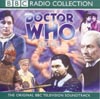
This 3 CD set features the complete audio tracks of all
7 television episodes of this story, in two formats:
- The CD Audio version features narration by
actor William Russell (who also played Ian Chesterton)
to help listeners follow what used to be visual aspects
of the story. This version spans all 3 discs
and is playable in any normal audio CD player.
- The .mp3 version can be accessed from the first disc
by computer only (Mac or PC),
and features the original sound
from the television episodes with no narration added.
This package also includes:
- A detailed map of Marco Polo's journey, both printed in
hardcopy and stored in .jpg files on disc one in six
different sizes.
- More bonus data files on disc one, including a .pdf
file of the linking narration script.
Comments on this article are welcome. You may contact
the author from this page:
Contact page
|


 2006
2006
 2006
2006