Frontier in Space
 |
 |
 |
DVD NTSC
Region 1
Box Set


|
DVD PAL
Region 2
Box Set


|
VHS Video
A
 B
B


|
|
(Doctor Who Story No. 67, starring Jon Pertwee)
- written by Malcolm Hulke
- directed by Paul Bernard
- produced by Barry Letts
- music by Dudley Simpson
- 6 episodes @ 25 minutes each
|
Story: An air of distrust has brewed up between
the galactic empires of Earth and Draconia, fueled by
violence and accusations of piracy, and the Doctor and Jo
find themselves caught in the middle. Who really stands
to benefit if war were to break out? And what is behind
the strange hypnotic sound experienced by the pirate victims?
|
|
DVD Extras include:
- Audio commentary by Katy Manning (Jo Grant),
producer Barry Letts,
and script editor Terrance Dicks.
Moderated by Clayton Hickman.
- "The Space War" making-of featurette (18 min.) with Manning,
Vera Fusek (President of Earth),
Michael Hawkins (General Williams), and
visual effects designers John Friedlander and
Mat Irvine.
- "Roger Delgado: The Master" biography featurette (32 min.)
- "Perfect Scenario: Lost Frontier" featurette (30 min.)
- Featurette on the third Doctor (Jon Pertwee) in comics (16 min.)
- Pop-up Production Note Subtitles
- Photo Gallery
- bundled with "Planet of the Daleks" (the next story).
Buyers' Guide Review
by Martin Izsak
|
|
(A more in-depth analysis, containing "SPOILERS" and intended
for those who have already seen the program, can be accessed
here.)
|
In concept, this story has a huge load of selling points going for it.
It's got a pro-peace sociological message struggling through a highly
emotional
conspiracy, it's got many significant alien races and arch enemies
of the Doctor both old and new,
it is set all across the galaxy from the Earth and Moon
to several planets on the far side of the Frontier,
and it's billed as the first half of a disguised, modernized
"Masterplan"-sized epic
(see story no. 21).
And so, the audience's anticipation is huge, and remains huge all
throughout a first viewing/reading of the story. BUT.... (and this
but is bigger than ever), from scripting to directing to music and
effects and heavy post-production fixes, "Frontier in Space" does
not deliver well, becoming in my opinion one of the lowest quality
and slowest-paced stories in the entire Jon Pertwee era. This view may
be an upset against the opinions of many other fans who love this space
opera crusade for peace, truth, and justice from the noble,
societally-conscious pen of well-meaning Malcolm Hulke, but the gulf,
between what the story desperately wants to be and what it actually is,
is too wide to be ignored.
Plotting Potholes
By far the biggest design flaw in the writing of this story
is that, no matter where in the galaxy the story takes us, it finds a
jail cell from within which to tell itself. The excitement of the
characters and the conspiracy is rapidly eaten away by the persistence
of the capture and escape routines that occupy a bulk of the screen
time. But Hulke's trademark flaws are also in full swing: even with all
the effort to make the characters individual in their beliefs and
motivations, they are all unbelievably excruciatingly bad listeners,
and many times the Doctor pathetically gives up even trying to explain
himself to the characters of the outside world, and has a nice little
faithless "they'd never believe us" chat with Jo in some cell somewhere.
The Draconian race fulfills for this particular script Hulke's
need to include reptiles in all that he writes solo. Everyone seems
to love the Draconians, and with good reason. The
combination of costume, mask, and make-up is extremely effective, and
in comparison with regular Earth people, the Draconians are different
and equal, and kind of cool at that. They're almost a template for
the modern Klingon, only less brutal. But I have never heard praise
for any individual Draconian characters. Like their Earthling
counterparts, they rather blandly dig their heels into their
prejudices and drag the plot out with overdrawn arguments that make
little progress. Of course progress must be made eventually, and for
this Hulke has created a misunderstood incident which comes off as
unbelievably thin motivation to support all of General Williams'
hostility.
In the end, this all adds up to an extremely slow pace in the
final script: a parade of moronic characters who aren't very interesting
and get nowhere when they talk to each other, plus lots of marching to
and from jail cells, sitting in jail cells, escaping from jail cells to
get recaptured, and then more tiring fruitless arguments. The
conspiracy angle is not spot on in this one. The Earthlings and
Draconians are insufferably ignorant, but as such, taking the Doctor
and Jo prisoner is logical for them as they are diplomatically
civilized. It is not logical for the behind-the-scenes enemies
to do the same later on,
because permanently shutting up any potential leaks to keep their
masterplan secret should be their priority, but of course it is not
permitted for them to knock off the main character of the TV show.
For this reason, the Doctor and Jo would be put to better use
freely investigating the behind-the-scenes plot while the enemy
forces erase their leads and informants. Malcolm Hulke
in particular is usually far better at writing this dynamic, but he
doesn't get it remotely right this time. The Doctor and Jo should also
be using the TARDIS to go anywhere in the galaxy that a clue should
lead them, just as they might use Bessie to travel all over England
in a UNIT story, but for this story the TARDIS too is stuck in the
"Marco Polo"-style capture-and-escape plot mistake
(see story no. 4).
No, we're doing
spacecraft for vehicles of choice this story, and the production team
somehow believe that spacecraft are so interesting and sci-fi that
this already slow story can still afford to stop periodically to
allow someone to slowly wander about outside the spacecraft.
Not this time, for Dudley Simpson, Paul Bernard, and the film/video
editors can't manage to make such sequences interesting or well-paced.
The spacecraft models are also quite a letdown, even if they were
created from Gerry Anderson's usually excellent leftovers, because
the script pivots on the idea that the spacecraft are clearly,
recognizably different from each other along racial lines, and the
model maker has fashioned them all to be essentially shaped like
one boring long tube. Only one unique police ship seems
to be recognizably different, and even that's not by much.
The story does have its share of plusses. The idea of the
main deception in the story is actually a good intriguing idea,
capable of sustaining about an episode and a half single-handed.
Do this through a new technology to be discovered, explored,
and defeated, and it may give you two good episodes. It just doesn't
work if you stretch it out to five and a half episodes, and have
no other quality plot elements working along side it.
Acting
Things do get better in episode three, not
because the plot or the pace picks up at all (it in fact slows down
some in my opinion), but because Roger Delgado is the one actor
inspired enough and talented enough to put a really enjoyable
performance into this production. Jo Grant's character has been
written to continue her recent trend of being far more clever
and capable than in her season eight and nine antics, best evidenced
by her overcoming most of the challenges she faces when not under
the Doctor's protective wing, and it is in her scenes opposite Delgado
that Katy Manning seems to shine as an actress. Most of her other
scenes are typically average Jo, good but prone to be a bit flippy,
with extra ham on the screaming bits. Jon Pertwee seems largely bored
with this story, perhaps with good reason, but this is dangerous since
it will encourage the same in the audience.
Even though supplied with an inferior script, director Paul
Bernard himself seems to have let many elements slump, particularly
the timing and pacing of the story. Too much time is given to captivity
and moving to and from captivity, whereas more could be spent on
planning and executing better action sequences (in the video studios
if money for outdoor film is tight), and on getting the Doctor's
dialogue scenes in the out-of-jail world to display juicy, dramatic
acting performances that are worth savouring on screen a little longer.
This might have made the adjusted episode endings more justified;
as it stands I think they are more the result of poor pace planning.
Plus Bernard went on the cheap with regards to a visual TARDIS
materialization, eating into his visual literacy marks. Even worse,
he neglects to show any
open space on the other side of the airlock door in
episode five. Without any dialogue either to prepare the audience,
the whole sequence of the Doctor and the Draconian Prince trying
to close the airlock is very confusing until it is all over.
And as far as the bright orange inflatable raft monster on the quarry
planet goes, what were its designers thinking in the first place?
|
The new music in this story lacks emotional teeth, both in
composition and instrumentation. The only really good bits are the
ones that Dudley Simpson composed way back in season eight.
Some of the new variations work
more on humorous lines than suspense or threat, while others
neatly appear in their original versions as nostalgic reminders
highlighting the characters' journeys and growth.
Considering the transitional style of much of
this story's footage, one would have thought that Simpson could
step up and help fill the emotional gaps, as he did so excellently in
"The Ambassadors of Death" (story no. 53),
but the job is either
not attempted or poorly done here. There seems to be an overall
theme for the story or the Earth forces, but it sounds irritating
and doesn't really work.
|
"Frontier in Space" Episode One (1:46) and
"Hypnosis Music" (0:36) are available on:
|
"Frontier in Space" Episodes One & Two (5:37) and
"Hypnosis Music" (0:36) were released on:
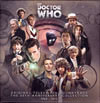 |
Audio CD -
Doctor Who:
The 50th Anniversary Collection
11-disc version (2014)
More info
|
|
|
Illusions of Progress
Episode five begins a breath of fresh air for the story,
as the Doctor manages to stay out of obvious captivity for
more than five minutes at a time, and actually makes some
progress resolving the main misunderstanding at hand. Unfortunately,
the progress is short lived, because episode six is mostly dead
in the water all over again. With so much at stake on the galactic
stage, and with Hulke having knocked his protagonists back to square
one so often, there is a lot of good stuff needing to be taken care
of. But what conflicts do we spend our screen time combatting? The
Doctor farts around floating outside a spacecraft, then worrying
about the repair he did there -> all way off topic. Jo is involved
in yet another overcomplicated captivity number just to bring the
Doctor to the scene, which is really unnecessary since he's coming
anyway. The action should be at its most serious in the final
setting, yet it remains silly and is probably the most boring
location footage in the entire Jon Pertwee era. You can still do
exploration in the final episode of a Doctor Who, but I think
exploration at a leisurely pace won't work well after the midpoint
of a story, particularly if the Doctor's party and the audience
already have all the answers to all the questions so far posed
by the narrative.
There are many more reasons to consider the final episode lame
which involve spoilers, so I'll save the discussion of them for
the in-depth analysis version of this
review. Suffice it to say that the portions that should be emotional
rush by too quickly, have no teeth and/or quality visual effects,
and/or make no logical sense for character motivations and/or plot.
All this after so much film was wasted on idle wandering.
Unforgivable. No wonder Jon Pertwee is bored asleep with
this tale.
Unresolved and Unlinked
Episode Six conflict remains as poor as a pauper, as our
protagonists are confronted with the overused escape from jail
problem for the millionth time in one story. The solution is
unique this time around, and is the only remotely entertaining
scene of the story's conclusion. Jon Pertwee still doesn't
quite muster up the right emotional quality for the scene.
And though it brings a much needed satisfaction to the
story on the emotional level, on the philosophical, it is
kind of sad to see Hulke requiring his protagonists to sink
to the moral level of the villains in order to get out of their
predicament.
Worst of all, none of the characters we've come to root for
really accomplish anything in the final episode. The villains
are suddenly no longer there, their plans barely threatened.
Nothing else is really resolved.
The final insult is the ridiculously chopped ending.
Trying to link the end of this story into the beginning of the next
with a good cliffhanger is a noble goal, but since the
following story doesn't go anywhere near
the conflicts raised in this one,
Doctor Who's writers should have made sure those conflicts were resolved
somewhere at some point in the series. Instead, they further destroyed
what little resolution "Frontier in Space" had.
Question: Does the original ending taped by Paul Bernard still
survive,
or was it taped over by the new ending, without ever being duplicated
or transmitted or archived or telesnapped or anything? It may
at least shed some welcome light on the motives behind the
creation of this story, and would make a great DVD extra.
However, it looks like we'll be settling for more talk about the
ending on the 2009/2010 DVD, rather than seeing the original ending
for ourselves.
In the end, I think I have to say that this is Malcolm Hulke's
least successful Dr. Who script, one small good story idea with great
scope,
underdeveloped and overblown into a long, boring, and essentially
unresolved mess that failed to inspire quality or ingenuity from
most of the rest of the production staff.
This story is available on DVD (bundled with the next story) and VHS video.
Click on the Amazon symbol for the location nearest you
for pricing and availability:
|
 |
|
DVD NTSC Region 1 Box Set
for the North American market
in the U.S.
in Canada
|
DVD PAL Region 2
Box Set
for the U.K.
|
VHS Video
A
in the U.S.
B
in the U.S.
in Canada
for the U.K.
|
Comments on this article are welcome. You may contact
the author from this page:
Contact page
|