DVD Extras include:
Defining WorldsAll of the characters and settings are introduced exceptionally well, the science expedition on the planet, the Morestran military arriving on their ship, and most importantly of all, the Doctor and Sarah in the TARDIS. Not a single previous Tom Baker story has opened with a proper materialization, or a scene in the interior. "Planet of Evil" delivers on both, and gives many of the characters plenty to do in, around, and with the vehicle later on in the story as well. "Planet of Evil" gets full marks for TARDIS visual literacy, repeatedly demonstrating the relationship between interior and exterior throughout. Curiously, the console room door to the real world is never shown opening or closing, while the door to the rest of the interior seems to be a redress of the main door of the Master's TARDIS from "The Time Monster" (story no. 64).Roger Murray-Leach continues to be quite creative with set design. The jungle set has rightfully received a lot of praise, and works excellently for night and dusk scenes. However, it never really delivers day scenes as believably as, say, jungle sets from "Planet of the Daleks" (story no. 68) or "Meglos" (story no. 111). There's just never enough light in the distant background to pull it off. The black pool itself gets pulled off with much greater finesse than I would have expected, thanks to trick CSO, but the set is claustrophobically too small for my liking. Finally there's the Morestran ship itself. It's definitely unique, but I think the multi-level crutch gets used too often to be believable. The thin, plain, empty glass table in place of any relevant useable controls for the Captain and his closest officers makes the upper deck of the bridge seem totally irrelevant, and I was never very enamoured with the wall of stairs and ladders serving as the exterior exit of the ship. It does at least give the ship size, and lend itself to a few stunts during the battle between the crew and the anti-matter creature. The Morestran costumes seem to be designed for superheroes, as the low neckline becomes unflattering for most of the crew.
Motive IllogicOnto the premises, the central anti-matter idea is not as believable as, say, the struggle between anti-matter doppelgangers on the original Star Trek episode "The Alternative Factor". Mind you, neither version of the "Lazarus" character was very well fleshed out in that episode, but at least the idea that he was being driven mad was a cornerstone of the exploration of the anti-matter universe concept.I'll have to save most of my discussion of how the premises play out in the plot in "Planet of Evil" for the In-depth analysis version of this review, but suffice it to say, that the focus of the story is a little too bent on horror spectacle lurking around the corners and in creating tension, and it doesn't take care of motives as well as it needs to. As long as Hinchcliffe and Holmes get a mad killer wandering about, they seem happy.
CastingWe have a bit of a reunion of the cast from "The Savages" (story no. 26), with both Ewen Solon (previously Chal) returning to play Vishinsky and Frederick Jaeger (previously Jano) returning to play Professor Sorenson. Solon is welcomingly solid in his role, while Jaeger has by far the most demanding role of the story and pulls it off incredibly well.Also on hand is Prentis Hancock, fresh from completing his first season on "Space: 1999", landing yet another argumentative role as Salamar. Thankfully this character is far more watchable than Vaber from "Planet of the Daleks". Salamar's impressions of the Doctor are quite strangely scripted though. In the beginning, the Doctor's dialogue to Salamar is most suspiciously vague and cryptic (and apparently for no good reason), yet surprisingly Salamar trusts him quite easily. If that had been my first impression of the Doctor, I would not have trusted him myself. Then later on, after the Doctor has proven himself right several times and he finds the words to explain his reasoning and motivations far more clearly and worthy of trust, Salamar turns on him instead. The script could have done a far better job designing the dialogue for their interaction. The cast also includes Graham Weston (de Haan) previously of "The War Games" (story no. 50) and Michael Wisher (Morelli) who is quickly turning into one of the most frequently used character actors on the show during these years. Their characters bring out a lighter side to the story and are quite enjoyable to watch. Able stuntman Terry Walsh is also quite visible as a Morestran soldier. The Doctor does get surprisingly little to do in the first episode, where Sarah seems to fare far better. But the Doctor remains quite busy in the rest of the story, and does particularly well during the climax. The script seems quite prepared to give us a few bouts of the "Man of Sleep", but enough wisdom is used between Tom Baker and the crew to keep these moments to a minimum, and emphasize his recovery and subsequent actions instead.
EffectsThe superimposed red outline effects for the Anti-matter energy creatures are most definitely inspired by the Id creature from "The Forbidden Planet", and work fairly well. They look best against dark backgrounds, and the natural creatures have an advantage over the later incarnations in having more lines running through their centres and looking less hollow. The arbitrary decision to not reveal them until the end of the first episode leaves us with very silly death scenes throughout the first episode, where the actors struggle against absolutely nothing before slowly fading away. I think it would have been better to either bring out the monster effect right away, or cut away from each death scene at the first hint of fear in the victim's eyes when they spot the off-screen monster. Later, their corpses will be found, and that's all you really need. The viewers' imaginations will undoubtedly cook up something better to fill in the gaps than actors struggling against nothing.The footage of laser fire sequences is quite excellent, with flash charges going off in the gun and echoing around the surrounding jungle quite effectively, but this sadly lacks any superimposed beams to make the shots complete. With the monsters themselves being a superimposition effect already, perhaps this is asking too much of the production team of the day, but it did make a very disappointing first viewing for me years ago.
Soundscape for the Unknown
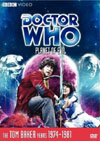
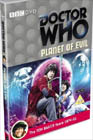
This story has become available on DVD and VHS video:
Comments on this article are welcome. You may contact the author from this page:
|


 PAL
PAL