STAR TREK:
- The Original Series (TOS)
- The Animated Series
- The Movies
- The Next Generation (TNG)
- Deep Space Nine (DS9)
- Voyager
- Enterprise

THE ORIGINAL SERIES:
- Season One
- Season Two
- Season Three
- "Season Four"
Season One:
-1: "The Cage"
-2: "Where No Man Has Gone Before"
-3: "The Corbomite Maneuver"
-4: "Mudd's Women"
-5: "The Enemy Within"
-6: "The Man Trap"
-7: "The Naked Time"
-8: "Charlie X"
-9: "Balance of Terror"
-13: "The Conscience of the King"
-16: "The Menagerie"
-20: "The Alternative Factor"
----: _Time Travel Season 1
-21: "Tomorrow is Yesterday"
----: _Prime Directive Origins
-22: "The Return of the Archons"
-23: "A Taste of Armageddon"
-27: "Errand of Mercy"
-28: "The City On the Edge of Forever"
-29: "Operation -- Annihilate!"
-Season 1 Rankings
SCIENCE FICTION:
- Doctor Who
- Sliders
- The Matrix
- Main Index
- Site Map
|
The Alternative Factor
(Star Trek story #20 in production order)
- written by Don Ingalls
- directed by Gerd Oswald
|
|
|

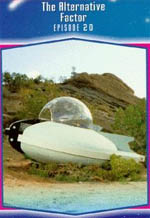
The Alternative Factor
|
In one of this story's many misleading moves,
its main guest star Lazarus claims to be a time traveler.
However, the episode has practically nothing to do with
time travel per se, and time travel only seems to be
mentioned as one of a number of excuses the writer
could have come up with for separating Lazarus from the
rest of his society.
More to the point, Mr. Spock spends most of the episode
convinced that Lazarus is a liar, and it remains unclear,
and ultimately unimportant,
whether or not he is lying about the time travel bit.
|
Lazarus actually turns out to be more of a "slider",
but unlike in Tracy Tormé's 1995 TV series
"Sliders",
the more primitive, dualistic thinking here postulates
only two universes, and generates much fear surrounding
the idea of a matter-antimatter collision. Seeing as how
the Enterprise's engines operate on such collisions
regularly, this shouldn't be such a big deal, nor should
a parallel opposite universe be required to find this
particular danger in the first place.
So, despite invoking both time travel and parallel universes
in the same breath, this episode actually does nothing to
demonstrate how the two ideas support each other in maintaining
an anti-tragedy arena that allows free will, or indeed how
the two ideas interact at all.
Our focus today is on the aspect of doubles, particularly
Lazarus's double, and how the idea of looking into such a mirror
can drive one to madness. The episode proceeds to be one that
is difficult to follow closely and appreciate on a character level
though.
The Big Cheat
The writer holds a lot of honest explanation back to attempt
to create a bit of a mystery, but this doesn't really ring true
for the characters he has put into the episode. Even after
one has seen it once through, each occurrence of
the lengthy effects sequence tempts one to believe that
Lazarus has once again switched places with his double.
Not so, and attempts to figure out their separate characters
this way will easily have one shrugging one's shoulders
with the disappointment that they are both equally silly.
In actual fact, we are often left with the same Lazarus
we started off with (instead of his double) after some of these
effects sequences. At other times, Lazarus switches with his
double and no effects sequence is shown, for example during
one of the commercial breaks. The cut on the forehead is a much
more accurate indicator of which Lazarus we are seeing at any
given time - and this reveals another bizarre writing cheat.
The "good" Lazarus has no on-screen dialogue whatsoever
until the final act of the show. Yes, believe it, even though
our regular characters apparently have plenty of opportunity
to talk to him earlier on, and apparently do talk to him
when the camera's not around to show it. It seems that the only
reason they don't get his superior explanation of what's going
on from the beginning is the writer's artificial desire to
keep it a mystery until the end.
Many other processes remain confusing as well. Does Lazarus
really need his space/time craft on the surface to use the
corridor between universes? He seems to end up there quite
well without it "during his alleged confrontations". Also,
why does Spock sometimes detect the whole universe winking out
when Lazarus enters/exits the corridor, while at other times
he detects nothing?
Though this episode works hard to open up a new concept of
parallels and succeeds in leaving its audience with something
interesting and haunting to provoke substantial thought
afterwards, its sloppiness in creating characters and processes
that we can believe in, follow on-screen, and root for,
make it one of the lesser episodes of the season. No wonder
it was held back while countless other episodes that were filmed
later were broadcast ahead of it.
(Our review of "Mirror, Mirror" has moved to its own page here:
"Mirror, Mirror"
Read the next Star Trek review article:
"Time Travel - TOS Season One"
which, amongst other things, covers the next episode "Tomorrow is Yesterday"
and the infamous "City on the Edge of Forever"....
|
|
"The Alternative Factor" is
available on DVD and Blu-Ray.
Click on the Amazon symbol for the desired disc format
and location nearest you for pricing and availability:
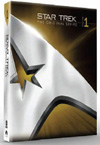
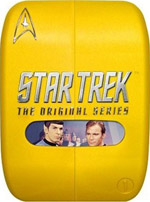
Star Trek Season One "Purist" Standard DVD Box Set:
|
|
Watch the legend develop from its infancy.
Set contains 29 episodes from the first season
in their original wacky broadcast order,
including "The Menagerie Parts 1 & 2" which used
footage from the original unaired pilot "The Cage".
However, "The Cage" itself is only included with
the Season Three Box Set.
As someone interested in researching how the episodes
actually looked and sounded originally, and when and
exactly how certain musical cues first debuted,
this was the DVD set for me, and it remains the most
untampered-with full-season collection of Star Trek
out there. Unique extras include pure text commentaries
on select episodes.
Sadly, these sets are starting to
become rare, and prices are now rising as these
become collectors' items....
|
DVD U.S.


| DVD Canada


| DVD U.K.


|
Standard DVD Extras include:
- original restored broadcast versions of the 29 episodes.
- "The Birth of a Timeless Legacy" documentary (24 min.)
- Text only commentary by Denise & Michael Okuda
on "Where No Man Has Gone Before",
"The Menagerie Parts 1 & 2",
and "The Conscience of the King".
- "To Boldly Go" featurette (19 min.) discussing
"The Naked Time",
"City on the Edge of Forever",
"The Devil in the Dark",
and "The Squire of Gothos".
- "Reflections on Spock" featurette (12 min.)
- "Sci-Fi Visionaries" writing featurette (17 min.)
- "Life Beyond Trek: William Shatner" featurette (10 min.)
- "Red Shirt Logs" Easter Eggs (7 min. total)
- Photo Log (still menus)
- Original Trailers for every episode (1 min. each)
|
|
|
|
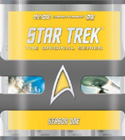
The Original Series Remastered Sets
The re-mastered Star Trek sets are more readily available,
and in addition to picture and sound quality restoration,
liberties have been taken with "upgrading" the episodes.
Most famously, new CGI effects and optical shots have
replaced many space scenes, matte paintings, and phaser
effects. Unlike similar upgrades applied to select
Doctor Who DVD releases since 2002,
the CGI effects cannot be turned off to see the original
effects. The kicker for me comes from reports that the episodes
have been rescored with new music. Interesting, funky, but
since it's primarily the original music I'm after in the first
place, this was not the set for me.
Another curiosity: Season One was released on double-sided
discs, with standard DVD on one side and HD on the other.
Reportedly, not all extras are accessible on the standard
DVD side. However, by the time the remastered versions of
seasons two and three were released, HD had clearly lost
the standards war to Blu-Ray, and so seasons two and three
"remastered" offer standard DVD only yet again.
|
Adding to the bizarre formatting is the very gimmicky,
awkward packaging that is prone to damage both during shipping and
with light usage. The season 1 set fares better than its counterparts
for seasons 2 or 3 though,
in having some interesting bonus features not found on any other
season one Star Trek set:
DVD/HD Combo Season 1 Exclusive extras:
- Starfleet Access interactive trivia plus picture-in-picture interviews for
"The Galileo Seven" (HD version only).
- "Beyond the Final Frontier" History Channel documentary (SD, 90 min.)
with host Leonard Nimoy.
- Trekker Connections interactive DVD game (SD side)
- Star Trek online game preview (SD, 3 min.)
|
|
|
|
Season One - Blu Ray
|
|
29 episodes @ 51 minutes
Star Trek sets are now available on Blu Ray.
Picture and sound quality restoration has gone up yet
another notch since the remastered version, as have the
liberties taken with "upgrading" the episodes.
Once again, even newer CGI effects and optical shots have
replaced many space scenes, matte paintings, and phaser
effects.... but this time the upgrades have the same respect
and user-functionality applied to select
Doctor Who DVD releases since 2002,
as the CGI effects can now be turned off to see the original
effects. Good show. It seems that the music
has still been tampered with too much for my liking though.
|
Blu-ray U.S.


| Blu-ray Canada


| Blu-ray U.K.


|
Blu-ray features add:
- option to watch episodes with original or new CGI effects.
- Spacelift: Transporting Trek into the 21st Century featurette (HD, 20 min.)
covering the restoration, CGI effects, and music upgrades.
- Starfleet Access - Okuda interactive trivia
plus picture-in-picture interviews
on 6 episodes:
- Where No Man Has Gone Before
- The Menagerie Part 1
- The Menagerie Part 2
- Balance of Terror
- Space Seed
- Errand of Mercy
- Behind-the-scenes 8mm home movies (HD, 13 min.) from
Billy Blackburn (Lt. Hadley / Gorn)
- Kiss 'N tell: Romance in the 23rd Century (8 min.)
- Interactive Enterprise Inspection (HD)
- plus all documentaries, featurettes, and episode promos
from the "purist" standard DVD set listed far above.
|
Both "The Alternative Factor" and "Mirror, Mirror"
(along with 3 of its best Deep Space Nine sequels)
are available in the following themed DVD box set.
Click on the Amazon symbol for the desired disc format
and location nearest you for pricing and availability:
|
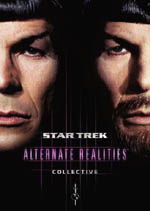
Star Trek Fan Collective:
Alternate Realities
 |
Region 1, NTSC, U.S.

Region 1, NTSC, Canada

Region 2, PAL, U.K.

A series of "Fan Collective" DVD Sets are also on the market,
offering a sampling of episodes from across all Star Trek
series and spinoffs. "Alternate Realities" is apparently
the first of those to offer the remastered versions of
original Star Trek episodes, with the upgraded special effects.
Those who are dubious about this process may wish to try
this less-expensive-than-a-full-season set to see what all
the fuss is about.
We also get some long-awaited audio commentaries on a few
of the episodes, a welcome rarity for Star Trek's
live-action TV shows, although some British fans have
complained that the audio commentaries are missing from
the Region 2 version.
|
|
20 episodes @
43-51 minutes each:
- Mirror Universe
- TOS: "Mirror, Mirror"
- DS9: "Crossover" (with director's commentary)
- DS9: "Through the Looking Glass"
- DS9: "Shattered Mirror"
- Ent: "In a Mirror, Darkly (Part 1)"
- Ent: "In a Mirror, Darkly (Part 2)"
- Parallel Dimensions
- TOS: "The Alternative Factor"
- TNG: "Parallels" (with writer's audio commentary)
- Twisted Realities
- TOS: "The Enemy Within" (with audio commentary)
- TOS: "Turnabout Intruder"
- TNG: "Frame of Mind"
- Voy: "Shattered"
- Alternate Lives
- TNG: "Yesterday's Enterprise" (with director's audio commentary)
- TNG: "The Inner Light"
- DS9: "The Visitor"
- Voy: "Before and After"
- Voy: "Timeless"
- Voy: "Course: Oblivion"
- Ent: "Twilight" (with writer's audio commentary)
- Ent: "E2"
- Special Features
- Mirror Universe: Part 1 (14 min.)
- Mirror Universe: Part 2 (5 min.)
- Parallel Dimensions (7 min.)
- Twisted Realities (13 min.)
- Alternate Lives: Part 1 (11 min.)
- Alternate Lives: Part 2 (15 min.)
- Audio Options (may vary according to region)
- English
- Español
- Portugues
|
Article written by Martin Izsak.
Comments are welcome. You may contact
the author from this page:
Contact page
If you liked this article, or simply enjoy the parallel universe
theme in science-fiction, be sure to check out the 1995-1999
TV series "Sliders" by Robert K. Weiss and
Star Trek the Next Generation writer Tracy Tormé,
and read our complete series of
in-depth Sliders episode reviews, best accessed from our
SLIDERS Episode Guide Catalogue.
You may also be interested in:
Doctor Who #54: "Inferno"
or
Doctor Who #176: "Rise of the Cybermen"
|