
STAR TREK:
- The Original Series (TOS)
- The Animated Series
- The Movies
- The Next Generation (TNG)
- Deep Space Nine (DS9)
- Voyager
- Enterprise

THE ORIGINAL SERIES:
- Season One
- Season Two
- Season Three
- "Season Four"
Season One:
-1: "The Cage"
-2: "Where No Man Has Gone Before"
-3: "The Corbomite Maneuver"
-4: "Mudd's Women"
-5: "The Enemy Within"
-6: "The Man Trap"
-7: "The Naked Time"
-8: "Charlie X"
-9: "Balance of Terror"
-13: "The Conscience of the King"
-16: "The Menagerie"
-20: "The Alternative Factor"
----: _Time Travel Season 1
-21: "Tomorrow is Yesterday"
----: _Prime Directive Origins
-22: "The Return of the Archons"
-23: "A Taste of Armageddon"
-27: "Errand of Mercy"
-28: "The City On the Edge of Forever"
-29: "Operation -- Annihilate!"
-Season 1 Rankings
SCIENCE FICTION:
- Doctor Who
- Sliders
- The Matrix
- Main Index
- Site Map
|
Star Trek
Prime Directive Origins
"Be the change you want to see in the world."
~ Mahatma Gandhi, 20th century spiritual & political leader
|
|
|

Starfleet's non-interference Prime Directive has
an obscure beginning in Star Trek history.
Its first mention, and indeed ONLY mention in all of the first season,
is in a brief exchange between Kirk and Spock in
"The Return of the Archons", where they
quickly decide that the directive doesn't really apply to this week's
situation. What's most bizarre is the way this exchange appears
to have been tacked on in hindsight, as though to maintain
a congruent view of the Star Trek universe. One would have
expected a concept like the Prime Directive to have debuted
in an episode in which it both had something more to do with the story,
and in which it was properly introduced to the audience through the
narrative and dialogue. "The Return of the Archons" doesn't
really say what Starfleet's prime directive is, and indeed spends
more time studying a completely different 6000-year-old local
idea, also confusingly called a prime directive.
"We seek to better ourselves..."
At its heart, our infamous Prime Directive is the highest
General Order in Starfleet - an instruction to not
interfere in the affairs of other civilizations.
It is quite specific with regard to less developed civilizations that
have not yet acquired warp drive (and thus the capability
to come out and mingle with the rest of the galaxy) -
absolutely no open contact is allowed at all with such societies.
The Roddenberry Glory
The real origin of the prime directive in Star Trek can
perhaps be traced back to the second pilot. We now know
this story as
"Where No Man Has Gone Before",
written by Samuel Peeples. However, producers Herb Solow
and Robert Justman revealed in their "Inside Star Trek"
book and audio cassette that Peeple's script was one of
three competing to be made as the second pilot. The
other candidates included
"Mudd's Women" by Stephen Kandel
based on a Gene Roddenberry "springboard" story idea
and filmed almost as soon as regular production began
on the series, and "The Omega Glory" which Gene Roddenberry
was writing himself. While
"The Omega Glory" did not
become a filmed episode until the very end of the second season,
we have to assume that the script was in some
form of development long before the series even began.
And as we know, the story of "The Omega Glory" is deeply
saturated in the Prime Directive. The real origin of this law
therefore appears to have been an off-screen one, collecting dust
as a half-finished script on one of Roddenberry's shelves,
while the idea rolled around in his head and influenced
the notes he made on other scripts throughout the first
two years of Star Trek.
Although conceived with the best of intentions,
the Prime Directive is a flawed philosophy
(just as "The Omega Glory" remained a story
of deeply flawed symbolism),
and it is a great pity that this franchise
for exploring the human condition seems to have little
capacity for successfully challenging its most entrenched
policy.
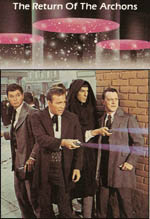
The Return of the Archons
(Star Trek story #22 in production order)
story by Gene Roddenberry
teleplay by Boris Sobelman
directed by Joseph Pevney
|
But, returning to the Archons and our only actual season one
prime directive story, there isn't much meat here to sink
any of our arguments into. In fact, the episode is bizarrely
thinner than most in setting up the society on the planet
for the viewer, with the episode opening well after the
Enterprise crew have become involved, and with the information
in the expositional Captain's Log entries being rather sparse.
No doubt making good use of the studio's stock assets,
the costumes and initial backlot sets suggest a society on
par with the gentlemanly side of the American West in the 1800's,
an assumption quickly dispelled by the culture's
self-awareness of its history regarding all the remnants
of its previous higher technology.
At any rate, the Enterprise crew decide to trade in their own
uniforms for local garb during all landing missions. Knowing how
the Enterprise crew arrived at this decision would be critical
if we wanted to accuse them of deception, but
"Return of the Archons" has kept itself in the clear by
sidestepping this issue.
Kirk and company later flip sides constantly in their use
of deception as a means to achieve their goals during the
episode. Although often attempting to appear as spaced out
and as entrenched in this week's dystopia as the locals
in order to blend in and steer clear of suspicion and
opposition, they often confront the more solid and actual
threats with their true selves, true backgrounds, and true nature....
with these moments nearly always being more entertaining
than the deceptive ones.
|
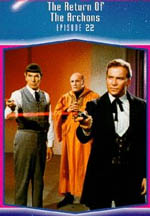
Interestingly, the narration on the episode's trailer appears to give
some extra information that isn't in the actual episode - that the Enterprise crew
came here to discover what happened to a previous ship, the U.S.S. Archon. Ahh,
so that's who the Archons were! It would have been better to put that somewhere
in the episode in place of some of that repetitive irritating spaced-out dialogue.
|
When all is said and done, "The Return of the Archons"
proves to be one of the lesser scripts of the season, and
doesn't turn out to be a great episode. Most of the characters,
at many times including our regulars, are locked in unusual
behaviour patterns perpetuated by the needs of the dystopia
of the week, patterns which naturally distance the characters
from the audience. Instead of making the exploration of these
patterns quick and compelling, we drag our way through far more
than is palatable, while the actors never quite figure out
on their quick TV shooting schedule how to imbue those patterns
with the sort of charisma that audiences respond to. The end
result is something that very few non-sci-fi-geeks will sit
through.
|
|
The Galileo Others
As we continue through Star Trek, we will continue to keep a watchful
eye on the series' portrayal of the Prime Directive, including those
stories where mention of the Prime Directive is conspicuous by its absence.
Season One has a few more examples worth closer scrutiny such as
"A Taste of Armageddon" and
"Errand of Mercy", which now both have
complete reviews on further pages here on this site...
One of the other more notable cases occurs in an episode we've already
passed by this point: "The Galileo Seven" (episode 14).
Mr. Spock is arguing for restraint in his crew's
position against some native creatures on an asteroid who are
quite far from achieving warp drive, and he is having a hard time
keeping his crew from mutinying. Starfleet's Prime Directive
seems to be the perfect thing to remind this crew of, to get
them back in line and show the locals some respect, yet Spock
struggles to make his case without mentioning it. Again, it
is all too obvious that the writers hadn't figured it out yet,
and also possible that Starfleet had not yet adopted this policy
as their highest law. Perhaps Season Two had better things to say
regarding how recently the Prime Directive came into prominence.
And so, there will be much, much more to say about
the use of the Prime Directive in Star Trek stories
as we delve into Star Trek's continuing adventures,
as this non-interference concept slowly crawls out of the closet
and weaves itself through many a controversial tale.....
Read the next Star Trek review:
"A Taste of Armageddon"
|
|
"The Return of the Archons" and "The Galileo Seven"
are available on DVD and Blu-Ray.
Click on the Amazon symbol for the desired disc format
and location nearest you for pricing and availability:
Star Trek Season One "Purist" Standard DVD Box Set:
|
|
Watch the legend develop from its infancy.
Set contains 29 episodes from the first season
in their original wacky broadcast order,
including "The Menagerie Parts 1 & 2" which used
footage from the original unaired pilot "The Cage".
However, "The Cage" itself is only included with
the Season Three Box Set.
As someone interested in researching how the episodes
actually looked and sounded originally, and when and
exactly how certain musical cues first debuted,
this was the DVD set for me, and it remains the most
untampered-with full-season collection of Star Trek
out there. Unique extras include pure text commentaries
on select episodes.
Sadly, these sets are starting to
become rare, and prices are now rising as these
become collectors' items....
|
DVD U.S.


| DVD Canada


| DVD U.K.


|
Standard DVD Extras include:
- original restored broadcast versions of the 29 episodes.
- "The Birth of a Timeless Legacy" documentary (24 min.)
- Text only commentary by Denise & Michael Okuda
on "Where No Man Has Gone Before",
"The Menagerie Parts 1 & 2",
and "The Conscience of the King".
- "To Boldly Go" featurette (19 min.) discussing
"The Naked Time",
"City on the Edge of Forever",
"The Devil in the Dark",
and "The Squire of Gothos".
- "Reflections on Spock" featurette (12 min.)
- "Sci-Fi Visionaries" writing featurette (17 min.)
- "Life Beyond Trek: William Shatner" featurette (10 min.)
- "Red Shirt Logs" Easter Eggs (7 min. total)
- Photo Log (still menus)
- Original Trailers for every episode (1 min. each)
|
|
|
|
The Original Series Remastered Sets
The re-mastered Star Trek sets are more readily available,
and in addition to picture and sound quality restoration,
liberties have been taken with "upgrading" the episodes.
Most famously, new CGI effects and optical shots have
replaced many space scenes, matte paintings, and phaser
effects. Unlike similar upgrades applied to select
Doctor Who DVD releases since 2002,
the CGI effects cannot be turned off to see the original
effects. The kicker for me comes from reports that the episodes
have been rescored with new music. Interesting, funky, but
since it's primarily the original music I'm after in the first
place, this was not the set for me.
Another curiosity: Season One was released on double-sided
discs, with standard DVD on one side and HD on the other.
Reportedly, not all extras are accessible on the standard
DVD side. However, by the time the remastered versions of
seasons two and three were released, HD had clearly lost
the standards war to Blu-Ray, and so seasons two and three
"remastered" offer standard DVD only yet again.
|
Adding to the bizarre formatting is the very gimmicky,
awkward packaging that is prone to damage both during shipping and
with light usage. The season 1 set fares better than its counterparts
for seasons 2 or 3 though,
in having some interesting bonus features not found on any other
season one Star Trek set:
DVD/HD Combo Season 1 Exclusive extras:
- Starfleet Access interactive trivia plus picture-in-picture interviews for
"The Galileo Seven" (HD version only).
- "Beyond the Final Frontier" History Channel documentary (SD, 90 min.)
with host Leonard Nimoy.
- Trekker Connections interactive DVD game (SD side)
- Star Trek online game preview (SD, 3 min.)
|
|
|
|
Season One - Blu Ray
|

|
29 episodes @ 51 minutes
Star Trek sets are now available on Blu Ray.
Picture and sound quality restoration has gone up yet
another notch since the remastered version, as have the
liberties taken with "upgrading" the episodes.
Once again, even newer CGI effects and optical shots have
replaced many space scenes, matte paintings, and phaser
effects.... but this time the upgrades have the same respect
and user-functionality applied to select
Doctor Who DVD releases since 2002,
as the CGI effects can now be turned off to see the original
effects. Good show. It seems that the music
has still been tampered with too much for my liking though.
|
Blu-ray U.S.


| Blu-ray Canada


| Blu-ray U.K.


|
Blu-ray features add:
- option to watch episodes with original or new CGI effects.
- Spacelift: Transporting Trek into the 21st Century featurette (HD, 20 min.)
covering the restoration, CGI effects, and music upgrades.
- Starfleet Access - Okuda interactive trivia
plus picture-in-picture interviews
on 6 episodes:
- Where No Man Has Gone Before
- The Menagerie Part 1
- The Menagerie Part 2
- Balance of Terror
- Space Seed
- Errand of Mercy
- Behind-the-scenes 8mm home movies (HD, 13 min.) from
Billy Blackburn (Lt. Hadley / Gorn)
- Kiss 'N tell: Romance in the 23rd Century (8 min.)
- Interactive Enterprise Inspection (HD)
- plus all documentaries, featurettes, and episode promos
from the "purist" standard DVD set listed far above.
|
Article written by Martin Izsak.
Comments are welcome. You may contact
the author from this page:
Contact page
|