Original DVD Extras include:
Special Edition DVD extras add:
"Listen to that! That's the sound of this planet screaming out its rage!"Just what metaphysical statement am I talking about? It has been said that our Earth was headed for destruction had it continued down the same timeline it was on throughout most of the 1970's, and that some time around 1981 - 1982, the human race chose a new path with a more successful resolution of old issues. Many of these old Jon Pertwee stories from the 70's showcase the sadness and frustration felt by those who grasped the reality of where we were headed socially: into a global apocalypse of conflict. Malcolm Hulke's work as a whole stands out particularly well on this issue. However, no one story truly encapsulates the idea better than "Inferno", where the Earth's destruction can be fully experienced and at the same time relegated to a parallel timeline, while the reality of our new choice for a less destructive resolution of conflict has the approving stamp of being the "true line" of present-day history.
"The TARDIS console slipped me sideways in time...."Also, if the Doctor's character can be seen to grow and develop throughout the 30+ year history of the show, it is here in "Inferno" that he demonstrates his biggest breakthrough. John Lucarotti's novelization of "The Massacre" (story no. 22) makes plain the early Doctor's "fatalist" view of time travel, a limiting trait that can be seen to bring out some of the most anti-heroic behaviour from the Doctor in nearly every old historical story of the program's history. The story dynamics improved as this old conundrum was abandoned along with the historical settings that usually brought it on. However, there's no better medicine for that fear of changing history than a good parallel universe to prove that EVERY history has its place, and that ALL of them coexist simultaneously. The experience of one history does not erase the existence of another. It still remains to be seen, however, how well the Doctor truly understands this, or how long this impression will last in him.
"Yes, of course, of course.... An infinity of universes.... ergo, an infinite number of choices.... So free will is not an illusion after all!The Time Lords may have conquered Time and Space, but they still have something to learn about freedom of choice. "Inferno" makes a pioneer out of the Doctor, as he leads this exploration of a new frontier. And ultimately he is a much better hero because of this new philosophy.So, to disagree with Susan's dissertation to her science teacher in "An Unearthly Child" (story no. 1), the fifth dimension isn't "space". "Space" is already covered in the first three dimensions, thank you! If the fourth dimension is "time", as measured by clocks and calendars the way any normal person would think of it, then the fifth dimension is most easily described as "CHOICE", that which can slide us across parallel universes to any imaginable outcome. Every choice and deciding thought creates a small movement through that fifth dimension. The pattern can be chosen!
"What did you expect? Some kind of space rocket, with Batman at the controls?"No complaints about the TARDIS in this story, with it making plot-critical appearances in six out of seven episodes. Well, we still only get the console, but let's face it, that's where all the action is today. Surprisingly the TARDIS is at its best not during the critical shifts between universes, but during the demonstrations in episodes one and five. The familiar dematerialization sound is most often present and mixed in with other excellent Brian Hodgson creations both old and new, and for the story's only true materialization in episode five, the satisfyingly reversed and over-echoed sound from "The Invasion" (story no. 46) is used once again.
Mirror, MirrorThe parallel universe / altered-regular-cast concept is not totally new, as the classic Star Trek episode "Mirror, Mirror" predates "Inferno" and may have helped inspire that aspect of the story. What is very curious are the reports I've read that one of the early drafts was four episodes long and contained none of the parallel universe material. That would make the expansion of "Inferno" to seven episodes, complete with alternate versions of Benton, the Brigadier, and Liz Shaw, one of the most marvellous upgrades ever masterminded for the program. Archive notes from Andrew Pixley indicate it didn't actually happen this way, though. In any case, "Inferno" needs its parallel universe to remain a powerful story.
"Well, I didn't know he'd go off like that! The man's so infernally touchy!"As excellent as "Inferno" now is all the way through, it is interesting to watch the quality of the dialogue evolve with each episode. The guest characters are a bit on the stereotypical side in this story, which is not particularly a bad thing as the script and the production team know what to do with them, but they're not quite as fully or as sympathetically developed as those in "The Silurians" (story no. 52). Early on we get a lot of short-tempered clashing between them, and when faced with this situation, the Doctor appears to be choosing to aggravate matters often instead of coming to the point of his argument. He's only humanoid, after all.As the story runs its course, however, the dialogue gets better and better - the arguments get to the point, and rely less on empty style and flourish. Also, unlike "Silurians", the characters here do eventually learn to see the world from the eyes of those around them: Sir Keith Gold is good at that from the beginning, Section Leader Elizabeth Shaw and the Brigade Leader take their stubborn time, but do eventually come to believe the Doctor's story, and Greg Sutton and Dr. Petra Williams overcome their differences to find common ground in the classic male/female way in both universes. Lethbridge Stewart doesn't like Miss Shaw's rebellious tone in either universe, but this is at least resolved with humour in one.
"You know you really do look better with that moustache!"Nicholas Courtney's performance as the good old Brigadier is as enjoyable as ever, and he even manages to remain extremely charming when yelling an order to Sergeant Benton to drag in Professor Stahlman. Courtney also does a good job as the Brigade Leader, although this is not quite as polished: his final scenes in the hut leave something to be desired in terms of making the action seem believable.Jon Pertwee is at the top of his form all the way through, and Caroline John also turns in top notch performances in both of her roles, although a stiffer Liz Shaw may not have been too great a stretch for her. John Levene has appeared twice before as Sergeant Benton in "Doctor Who", but this is the story in which he truly earns his place as a series regular. The dynamics of the parallel universe story-plot that make "Inferno" what it is DEMAND alternate versions of character exposition, so we get to see a lot of what makes the good Benton tick, in order to contrast it with the parallel bad-Benton. Levene is truly excellent in both roles, and even gets a chance to play a monster again as he had also done before on Who - his best monster performance is his last one here. From this story onwards, Benton would remain recognizable to the mainstream audience. The guest characters sport fewer differences from one universe to the other. Derek Newark, last seen taking over the tribe in "An Unearthly Child" (story no. 1) as Za, is much more civilized and enjoyable here as Greg Sutton, and possibly even more energetic to boot. The director's wife, Sheila Dunn, has graduated from bit roles like Blossom LeFavre in "The Dalek Masterplan" (story no. 21) and voice-over roles like the receptionist computer in "The Invasion" (story no. 46) to bring Dr. Petra Williams to life, solidly and sympathetically. Dr. Williams is a strong character, deflecting Sutton's obnoxiously obvious early come-on in episode one with a great deal of charm, learning to take charge when necessary as the high position she has earned allows her to, and having the most crucial, proactive role of technical expertise in the main plot throughout episode six's dramatic conclusion - she is a showcase of the best of women's lib, while remaining female in character and likeable to boot. Christopher Benjamin, perhaps better known for his role in "The Talons of Weng-Chiang" (story no. 91), is I think even better here in "Inferno" where he seems perfectly cast as the likeable, almost over-sensitive Sir Keith Gold. Olaf Pooley gives a tour-de-force performance as Professor / Director Stahlman. Even though the mad scientist is scripted to be a little one dimensional, he greatly succeeds as a character where Zaroff of "The Underwater Menace" (story no. 32), or even Robson of "Fury From the Deep" (story no. 42) do not. His motivation to succeed in producing energy for the British government is easily understandable, as is his emotional vulnerability if his theories should be proven wrong. Pooley also makes a great Primord monster as well, demonstrating ability to act outstandingly through any amount of odd make-up, prosthetics, or costumes. Curiously though, while the conversion to a Primord involves massive growth of new, extra hair all over the body, Professor Stahlman somehow manages to LOSE his moustache! Maybe this has something to do with the larger nose squeezing the upper lip out of existence.....?? And speaking of Primords, let's not forget the minor character of John Bromley (Ian Fairbairn), who, while never really having a role greater than that of the token victimized extra, manages to have his role stretched over six of the seven episodes until he becomes something of an iconic symbol for the story. The image of him is captured on the cover of the edition of the novelization that I happen to have, helping him to stand out even more in my mind. And what do you know, he seems to be all over each and every version of the various pieces of cover art for the DVD's as well.
"There's nothing we can do! Is that right, Doctor?""You're seriously ill; you've been infected!"Once more, the third Doctor displays several of his least effective traits, but thankfully these are kept to something of a minimum in this story. His "Doomsayer" tactics are evident once more, emphasizing the eloquent statement of problems as though that is more of an achievement than it ever really is, and our secondary hero Greg Sutton is quick to jump aboard the bandwagon with him. However, since the plot of "Inferno" follows through on the consequences of those problems, the "Doomsaying" is not as out of place here as in other stories, and the Doctor does promote solutions as well where appropriate.
"If we get you back, Doctor, you'd better make darn sure they stop their drilling. I'd hate to think this was all for nothing."The "Man of Sleep" apparently returns for the first part of episode seven, threatening to waste the sacrifice that his new friends in the parallel universe made for him. This is shaky ground! However, the Doctor's actions before and after, combined with the emotional weight of his experiences and his philosophical breakthrough, justify his unconscious screen time this time around.
"Stop this infernal drilling!"Sir Keith is poised to do just that, suspending the project pending a full inquiry, by authority of the minister, yet when it comes down to the final crunch, he waffles and says he has no authority! Well, what else was that hair-raising, time-consuming trip to the minister for, then? Surely the minister revoked Stahlman's authority! However, it is left up to Stahlman to graphically convince our protagonists that their judgement is far better than his own. The Professor is slightly more humane and conscientious than his parallel "Director" Stahlman counterpart. Where the Director recruited a team of fellow Primords-to-be in episode five, the Professor goes it alone when his time comes. Even the villains are more compassionate in the true time-line, thankfully!
"Nothing like a nice happy ending, is there?" "Now come along, dear fellow. Put on a smile!" :-)The season comes to a close with a scene full of humour, good cheer, and comical conflict for the series' regulars. The Doctor attempts his usual heroes' exit, but thankfully the results are a little atypical this time around, lending to greater entertainment value. A great finish for a classic.
International Titles:Deutsch: (Das Inferno)Magyar: "Pokol"Français: (Inferno)Русский: "Ад"Italiano: (Il inferno)
"....Degrees in medicine, physics, and a dozen other subjects. Just the sort of all-rounder I've been looking for."Season Seven has got to be one the most successful years of the Doctor Who program, especially in raising the maturity level of the show's content, scripts, and production values. Although the writers felt they needed to replace Liz Shaw with an assistant who requires constant, simpler explanations from the Doctor, I don't truly believe this really was to help the audience understand what was going on. Season Seven just didn't have that problem, and is probably the most easily understood year of stories in any of the first three Doctor's eras. Liz Shaw's assistant character worked extremely well for the audience, but probably required more effort from the writers. While they opted for a simpler and easier assistant character to write for, they also sadly left the peak of the maturity level of the scripts behind as well.....
Season Seven Rankings:
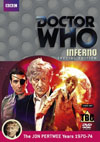
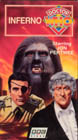
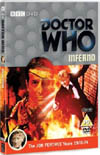
"Inferno" is now available on DVD and VHS video:
Comments on this article are welcome. You may contact the author from this page:
|
|||||||||||||||||||||||||||||||||||||||||||||||||||||||||



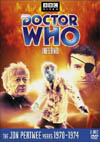
 in the U.S.
 in Canada
 for the U.K.