Original DVD Extras include:
- Audio commentary by actress Katy Manning (Jo Grant),
producer Barry Letts, and script editor
Terrance Dicks.
- interviews of writer Robert Sloman (7 min.) and
actor Stewart Bevan (Professor Clifford Jones) (8 min.)
- Visual Effects featurette (12 min.), with an interview of
visual effects designer Colin Mapson
and a special "Making a Maggot" segment.
- "Global Conspiracy!" (11 min.) - a mockumentary by writer/actor
Mark Gatiss, also starring
Roy Evans (twin brother of Bert the miner),
Tony Adams (Mark Elgin),
Stewart Bevan (Cliff Jones), and
Jerome Willis (Jocelyn Stevens).
- Pop-up Production Note Subtitles
- Photo Gallery sound effects montage (8 min.)
- "Who's Who" actor biographies (text only,
may appear on original edition Region 1 discs only)
Special Edition DVD extras add:
- additional commentary on episodes 3-6 by
Manning, Mapson,
Richard Franklin (Mike Yates), and
Mitzi McKenzie (Nancy).
- "The One with the Maggots" making-of featurette (27 min.) including
Dicks, Manning, Bevan, and
director Michael Briant.
- "Wales Today" archival footage (2 min.)
- revised Pop-up Production note subtitles
- "Doctor Forever: The Unquiet Dead" (23 min.) on the New Millennium resurrection of Doctor Who.
- "What Katy Did Next" (5 min.)
- The Sarah Jane Adventures: "Death of the Doctor" parts 1 & 2,
guest starring Katy Manning as Jo Grant.
- with optional commentary by writer Russell T. Davies
and Katy Manning (Jo).
- another Easter egg
In-Depth Analysis Review
by Martin Izsak
|
|
WARNING: This review contains "SPOILERS", and is intended for
those who have already seen the program. To avoid the spoilers,
read the Buyers Guide version instead.
|
Season Ten finally comes back to earning its generally favourable
reputation by offering another classic exquisite gem of a story
for its finale. Solidly anchored in an ecological theme and
wading deep enough into its symbolism to make it work as a
traditional UNIT vs. the monsters story as well, "The Green Death"
comes out on top of the season, with
"Carnival of Monsters" (story no. 66)
as a very close second.
It remains pleasantly surprising and moving throughout the years,
partly by hiding humbly in the shadow of the over-hyped dregs
of the season, partly by keeping a quick paced, heavily social
plot that is difficult to memorize and get bored of.
This is Robert Sloman's best Doctor Who script, even better
than the much-loved
"The Daemons" (story no. 59), I would say.
He still follows his standard
episode one formula though, keeping the Doctor preoccupied and
disinterested toward the business at hand, going off on a tangent
completely his own. This time it's a trip to Metebelis III that
is finally successful - a sequence that helps to define the
alienness of the Doctor and his interests, and demonstrates the
essentials of the TARDIS with exterior visuals and all the right
sound effects. The interior is not seen, but isn't really called
for, and the story can easily get by without it. The split of interests
even goes three ways as Jo and the Brigadier prepare to pursue
different tangents as well, before they discover they have a common
destination of South Wales anyway. Then suddenly, the chase is on
for the Doctor, using both the TARDIS and Bessie to get to the
scene of the story's main action just in time for the cliffhanger.
But episode one also manages to display extremely good exposition
of the main theme of the story, as scenes of Jo and Professor
Clifford Jones are expertly juxtaposed against the opposing viewpoint
at Global chemicals between Director Stevens and the Brigadier.
Top marks.
"I'm having a whale of a time!"
Jon Pertwee's Doctor manages to avoid most of his usual
downfalls, probably not spending more than a total of ten minutes
in the prisoner dynamic throughout the entire story, and even then
managing to thoroughly enjoy himself. With such a thematically
based story, he does get into Doomsayer mode now and then, but
these are relatively short bursts, usually resulting in him
changing tactics quickly to something that gets better results.
The high level of ecological research that went into the story
also helps keep it focused on imparting and playing with relevant
information, rather than doomsaying. There's no
Man of Sleep for
Pertwee's Doctor in this one either; luckily
Professor Jones took that role away from him near the end of the
story, along with the scenes of Jo blubbering that go with it.
This frees Pertwee up to do more of what he's good at:
Venusian aikido, fun disguises, deeper emotional scenes, and
above all lots of exploration, investigation and problem solving.
Episode Six is particularly good at keeping
him in problem solving mode, where he neatly wraps up most of
the mysteries and conflicts that had been brought up by the
story and its themes. The final computerized world take-over
crisis seems a bit artificial, deadline and all, as though created
solely to give the ending a bit more bang, but at least the Doctor's
role in solving this one remains on spiritually and philosophically
sound ground, keeping his final heroics logical, believable, and
satisfying.
Acting is of a generally high calibre by everyone all throughout
the story, and the fact that the characters are all written to be
normal, believable human beings certainly helps. Jo is only the third
of four companions to be "married off" in the long history of the show,
and even if this kind of exit has gained the reputation of a
cliché, it works this time
around. Perhaps having a real couple on the cast playing the
Cupidly-smitten helped generate the right on-screen chemistry. But as far as
Jo's usefulness as a companion goes, her earlier Season Ten progress
is undermined as she is unfortunately written to be a ninny again.
She still makes many important contributions to her friends, but
more often than not by accident rather than design. Katy Manning
turns in a good performance anyway. The only acting complaint I have
is for John Dearth during the demise of his BOSS computer character,
which gets a bit too hammy, and Jerome Willis playing Stevens catches a
bit of the contagion. The whole sixties psychedelia of the ending
could do with a bit more qualitative restraint there, but the general
effect is very cool. Nicholas Courtney is enjoyable as always as
the Brigadier, who is thankfully written to be a little more on the
ball than he was back in
"The Three Doctors" (story no. 65).
Juxtaposed against the previous two space story flops of the
season, "The Green Death" brings home the appeal of UNIT stories:
they have a large cast that you can depend on to be enjoyable,
and have their stories set in places that are full of social
complexity that is easy to believe in and realise on screen on
a tight budget. Space/future-based stories have a steeper challenge
in trying to create these elements from scratch; half the challenge
is the writer's burden in crafting real characters and a plot that
is easy to follow but not so easy to predict, but the other half
for the production crew is what Doctor Who is all about. That's
why I like it so much better than Star Trek. Star Trek learns
how to do its regular characters and their ship and a typical
planet exterior really well, after which they take very few real
artistic risks production-wise. Dr. Who is always stretching itself
beyond its means, taking one artistic risk after another, which makes
these reviews so enjoyable and such an education in the art of
film & video.
So "The Green Death" may have a lot of de facto bonuses going
for it which it capitalizes on, but it does not fail to stretch
itself anyway to do justice to its maggot monsters, its Metebelis III
sequence, and its realization of mechanized monetary appetite, brainwashing
and restoration included. CSO is a staple device for much of this,
and there is some flawless execution for most of UNIT's outdoor
dialogue scenes. Curiously though, the mine scenes leave a bright
halo around people through too bright a choice of background
key colour, while outdoor sequences such as Bessie's jaunts leave
a dark shadow around people through too dark a choice of background
key colour. A little more colour co-ordination in pre-production
might have brought things up a notch, but this is generally a minor
consideration.
Dudley Simpson seems to be slacking off where composition is
concerned, as none of his music seems to reach over the fence to
become memorable or deep. The story has many emotional
keypoints, well-acted and well-directed to the point where a little
musical underscore would be the professional icing on the cake and
make everything complete. To his credit, Simpson does not spoil
any of these with the wrong instrument or mood, but even when he does
deign to write some music for them, there's really nothing to his cues
that you can hang your hat on. For example, Jon Pertwee muses on the
foreshadowing of Jo abandoning him as he steps into his TARDIS and
leaves his lab, a wonderful scene begging for a lonely "departure theme"
or something, and Simpson senses the mood and starts to build it up
musically.... but then stops all the development before even getting
a handful of notes out or introducing a chord change to anchor the
mood to. Director Michael Briant gets some guitar music
like he asks for, but it too
remains too low key and non-descript for my tastes. Simpson has
developed a substantial palette of themes in previous stories that
he could be drawing on as well, if inspiration for new material is
in short supply, but he seems to be unable to tap into that either.
The music is disappointing this time around, and perhaps a warning
in allowing one composer a complete monopoly on an entire season
of a challenging risk-taking program. In this respect, I have to bow to
the original Star Trek's methods of reusing stock tracks
whenever and wherever it suited the mood - they ended up with a very
fun and recognizably unique repertoire that I enjoy more each time
I hear it.
All in all, "The Green Death" is one of the very best of the
Jon Pertwee Era, right up there with most of season seven in the
stratosphere of high quality.
International Titles:
Deutsch: (Die grüne Mine)
Magyar: (A zöld bánya)
vagy "A zöld halál"
Français: (La mine verte)
ou (La mort verte)
Русский: (Зелёный рудник)
или "Зелёная смерть"
Season Ten Rankings:
Best Story:
- The Green Death
- Carnival of Monsters
- The Three Doctors
- Frontier in Space
- Planet of the Daleks
Best Writer:
- Robert Sloman
- Robert Holmes
- Bob Baker & Dave Martin
- Malcolm Hulke
- Terry Nation
|
|
Best Director:
- Michael Briant
- Barry Letts
- Lennie Mayne
- David Maloney
- Paul Bernard
Best Music (all Dudley Simpson anyway):
- Carnival of Monsters
- The Three Doctors
- The Green Death
- Frontier in Space
- Planet of the Daleks
|
|
Best Video Effects:
- Carnival of Monsters
- The Three Doctors
- The Green Death
- Planet of the Daleks
- Frontier in Space
|
"The Green Death" is now available on DVD and VHS video:
Original 1-disc release:
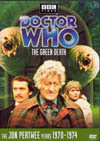 |
 |
 |
DVD NTSC Region 1
for the North American market:

 in the U.S.

 in Canada
 |
DVD PAL Region 2

 for the U.K.
 |
VHS Video
NTSC
A
 in the U.S.
NTSC
B
 in the U.S.
NTSC
 in Canada
PAL
 for the U.K.
|
|
|
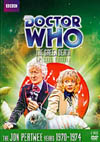
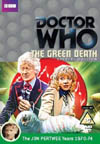
New Special Edition 2-disc re-release:
|
 |
 |
DVD NTSC Region 1
for the North American market:
 in the U.S.
 in Canada
NEW for Aug. 13, 2013.
|
DVD PAL Region 2
 for the U.K.
NEW for Aug. 5, 2013.
|
|
Special Edition DVD extras add:
- additional commentary on episodes 3-6
- "The One with the Maggots" making-of featurette (27 min.)
- "Wales Today" archival footage (2 min.)
- "Doctor Forever: The Unquiet Dead" (23 min.)
- "What Katy Did Next" (5 min.)
- The Sarah Jane Adventures: "Death of the Doctor" parts 1 & 2.
- with optional commentary by Davies and Manning.
- another Easter egg
- revised Pop-up Production note subtitles
|
|
Comments on this article are welcome. You may contact
the author from this page:
Contact page
|