Special Edition DVD Extras include:
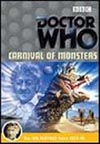
I've heard some (female) Blake's 7 reviewers complain that Robert Holmes does not write well for women, but I must say that I haven't seen Jo Grant's character appear as clever and deductive anywhere else as she does here - this could be her best story. The style of story-telling we get here is unique for its time, something that hasn't really played out since "The Krotons" (story no. 47) and "The War Games" (story no. 50), and won't become a staple Who formula until the Tom Baker era. This is a true sci-fi mystery, a chain of questions and answers carefully plotted to lead the audience suspensefully towards a neat, new, scientifically challenging idea. Episode one plays to the mystery and allows the Doctor and Jo to build up the questions, while episode two gives great audio/visual exposition of the answers, and presto - there's your new sci-fi idea. From the cliffhanger into episode three, Holmes ups the ante with bigger threats and lots of action, while much of the emotional ramifications of the sci-fi idea settle in. And episode four brings the Doctor face to face with those responsible for setting up the main predicament, where he can confront them accordingly. Doctor Who has won its award for writing today. Holmes' Achilles' heel is still there though, gently reminding one of "The Space Pirates" writing fiasco from season six. Commissioner Kalik, enjoyably played by Michael Wisher, is up to lots of crafty no good on the side, but neither the Doctor nor anyone else ever gets to investigate him, expose him, or do anything about it at all. In the end, Kalik is left to do himself in with a little of his own miscalculation. And the Doctor's final heroics only go as far as building a machine in early episode four, while Vorg upstages him in the second half, getting all the heroics of operating the machine and saving the planet. And one has to scratch one's head to ask: why? If the phase two lever is set to magically transport everyone to where they need to be, what really is the point of the Doctor going back in with a phase one lever? Surely Jo would be rescued just as effectively by just skipping to phase two? If not, the script needs to elaborate a reason, and/or give the Doctor a clear goal to accomplish inside the machine and show him achieving it, rather than just having him wither down and become the Man of Sleep for the climax. As it stands, the Doctor seems to achieve absolutely nothing by going back in, and it really is a repeat of what he's been doing in previous episodes. There's lots of CSO work in this story, most of which is excellent and effective. The Drashigs in particular are a real achievement. Only the TARDIS model & its lighting give the CSO game away at the episode one cliffhanger, and rather obviously at that, as the model is so obviously different from the full scale version. Holmes also falls back on a tried and true favourite theme of mine: government corruption and conspiracy, and as I say, it's a great shame that this issue is never explored, highlighted, or dealt with by the series regular characters. But Holmes gets the dynamic spot on: Kalik will secretly create havoc and destruction, panic and fear, while planning to publicly show up as a hero with a solution and earn the favour of all the common citizens. It still amazes me how many people watch so many films that illustrate this, and still fall for the politician's magic trick when it happens in real life. Anytime a political figure gains ground from combating a horrible disaster or tragedy, it is worth wondering if he or she didn't have an intentional, plausibly deniable hand in setting the whole disaster up in the first place. Kalik is the true political showman of this piece. The acting is of a high calibre by all participants, with recurring stars like Michael Wisher, Peter Halliday, and Ian Marter being particular favourites of mine. Director Barry Letts is in fine form, turning out what is probably his best solo directorial work on Doctor Who.
Comments on this article are welcome. You may contact the author from this page:
| |||||||||||||||||||||||||||||||||||||||||||||||||






 in the U.S.
 in Canada
 for the U.K.