Carnival of Monsters
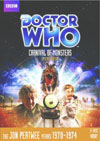 |
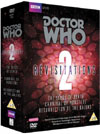 |
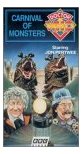 |
DVD NTSC
Region 1
Special Edition


|
DVD PAL
Region 2


|
VHS Video
NTSC

NTSC

PAL

|
|
(Doctor Who Story No. 66, starring Jon Pertwee)
- written by Robert Holmes
- produced and directed by Barry Letts
- music by Dudley Simpson
- 4 episodes @ 25 minutes each
|
Story: The Doctor lands the TARDIS way off
course, on an olde English ship traveling the Indian
Ocean. However, his curiosity is peaked by the
anachronisms, temporal anomalies, and monsters
he soon encounters, and he suspects a diabolical
crime is being perpetuated. He and Jo Grant embark on
an odyssey of strange locations leading to
an alien planet on which a vaudeville showman
is applying for a visa from some conspiratorial
alien officials....
|
|
Special Edition DVD Extras include:
- Original audio commentary by
actress Katy Manning (Jo Grant) and
director/producer Barry Letts.
- Additional audio commentary by actors
Jenny McCracken (Claire Daly),
Cheryl Hall (Shirna),
Peter Halliday (Pletrac),
script editor Terrance Dicks,
and sound effects designer Brian Hodgson.
- Making-of featurette (23 min.) with
Letts, Dicks, Manning, Hall, Halliday,
assistant floor manager Karilyn Collier, and
visual effects assistant Colin Mapson.
- Behind the scenes footage (2 min.)
- Expanded Visual Effects Test Film & Model Sequences (9 min.)
- "Mary Celeste" featurette on ships disappearing at sea (18 min.)
- Featurette on the novelization work later done
by Ian Marter (John Andrews / Harry Sullivan) (16 min.)
with Gary Russell, Tom Baker, Terrance Dicks, Lis Sladen, Nick Courtney,
and Nigel Plaskitt.
- Colour Separation Overlay (CSO) Effects Demo (3 min.)
- Pop-up Production Note Subtitles
- Photo Gallery music and sound effects montage (3 min.)
- Early edit of Episode 2 (30 min.)
with deleted/extended scenes and the "Delaware" title music.
- Alternate ending (1 min.)
- TARDIS-cam No. 2: Vortex Journey (1 min.)
- "The A-Z of Gadgets and Gizmos" featurette (11 min.)
Buyers' Guide Review
by Martin Izsak
|
|
(A more in-depth analysis, containing "SPOILERS" and intended
for those who have already seen the program, can be accessed
here.)
|
The greatness of the later Pertwee era begins here, with Robert
Holmes best Doctor Who script so far, where he combines his great
imagination with a now more refined writing style and a blossoming
talent for engaging, well-developed characters.
The story begins where the characters come together for the
first time and introduce themselves to each other, first on the
planet Inter Minor, and then on the S.S. Bernice, making them all
easy to get to know and understand. The TARDIS makes a technically
perfect landing this time, perhaps owing the use of the correct
materialization sound to the directives of the ninth recording block.
(This story was recorded along with season nine).
Curiously, Robert Holmes seems to have a great aversion to writing
scenes for the TARDIS interior. He hasn't written any so far in
his Doctor Who career, and opts not to do so here either. Thus
a true classic misses some key exposition for the uninitiated viewer.
I've heard some (female) Blake's 7 reviewers complain that
Robert Holmes does not write well for women, but I must say that
I haven't seen Jo Grant's character appear as clever and deductive
anywhere else as she does here - this could be her best story.
The style of story-telling we get here is unique for its time,
something that hasn't really played out since
"The Krotons" (story no. 47) and
"The War Games" (story no. 50), and won't
become a staple Who formula until the Tom Baker era. This is a true
sci-fi mystery, a chain of questions and answers carefully plotted
to lead the audience suspensefully towards a neat, new, scientifically
challenging idea. Episode one plays to the mystery and allows
the Doctor and Jo to build up the questions, while episode two gives
great audio/visual exposition of the answers, and presto - there's
your new sci-fi idea. From the cliffhanger into episode three,
Holmes ups the ante with bigger threats and lots of action, while
much of the emotional ramifications of the sci-fi idea settle in.
And episode four brings most of the concluding confrontations,
actions and effects that one would want to see.
Doctor Who has won its award for writing today.
Holmes' Achilles' heel is still there though, gently reminding one of
"The Space Pirates" writing fiasco from season six.
The Doctor doesn't get quite as involved with some of the characters as one
could hope, and he does get upstaged too much at the very end of
the story. The plot doesn't really give a full and logical
explanation of why this is so either, as some of the Doctor's
goals are unclear. You'll find a more detailed examination of this,
with spoilers, in the in-depth analysis
version of this review.
There's lots of CSO work in this story, most of which is excellent
and effective. The Drashigs in particular are a real achievement.
Only the TARDIS model & its lighting give the CSO game away at one
point, and rather obviously at that.
Holmes also falls back on a tried and true favourite theme of mine:
government corruption and conspiracy. This element is sadly not as
interactive as I would hope, but Holmes gets the dynamics of it spot on.
It still amazes me
how many people watch so many films that illustrate this, and still
fall for it when it happens in real life. Not to spoil it for those
who haven't seen it, I'll save further discussion of it for the
in-depth analysis version of this review.
The acting is of a high calibre by all participants, with
recurring stars like Michael Wisher, Peter Halliday, and Ian
Marter being particular favourites of mine. Director Barry Letts
is in fine form, turning out what is probably his best solo
directorial work on Doctor Who.
|
The musical score is definitely my favourite from season ten,
with bits for the old world sailing ship and Vorg and Shirna's circus
act antics being well within Dudley Simpson's preferred repertoire.
(Most of these can now be heard in pure form if you have the 11-disc version
of the 50th Anniversary Music CD Collection pictured at right, where this
track goes on to be the best new piece of music on all of disc 3 for Jon Pertwee's era.)
Simpson also sustains a unique musical sound for the story near the end
of episode three (sadly not on CD), which works very well in maintaining the suspense
and drive of the on-screen action.
|
A suite of music from
"Carnival of Monsters" Episode 1
lasting (3:35) was released on:
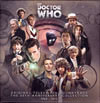 |
Audio CD -
Doctor Who:
The 50th Anniversary Collection
11-disc version (2014)
More info
|
|
|
|
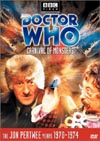
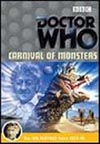
 in the U.S.
 in Canada
 for the U.K.