The Time Warrior
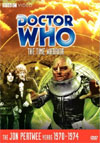 |
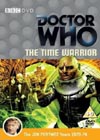 |
 |
DVD NTSC
Region 1


|
DVD PAL
Region 2


|
VHS Video
NTSC
A

NTSC
B

NTSC

PAL

|
|
(Doctor Who Story No. 70, starring Jon Pertwee)
- written by Robert Holmes
- produced by Barry Letts
- directed by Alan Bromly
- music by Dudley Simpson
- 4 episodes @ 25 minutes each
|
Story: Investigating the mysterious disappearances
of leading scientists, the Doctor teams up with reporter
Sarah Jane Smith and travels
back to medieval England to confront a stranded alien warrior
who has no qualms about making deals with unscrupulous local
barons or causing widespread destruction in his wake.
Sarah and the Sontarans make their Doctor Who
debuts.
|
|
DVD Extras include:
- Audio commentary by
Elisabeth Sladen (Sarah Jane Smith),
producer Barry Letts, and script editor
Terrance Dicks.
- "Beginning the End" making-of documentary (30 min.), adding
Donald Pelmear (Professor Rubeish),
Jeremy Bulloch (Hal the Archer), and
designer Keith Cheetham.
- Optional new CGI effects
- Hidden Easter Egg Trivia & Anecdotes (2 min.)
- Photo Gallery sound effects & title music montage (9 min.)
- Pop-up Production Note Subtitles
- Doctor Who 1974 Annual (DVD ROM PC/MAC)
In-Depth Analysis Review
by Martin Izsak
|
|
WARNING: This review contains "SPOILERS", and is intended for
those who have already seen the program. To avoid the spoilers,
read the Buyers Guide version instead.
|
Robert Holmes gives us another wonderfully written classic to
open Season Eleven. Displeasure at being asked to set a story in
the past didn't stop Holmes from writing something he and everyone
else could enjoy, for the BBC can do medieval stories and castle
settings very well and believably, and the addition of just one
hostile alien and his small spacecraft can shift the genre into
a wonderful culture-clashing sci-fi story. Characters like
Irongron, Bloodaxe, and Rubeish bring a lot of humour to the adventure,
while the Sontaran Linx, who remains "straight", benefits from the
contrast and appears even more threatening than he would have on
his own.
I have very few criticisms of this script, but they
appear to be habitual flaws for Holmes. The lack of TARDIS
interior scenes is inexcusable in my view, as we are introducing
Sarah to the show and bringing her on board for the first time,
not to mention possible new viewers at the start of the season.
Jon Pertwee has an excellent first-contact confrontation with
Linx in episode two, but is otherwise largely uninvolved with
the rest of the characters during that episode, reduced to eavesdropping
for most of the early portions. Many syndicated versions of
the story are bizarrely cut: One minute the Doctor's
trapped by an electrocuting headset, and the next he's running
around free - presumably Rubeish could have released him, but
where's the scene? Well, it's put back into its proper place on the
DVD version, and thankfully the Doctor is quite busy from
then onwards. Sarah is pretty touchy about women's rights, but
Holmes makes most scenes of Sarah's fighting for equality work
well enough as long as she brings the issue on herself by virtue of
it being her own pet peeve. The worst bit occurs when the Doctor
dredges up a silly comment about the fair sex - its motivation seems
to be only a means for Holmes to provoke Sarah, and doesn't seem
to be anything that the Doctor would otherwise normally say.
A wonderful Terry Walsh stunt flips the Doctor onto the floor
to play
Man of Sleep
during the final defeat of Linx, which is
instead handled by Hal the Archer. Again, disappointingly
reminiscent of the final heroics going to Vorg or the Master in
previous Holmes stories, not to mention all the non-involvement of
"The Space Pirates" (story no. 49).
Sure, Hal's actions may be too violent
for the Doctor, but then a non-violent solution to the problem
might be more respectable and enjoyable. Fooling the villain
into doing himself in if he can't resist his own violent tendencies
is always a good one. Oh well, better luck next time. The Doctor
still has plenty of good stuff to do throughout the rest of the
climactic episode.
Elisabeth Sladen makes her entrance in this story as journalist
Sarah Jane Smith, who has probably garnered more votes for best
Dr. Who companion of all time than anyone else. Sladen's acting
is top notch throughout her long Dr. Who career, always seeming
to emote the right response believably for Sarah. There are a few
moments where her eyes glaze over slightly and her lines or responses
come out a little slower than usual,
as though she's taking a few milliseconds to remember them, but these
are hardly noticeable and few and far between, and disappear after
her earliest stories when she becomes literally capable of living
her role.
Both Jon Pertwee and Nicholas Courtney make their roles fun
and enjoyable as usual as well. Kevin Lindsay makes a great Sontaran
too, defining for them the generally calm and calculated but
occasionally explosive ruthlessness that defines their race.
This version of Sontaran make-up may have been hell for the actor, but
it looks wonderful on screen, particularly previous to the TV era
of Michael Westmore of modern Star Trek fame.
I was disappointed to hear Jeremy Bulloch say, in a recent
DVD interview, that playing Boba Fett in Star Wars was the first
real science fiction that he'd done. Obviously he didn't remember,
or think very much of, the role he'd played in
"Doctor Who: The Space Museum" (story no. 15),
or his stint as Hal the Archer in this story. A pity,
since Bulloch makes a good swashbuckling character, and gets to show
his face in the story as well. Thankfully, Bulloch comes back for
this DVD's documentary, and more than makes amends.
For a director relatively obscure to the Doctor Who world,
Alan Bromly seems to do top notch work here. Again, only a few
complaints: Sarah's slipping past the Brigadier and the Doctor
to get into the TARDIS is not too believable. A bit more planning
with designing the sets and blocking out the actors and props might
have helped. Also, a visual TARDIS materialization would have
been more satisfying than just Hal's confused face and the sound
effect. But otherwise, Bromly gets good performances out of the
whole cast, and gets the cameras to where they need to be to
capture everything with clarity and the right mood and energy.
The scene of Linx knocking aside a surprise hand-to-hand attack from
Irongron is refreshingly believable and energetic, an achievement
considering the difficulties of working in the Sontaran costume and
make-up. To my knowledge, Bromly's only other Doctor Who credit is
the season seventeen adventure
"The Nightmare of Eden" (story no. 107).
Dudley Simpson clearly makes an attempt at some interesting
music for this story, notably a deep and bombastic sound for
the heavily built Sontaran alien, but doesn't introduce this
well, playing instead a lame high-pitched and tired fanfare when
the Sontaran first appears and claims the planet. Uggh!
It makes one pine profusely for Peter Howell's far superior
1984 Sontaran Anthem from
"The Two Doctors" (story no. 141).
Even after that, it seems that Simpson hides his best
bits under the dialogue, and plays less important, more random
music when he has the sound space more to himself. Go figure.
Thankfully, this is a case where the additional CGI effects on
the DVD make good improvements over the original, adding the
visual laser beams that were so badly missing from the original
story. Good job! The re-working of the climactic shot is not
as good, making essentially the same mistake as that at the end of
"The Ark in Space" (story no. 76).
There's something to be said about the force of the explosion,
and its ability to remove all trace of any anachronisms or
alien technology, when the old shot shows such instant and total
destruction of the castle. The modern version is a brief and
wimpy little fire blowing through the corridors by comparison,
leaving much for scavengers and archaeologists to sink their
teeth into.
In the end, "The Time Warrior" gets my nod of approval
as the best Sontaran story in Doctor Who. Since the Sontaran
race is new to the series here, Holmes is interested in them,
giving their representative Linx solid lengths of screen time
and an undisputed role as lead villain. The story has a great
balance of humour and seriousness, with next to no loss of life
despite the violent subjects it dives into. The Doctor's peaceful
restraint is, in fact, nicely highlighted in the script.
"The Time Warrior" is a fun romp, and Robert Holmes finally
gets one of his stories chosen as my season favourite.
Walt Disney's "Unidentified Flying Oddball" movie
(also known as "Spaceman in King Arthur's Court")
can eat its heart out.
International Titles:
Deutsch: (Der Zeitskrieger)
Magyar: "Az időharcos"
Français: (Le Guerrier du Temps)
Русский: "Воин времени"
This story is now available on DVD and VHS video.
Click on the Amazon symbol for the location nearest you
for pricing and availability:
|
|
|
|
DVD NTSC Region 1
for the North American market:
in the U.S.
in Canada
|
DVD PAL Region 2
for the U.K. |
VHS Video
NTSC
A
in the U.S.
NTSC
B
in the U.S.
NTSC
in Canada
PAL
for the U.K.
|
Comments on this article are welcome. You may contact
the author from this page:
Contact page
|