Special Edition DVD Extras include:
Options and ExperimentsFirstly, the experimental colour tinting on the first episode's titles are a lot of fun. I wish they'd tried a few more tints on various episodes in later seasons, just to give us some variety and make things less predictable.Then there are the opening shots in space, which the 2002 DVD gives us two versions of. I must say, firstly, that I always liked the original shots from 1975. They are much bolder, fresher, more exciting, and crisper than any other space model work done in Doctor Who up until that point. CSO was made for compositing space objects on starry backgrounds, as far as I'm concerned. It's the way it should be done. The composition of the first shot is satisfyingly bold, carefully guiding separate cameras by hand where computers would automatically sync things up today, all to combine three elements and get them artistically just right to tell the story. Top marks for visual literacy. That said, the 2002 CGI shots are lovely too. More attention is paid to making the little details seem real for the space station and its shuttlecraft, in terms of how it orbits the earth, when it should have its lights on and when not, etc. The visual literacy of the shots is a bit different, showing more of the earth than before, and not focusing on the station quite as selectively anymore. Here in the opening, things still work. What disappoints me is that, while they took the time to fix what ain't broke, they did nothing for the shot that had severe problems. "Robot" (the preceding story) has done little so far to acquaint new audiences with the TARDIS or the space-time travel capabilities that our main characters of this show have at their disposal, and "The Ark in Space" now does even less, doing the materialization of the TARDIS so badly on the cheap that fresh audiences may well still be confused. The lack of a nice visual trick cross-dissolve is extremely irksome - visually illiterate as I like to put it. The subsequent dialogue aims for a kind of attitude humour, but still doesn't inform us as to what exactly has amazed Harry so much.
The audience is denied being able to share in Harry's first experience traveling in the TARDIS.The lack of a scene in the interior between this story and the last is unforgivable, and bizarre. You'd think they'd want to make use of stock sets on what was intended to be the studio-bound "cheapie" story of the season. An interesting side-note to this is that, as of this point in 1975, Robert Holmes had not yet written a single scene for the TARDIS interior in his entire Doctor Who career. Hmmm..... He seems to have TARDISophobia or something.The three regular characters proceed to carry the first episode all on their own, and do a remarkably fine job of it. In many ways, it is reminiscent of "The Edge of Destruction" (story no. 3), a pause in the heavily populated adventures to give the regulars time to define their characters and relationships with each other, and this time there really is an intruding presence creeping about with them in the confined space they get to explore. The new Doctor and Harry get the best of this, and as a whole the episode and story work far better than was managed back in "Edge of Destruction". The sets by Roger Murray-Leach are really wonderful, helping to set the story apart from the usual outer space boxes seen previously on the program. It's doubly nice that the sets got re-used again in the final story of the season.
What's your genre?It's interesting to hear Philip Hinchcliffe's commentary on how he aimed to take the show more solidly into the realm of sci-fi, because his definition of certain genres is different from mine, as everyone's definitions are always at least slightly different. For me, the Barry Letts / Terrance Dicks / Jon Pertwee years were well-rounded, solid sci-fi years in terms of genre, often with social/moral conscience aspects integral to the plot and basic premise. The Hinchcliffe years tip the sci-fi scale in favour of horror in my view. Not slash-fest terror, mind you, because I never was frightened, and never knew anyone who "hid behind the couch", but horror, because disturbing things happen to people, and it shouldn't, and it makes you think afterwards how awful it would be to experience it, and what you might do if you were in the position of this character or that one. The moral compass in the Hinchcliffe years is much more reactionary - it rests more in the characters' responses to the sci-fi/horror concepts they encounter, rather than in the inception of the concepts themselves.Further on, the Graham Williams years (seasons 15-17) would tip the sci-fi scale in the other direction, more towards humour and fantasy, where one can escape to a fun place with colourful light-hearted effects, and fill the moral commentary on society with irony and satire. To be quite frank, more my own personal cup of tea. And lastly, the John Nathan-Turner years (seasons 18-26) seem to return to the centre of balance in my idea of sci-fi, where an additional push was made to give it all a big blockbuster, sequels-to-outdo-originals type of feel, a push that eventually overshadowed the sci-fi elements altogether but still gave us lots of great fun stuff. "The Ark in Space" really is a bold statement of the way Hinchcliffe and Holmes wanted to do things, and the change in atmosphere really is quite palpable. It's a riveting bottle-story, well-paced, and superbly delivered by the actors. Tom Baker finds himself in his new role, and Ian Marter finally gets lots of screen time to demonstrate how exceptionally good he is in his role. Elisabeth Sladen has less to do as Sarah, but still does it all extremely well. Richardson Morgan is great as Rogin, the one futuristic "awakened-human" character who seems to still have wit and emotional depth. Morgan was also very entertaining as Corporal Blake in the 1967 Pat Troughton story "The Web of Fear" (story no. 41). Wendy Williams plays Vira with a certain futuristic distance in her mannerisms, aiding that early sense of uncertainty as to whether the chief threat against the Doctor's party will come from the awakened humans themselves, caught in the grip of the automation and purification of their culture, or some other unknown..... As Noah, Kenton Moore has to continue to pull off that dichotomy all the way through, and he does a remarkable job of it. They say Tom Baker was unpredictable in humorous ways, which was probably true, but so were Noah and Vira in dramatic ways as characters, which fuels so much of this story's power. Many of the effects are limited, but director Rodney Bennett seems extremely expert in knowing what to do with what he gets. The "line-of-fire" visible beams that I always want to see aren't there, but particularly with the battles involving the "heavier artillery" of the fission guns, the fast-editing, close-ups, powerful sound effects, and visuals of sparks around the targets and interesting working props all combine to deliver a wonderful and absolutely essential energy to the drama. I love those sequences. They work, and with a different variety of cinematic ingredients than the usual sci-fi palette. It's so much better than much of what Doctor Who had been offering us previously in terms of fire-fights. It keeps the drama moving as it should, which Bennett has done a remarkable job on as a whole.
The Fine Details of the ConclusionFinally we come to the conclusion. Here again, the bits of the drama that don't come across so well aren't touched by the 2002 CGI crew. The idea that all the Wirrn have squeezed into the shuttle in such a short amount of time REALLY doesn't come across well at all. Firstly, before the 2002 DVD, I would always come back to the end of this story every once in a while, unable to remember how the good guys resolved their conflict with the Wirrn. Although that's actually a good thing, it happens for a bad reason: in large part because what we see on screen practically works at odds with what is supposed to be happening according to the dialogue. First we see Harry, Vira, and Rogin making sure that none of the Wirrn get on board the shuttle. We then see the trio coming out of the shuttle into the landing bay beneath it, not passing any Wirrn on the way. Then the Doctor and Rogin immediately, in the same scene, without a break, work to set the shuttle free. From the visuals, we obviously can't believe that all the Wirrn have scuttled past them up into the shuttle, and the existence of another way in is practically lost in an unemphasized line or two of dialogue. Adding new footage using CGI? This is the piece of the visual literacy puzzle that needs the fixin'. Showing the Wirrn getting onto and/or into the shuttle from above would have been a great purpose for new CGI footage.Once more, Holmes allows the Doctor to be upstaged for the final climactic heroic act, in this case making it necessary for his survival. It's the Doctor's plan, but Rogin knocks him out and does it himself, and it is Noah who ensures that the plan is a permanent solution and not just a temporary one. Not all I might have hoped for, but Tom's Doctor has been quite a bit busier than his predecessor recently in solving problems and doing heroic deeds all through the story, so it doesn't reflect badly on him. Also, it maintains that sense of horrific wonder, as each member of the audience can ask themselves what character strengths they might have shown in Noah's shoes, or in Rogin's. Quite nicely, the Doctor can perhaps take some credit for convincing Noah to act on behalf of humanity. In the end, the Wirrn's demise is handled visually by a single shot of the shuttle exploding. Again, two versions. Although I like the marvellous detail of the new CGI shot, and can marvel at the ingenuity and beauty of it on its own, I think, all nostalgia for the ground-breaking of the original shots aside, this is one example where the old original shot served the story better. It's all to do with timing and size. Sure, you can't even see the shuttle in the old shot - they probably didn't even have an element of it in the composite, but that means that the shuttle must have been extremely far away and therefore small compared to the size of the explosion. Also, during the second half of the shot, the explosion is over, and we see a lot of empty silent space. This all aids the idea that the Wirrn were completely wiped out, and that life is now back to peace and tranquility again. The CGI shot takes exactly the same short amount of time to go only half way with the ideas. We now see the shuttle clearly in all its glory, and we see a much smaller explosion by comparison, which rather embarrassingly leaves great pieces of the shuttle still floating around intact. After seeing how resilient the Wirrn were all through the story, it's now too easy for me to think that many of them probably survived the explosion, and are at liberty to fly back to the Ark when they please. And I also now wonder how much bang one should expect just from forgetting to "set the stabilizer"? Unless of course the shuttle was flying on automatic into Earth's atmosphere, which doesn't come across on either version of the final shot. It seems more like it's escaping Earth's orbit altogether.
The Rise of the TransmatHere comes another big plus for the story: Trans-mat finally comes of age. They may have screwed up with the TARDIS effects, but for the first time in the history of the show, Doctor Who's version of Star Trek's "beam-me-up" transporter is done to satisfaction with a proper trick-dissolve. Trans-mat features quite a bit in this story, and is nicely integral to the link to the next stories. I am disappointed, however, that Trans-mat took over from the TARDIS as the main vehicle moving our main characters from one story's setting to the next; I think an interesting move like that would be more appropriate for a new Doctor's second season than his first, again in the interests of "piloting" the show to new audiences and doing the TARDIS right first until it is a better established familiarity.Ian Marter, God bless him, made a wonderful and critically more logical improvement on it in his novelization of this story and the next. If the transmat is not working so well, why use it to get to the problem on the other end, when the TARDIS is sitting right there begging to be the hero? Marter's version uses it, and concocts a technical reason for it abandoning the trio on Earth to return to the Ark. This heightens the sense of them being trapped on Earth, because it would show that they're not willing to trust the transmat until after the Doctor has finished fixing it, and it also provides a reason for the TARDIS to be in motion to return to the Ark in the appropriate time period for "Revenge of the Cybermen" (story no. 79), rather than having us believe that after it was just sitting there after "The Ark in Space" it spontaneously decided to get up and shift back through time. So.... three cheers for Ian Marter, and too bad he wasn't quick enough with that one to get it into the filming and taping of the season.
International Titles:Deutsch: "Die Arche im Weltraum"Magyar: "A bárka az űrben"Français: "L'Arche dans l'espace"Русский: "Ковчег в космосе"Italiano: "Arca spaziale"
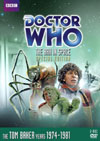
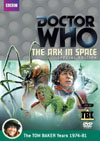
This story has become available on DVD and VHS video. Click on the Amazon symbol for the location nearest you for pricing and availability:
| ||||||||||||||||||||||||||||||||||||||||||||||||||||||||||


 in the U.S.
 in Canada
 for the U.K.