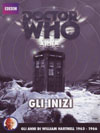
DVD Extras include:
Episode One - The Edge of Destruction - directed by Richard MartinThis story gets off to a very shaky start. The final shot is reprised from the end of "The Daleks" (the previous story), and continues through to follow up on the cliffhanger ending for that last story. Next, the first crewmembers to regain consciousness are unfortunately Barbara and Susan. David Whitaker's writing of incoherent characters here does not make good television viewing. Susan begins to flop around making tired, exasperating, desperate sounds, for reasons not very apparent to us. In her upcoming dialogue with Barbara, neither of them pays attention to what the other has said, and it is very tedious to try to follow their train of thought because it takes them a LONG time to finish a coherent sentence.Ian is next to wake up, and he doesn't improve the situation much, coughing up much of the same daftness as his two predecessors. Usually, when Ian is given something intelligent to say or do, "William" Russell turns in a great and riveting performance. Here he is often meant to simply stand in one spot and react emotionally, and unfortunately poor Russell sometimes turns into a bland stick of wood in these situations. There are plenty of such moments in this story, except here the wood is also limp and unable to stand properly in the first place. How director Richard Martin allowed this silliness to go before his cameras is a testimony to his not yet having acquired the ability to really command quality television at this point in his career, and it takes a real leap of faith on the audience's part to stay tuned in to see if something worthwhile will come out of this story. Finally, the Doctor wakes up, and William Hartnell's screen presence quickly restores drama to the proceedings. Now there is plot, intrigue, and realistic emotional expression. Susan makes a comeback with some very memorable moments in her performance, suddenly appearing in Ian's vision to menace him with scissors (finally some nice direction with moving camera angles here!!) although this quickly decays into hamminess as she stabs the couch with more floppy desperation, relying on the perfect music to carry the scene further. Also, Barbara's suggestion that something from outside has entered the TARDIS (either a mutant creature from Skaro, or an interdimensional whatever from the whiteness of the time vortex; take your pick), followed by Susan's suggestion that such a thing might hide "in one of us", acted with perfect creepiness as though the thing is inside her - this is one of the story's best and most memorable moments. Barbara also has the chance to give the Doctor the sharp end of her tongue, a great dramatic moment that is enjoyable to watch. However, it seems completely unrealistic to me, (the way it was shot anyway) that she could storm away from that confrontation in a fury of anger and even notice the distorted clock-face, let alone scream with such silliness and collapse into the sobbing blob of jelly that David Whitaker seems to think is the natural state of the female psyche. It seems more reasonable to me that Barbara was ready to take on Daleks with her bare hands at that particular moment. Cinematically, it is really poorly done also, because it is not only unclear why she is reacting that way, but also what exactly she is reacting to. I often find it very hard to see that something is wrong with the clock, and of course, Mr. Whitaker has put Barbara in a state where she is unable to articulate herself and explain what's unnerved her so. This story is famous for being the first to really explore the interior of the TARDIS, but it is interesting to note that ALL of the deep interior scenes beyond the console room appear in this first episode of the story, particularly the rooms with the strange bucket-seat beds.
Episode Two - The Brink of Disaster - directed by Frank CoxSomeone once asked what the longest scene in Doctor Who was, and the erroneous reply was the first scene in the TARDIS interior in "An Unearthly Child" (story no. 1). Well, sorry, no, I disagree. After the reprise from the previous episode, what follows is most DEFINITELY the longest scene ever in Doctor Who. Recording for "THE BRINK OF DISASTER" begins in the console room and stays there for a full 18 and a half minutes, right past the dramatic climax of the story. This is almost the full 25-minute episode, so I dare any fan to show me a longer uncut scene of original Doctor Who! (Yes, I know, "Midnight" (story no. 201) has recently set a new record in the 45-minute episode format, but that episode still has much to learn from the achievement here.)I have to hand it to director Frank Cox, and the cast of Doctor Who (William Hartnell in particular) for being able to pull this off without it seeming to become long, or boring, or claustrophobic, or anything other than good riveting drama all the way through. There are only a few minor glitches in the production - an unscheduled revealing of Ian's underwear as he lies on the floor is not particularly inspiring, and his habit of trying to grab at people's throats every time he gets in a panic to warn them of his fears doesn't make a lot of credible sense. This two-part story was supposedly meant to re-introduce viewers who may have missed the pilot to the main characters and the TARDIS and to expand and develop them, and dig deeper into who they are. It was poised to do so perfectly, and managed it somewhat - The TARDIS (a fifth character) comes out of this story with the best development, and the Doctor and Barbara are close seconds. But all this ridiculous concussed behaviour business really should have been under much tighter control, because it is ugly to watch, and only shows us who our characters are NOT. One concussed character, or two at the most, should have been sufficient, so that the others can remain sane and discuss the problems and concerns over the concussed ones, without trying to let the concussed ones carry the story on their own - this would have worked better. The only part of the concussed behaviour plot that worked was the possibility of Susan being possessed. The Doctor is largely responsible for solving the mystery and employing the solution, although Ian helps with encouraging questions (as a sidekick should), and the Doctor hands much of the credit to Barbara later, who fought tooth and nail to keep the Doctor from lapsing into recriminations and losing his head down the wrong path. Still, this is the best example of a heroic Doctor that the series has come up with so far. Nice one David Whitaker! The story finishes with the Doctor and Barbara healing their emotional differences just outside the console room. It is a very believably acted and moving scene, as the interaction of these two has been particularly exceptional throughout the story. Okay, so episode two does feature something from the `deeper' portions of the TARDIS, but not much. It is also interesting to note that the Fault Locator Room appears to be a completely separate room in the first episode, in the way in which it was shot, but it appears in this episode to be part of the console room separated by a glass divider. Finally, we get a welcome bit of a teaser for "Marco Polo" (the next story) as the travellers prepare to explore the frozen snows outside - a fun scene that proves that all is well again for the TARDIS and her crew.
International Titles:
Oddly, the titles for the first and second episodes find completely different ways to express essentially the same idea. The knock on effect is that a foreign translation for one title could equally apply to the other. In the end, the Italians chose a title for the complete story that was not merely a copy of the first episode's title, but a brand new mixture of their titles for episodes one and two.
Original English: "The Edge of Destruction""The Edge of Destruction" has become available on DVD as the third adventure in "The Beginning" DVD box set.Although the popular original edition from 2006 has now become a rare item, a newer 2013 re-issue offers identical content at a more competitive price... Click on the amazon symbol for your area to open amazon's page in a new window and see additional product information before purchasing.
Comments on this article are welcome. You may contact the author from this page:
|
|||||||||||||||||||||||||||||||||||||||||||||||||||||||||||||||||


 2013
2013
 2013
2013