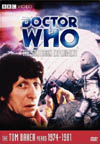
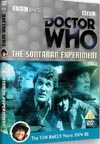
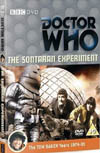
The Sontaran Experiment
 |
 |
 |
DVD NTSC
Region 1


|
DVD PAL
Region 2


|
VHS Video
NTSC

PAL

|
|
(Doctor Who Story No. 77, starring Tom Baker)
- written by Bob Baker & Dave Martin
- directed by Rodney Bennett
- produced by Philip Hinchcliffe
- music by Dudley Simpson
- 2 episodes @ 25 minutes each
|
Story: Beaming down from the Ark in Space
to the abandoned planet below, the Doctor, Sarah,
and Harry make further discoveries about the history
of its population and the sinister experiments
still taking place on the surface....
|
|
DVD Extras include:
- Audio commentary by
Elisabeth Sladen (Sarah Jane Smith),
co-writer Bob Baker,
and producer Philip Hinchcliffe.
- "Built for War" featurette
on the history of the Sontarans (40 min.),
with Sladen, Bob Baker,
actor/stuntman Stuart Fell (Sontaran),
script editors Terrance Dicks, Anthony Read, and Eric Saward,
and actors Colin Baker (the 6th Doctor),
and Nicola Bryant (Peri).
This covers the making of
"The Sontaran Experiment",
"The Two Doctors" (story no. 141),
and many other Sontaran related tales.
- Pop-up Production Note Subtitles
- Photo Gallery sound effects montage (5 min.)
In-Depth Analysis Review
by Martin Izsak
|
|
WARNING: This review contains "SPOILERS", and is intended for
those who have
already seen the program. To avoid the spoilers,
read the Buyers' Guide version instead.
|
This is a bit of an oddball story, the only one as short as two parts between
1964's "The Rescue" (story no. 11) and
1981's "Black Orchid" (story no. 121).
It's also one of the few to not feature the TARDIS in any form at all,
beyond the title graphics of course. Add to that the fact that it
all takes place on outdoor locations, without any real studio work
or even any indoor locations either. How does
the oddball measure up? Quite well actually. It doesn't attempt
to offer as much as
"Robot" (story no. 75) or
"Revenge of the Cybermen" (story no. 79),
so it is essentially playing it safe in many respects, but what it does do,
it does well.
Even without the TARDIS, the regulars make a visually satisfactory
entrance via transmat beam, a device that gets its fair share of
introduction, explanation, and demonstration throughout the first episode.
The story is also quite expert at creating a creepy, lonely atmosphere
full of fear of the unknown, and draws this tension out as long as
possible, until all the Gal-Sec humans, the alien robot, and the Sontaran
Styre himself are finally revealed.
This story complements
"The Ark in Space" (the previous story)
really well, as it recaps
the background of that story's setting and proceeds to extend
that story and flesh out more of the details of its interplanetary
social setting. The contrasting visuals between the two stories also
support each other - as characters in one setting can talk about
the other setting with the audience having a clear picture of it in
their minds.
Episode one is more geared towards suspense than action, and what
limited action it does get works well. Even without a visible beam effect
for the Gal-Sec weapons, director Rodney Bennett and the cast and crew do
such a good job during the one and only stun shot that one really can't
complain there. However, firearm effects are a disappointment through the
rest of the story, letting down many of the action sequences in which they
heavily feature in the second episode. The visual literacy is clear
enough throughout, but the lack of good beam effects and powerful
sound effects render such sequences dull.
Stuntman Terry Walsh has plenty to do in this one, playing the
short-lived Gal-Sec astronaut Zake in the first episode, and doubling
for the injured Tom Baker throughout the lengthy physical battle of
the climax. Kevin Lindsay returns to play the other members of the
cloned Sontaran species that feature in this story, although the new
easier-to-breathe-in mask makes it difficult to believe that Sarah
would mistake him for Linx before he begins to speak or display
his gestures. All the cast put in good performances, and the
series' regulars are exemplary as usual.
|
Dudley Simpson also continues to make the music for this short
story excellent and interesting. The music is very, very minimal
as the story begins, emphasizing how devoid of civilization
the setting really is, using only the shortest of stings where
absolutely necessary. Gradually, as the characters become more
populous, the music develops around them and intertwines with some
very distinctive sound effects for the robot's scanning habits
and other Sontaran technologies. The best parts are in the re-use
of the fourth Doctor's embryonic theme after his victory, and the
variations on it as he first sets out to deal with Styre and his robot.
|
Music by Dudley Simpson
Re-recordings based on several cues from this story
feature in the final track, "The Doctor's Theme", on:
|
|
The conclusion gives everyone something important to do, all
the while setting Styre up to do himself in. The finish has the
right energy, but Styre's collapse and the explosion of his spherical
ship lack a certain finesse. The story feels like it could have gotten
better had it gone on a little longer, using some spacecraft interior
sets in the studios and escalating into a deeper exploration of and
confrontation with the planned Sontaran invasion. But it is what it is,
as is, just an intriguing little coda to "The Ark in Space", another
quick notch on Tom Baker's rapidly growing belt of achievements.
In the end, "The Sontaran Experiment" is a modest little side-order
amidst Doctor Who's usual main course offerings, fairly high
in quality and style, but not altogether very profound in
its story content.
International Titles:
Deutsch: "Das sontaranische Experiment"
Magyar: "A szontár kísérlet"
Français: (L'experiment sontarien)
ou (L'Expérience sontarienne)
Русский: "Эксперимент сонтаранца"
Italiano: "Esperimento Sontaran"
Español:
|
(Spain): "El Experimento Sontaran"
(Mexico): "El Experimento del Sontaran"
|
This story has become available on DVD and VHS video.
Click on the Amazon symbol for the location nearest you
for pricing and availability:
|
 |
|
DVD NTSC Region 1
for the North American market:
in the U.S.
in Canada
|
DVD PAL Region 2
for the U.K.
|
VHS Video
NTSC
for North America
PAL
for the U.K.
|
Comments on this article are welcome. You may contact
the author from this page:
Contact page
|