The Web of Fear
This story is not known to exist in its original format
(6 black-and-white 25-minute TV episodes)
in its entirety.
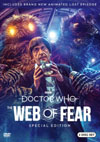 |
|
 |
DVD NTSC
Region 1


NEW for
Feb. 1, 2022!
|
DVD PAL
Region 2

NEW for
Aug. 16, 2021!
|
CD Audio - 3 discs

|
|
(Doctor Who Story No. 41, starring Patrick Troughton)
- written by Mervyn Haisman and Henry Lincoln
- directed by Douglas Camfield
- produced by Peter Bryant
- featuring library music tracks
- 6 episodes @ 25 minutes each
|
Story: Growing wisps of web in space
ensnare the TARDIS, forcing the Doctor,
Jamie, and Victoria into a nightmare in
the London Underground subway train system.
The army is working with Professor Travers
and his daughter Anne to combat the spread of
the Web over the city, suspecting that the
Yeti are once more involved. As their every
move to keep the tunnels clear is thwarted,
they know there is a traitor in their midst.
Can it be Colonel Alistair Lethbridge-Stewart,
arriving late to take charge?
|
|
DVD Features include:
- Five digitally remastered complete original episodes (#1, 2, 4, 5, 6)
- A new animated recreation of the missing episode (#3),
synchronized to the original television sound. (colour and BW options)
- The "telesnap" recreation of episode 3 using the original TV audio
over a montage of still images.
- Plus extra features:
- Audio commentaries on all episodes including
Tina Packer (Ann Travers),
moderated by Toby Hadoke.
- Audio commentary for episode 1 with
Deborah Watling (Victoria),
script editor Derrick Sherwin,
and moderator Gary Russell.
- Making-of featurette for the original story.
- Featurette on the making of the new animated episode.
- "The Missing Years" documentary
- Photo Gallery
- Trailer
In-Depth Analysis Review
by Martin Izsak
|
|
WARNING: This review contains "SPOILERS", and is intended for
those who have
already seen the program. To avoid the spoilers,
read the Buyers' Guide version instead.
|
Director Douglas Camfield returns to Doctor Who for the first time since
"The Dalek Masterplan" (story no. 21)
to oversee one of the most mythologically
important stories of the series. The results are excellent.
It isn't too surprising then, that so many clips from episode one
(the only episode known to exist for many years)
pop up so frequently in nostalgic documentaries
and featurettes about this era of Doctor Who.
Background music has a tendency to upstage dialogue in some of
Camfield's productions, and the first episode of "The Web of Fear"
dances on the threshold of good taste in music volume.
Back when the
only way to view the episode was to get a copy from
another fan, who got his copy from another fan, who got her copy
from another fan..... etc., the fragile sound suffered many generation
drops, and the problems were unfortunately magnified.
|
The story soundtrack on CD audio, however, is a vast improvement
and does not appear to have any real problems. Dialogue is crisp
and easy to understand, and of course Frazer Hines is on hand as
narrator to explain all the action. He gets into it emotionally, almost
like a sportscaster, and his enthusiasm becomes contagious. This is
great stuff. How much of the increase in sound quality is due to
Mark Ayres superb re-mastering techniques? This great audio
now graces the episode's release on VHS video and DVD.
Give thanks and enjoy.
|
|
The TARDIS sees more action in the first half-hour than
anywhere else in the Troughton era, bar episode one of
"The Mind Robber" (story no. 45)
and episode ten of
"The War Games" (story no. 50),
possibly another reason why it remains so attractive
to producers searching the archives for good flashback material. It
has perhaps a confusing start in having to clean up the loose ends of
"The Enemy of the World" (the previous story),
but before the first scene is finished, the
Doctor and his friends have whetted the audience's appetite for
exploring a new wondrous location in hopes of discovering a great
adventure. All the right stuff! The turbulent opening also serves to
build anticipation of similar rough flights in later TARDIS scenes,
and so earns its keep in the suspense department. Sound re-mastering
removes much of the initial confusion, as dialogue materializes where
only noise and shouting were audible before, and a single quick sentence
of narration from Frazer on the CD version puts it all in perspective right away.
Travers' scene in the museum is a nice little piece, setting up
a wonderful atmosphere for the story and linking it to its prequel,
"The Abominable Snowmen" (story no. 38).
The return of the Yeti is rapid indeed, not wasting any time waiting
for the end of the first episode like so many of the Dalek stories.
Jack Watling's reinterpretation of the older Professor Travers is
a joy to behold, cantankerous and absent-minded and spot-on with
comic timing. The music for this scene starts and ends superbly,
providing the atmosphere of a classic old horror flick, but the middle
of the piece, looped no less than three times in a row, gets a bit
silly as its high pitched lead note climbs higher and higher, fighting
the dialogue and nearly destroying the atmosphere. Mark Ayres'
remastering manages to put the music back in its place, where it can
enhance without bludgeoning. As good as this music works on its
own in this story, perhaps it is significant to note that it was
also used almost exclusively in the three previous episodes of
Doctor Who: "The Enemy of the World" episodes 4, 5, and 6.
Perhaps it is getting a bit too repetitious?
The absence of a proper audio/visual materialization for the
police box is forgivable, as we get to see it in no less than two
interesting locations, and the TARDIS has an entire story beat pitted
directly against the Web, giving our three travellers something
interesting to do in the interior for a change, where their dialogue
makes the concept of the TARDIS plain for new and casual viewers.
The Yeti and the Great Intelligence have many new tricks up their
sleeves for this story, allowing the investigations of the Doctor
and his friends to remain fresh, furthering their knowledge, and
focusing on exploration even more so than in their previous Tibetan
story. The base-defense formula is back, coupled with the dynamics
of a "bottle-story", all of which work well thanks to a good script,
great actors playing likeable recurring characters, and a master
director.
Unfortunately, the telecine insert of the Doctor's first meeting
with Nicholas Courtney's Lethbridge-Stewart is merely a figment of
Terrance Dicks' novelization. While in some ways this off-screen
entrance for the series' most important recurring supporting character
is most disappointing, it opens the door of another interesting set of
possibilities. Is it really the first meeting of the Doctor and the
soon-to-be Brigadier? Perhaps it is so only from Lethbridge-Stewart's
point of view. After all, the time-traveling first Doctor has
already met him across the scanner screen in
"The Three Doctors" (story no. 65),
not to mention face-to-face in
"The Five Doctors" (story no. 130).
What indeed is
the first meeting from the Doctor's point of view? Perhaps they
recognized each other already when they did meet here in this
story..... Then again perhaps not. Haisman and Lincoln have set
up Colonel Lethbridge-Stewart to be, through coincidence, a major
suspect, something that does not easily come to the mind of today's
average fan, or as easily to the Doctor after he gets to know old
Alistair. The Doctor really doesn't seem to know him, or at least
trust that he isn't under the control of the Great Intelligence, in this
adventure. Haisman and Lincoln do such a superb job of spreading
suspicion onto practically every character that it doesn't make much
difference - the "Who done it? Could it be....?" question will still
bite and confound cast and audience alike until the end.
Episode two is perhaps the weakest of the six episodes, what
with neither the Doctor nor Lethbridge-Stewart on hand, but Jamie
and Victoria get to reunite with Travers, and the different
viewpoints of soldiering held by likeable old Staff Sergeant Arnold
(an exquisitely unique character in terms of UNIT stories, expertly
played by Jack Woolgar) and the newly introduced Private/Driver Evans
keep the story interesting, as does the team's discovery that the Web
and the Yeti can render their explosives useless. The episode also
features a very effective, gripping battle-sequence that skyrockets
the sense of menace surrounding the Yeti, and the choice of music here
("Spine Chillers" by composer Edwin Braden)
perfectly amplifies horror, hopelessness, and tension all at once.
Corporal Blake and Craftsman Weams have one of the funniest soldiering
scenes in all of Doctor Who, as they shoot the breeze and speculate
on where the Yeti menace came from. The weakest episode is still
quite strong.
"Doctor, you'd better stay here and get on with your tinkering."
The atmosphere that we've all come to enjoy in the UNIT stories
is most definitely present in episode three. Lethbridge-Stewart takes
a scene or two to grow from latest new suspect into taking over the role
of lead local good-guy from Captain Knight / Professor Travers, and in
comparison to them, and Leader Clent, Giles Kent, Professor Parry,
Khrisong, Robson, and Jarvis Bennett, how can he not be the favourite
to fill this archetypal role in all of season five's offerings?
Episode Four delivers a lot of plot-impacting action, and with
Douglas Camfield in the director's chair, the film sequences turn out
to be exceptionally good considering the BBC's budget. Smartly, Camfield
seems to have arranged that most action sequences throughout the story
will be shot on film, where single camera blocking and precise editing
turn out the best results. There are still a few action sequences taped
in real time in the TV studio which are of a lesser calibre, but these
still work well enough in context. And then there's the audio component -
The sheer energy in the sound track speaks volumes to the impact of
episode four's action. The hopeless horror
music returns at the right moment, but also of note is the fact that
the Yeti have stolen the Cybermen's main theme music from their three
previous stories: Martin Slavin's Space Adventures, Part Two. Creature
identification aside, it works perfectly in this new context.
Mystery mounts in the final two episodes, as it becomes clear that
there must be a traitor in the midst, whose identity is not revealed
until the final moments of the last episode. The Doctor manages to
devise not one but several methods of getting back at the Yeti, the Web,
and the Great Intelligence throughout the final episodes, but his
increasing deviousness is too much for his friends to follow, and he is
unable to get as permanent a victory as he might have wanted. The
audience and the other characters need not be disappointed, as a very
satisfying set of revelations, character resolutions and display of
pyrotechnics brings "The Web of Fear" to a dramatically satisfying
conclusion. Despite the obvious door left open for it, a further
Yeti/Intelligence sequel never developed on Doctor Who, at least
not during the classic era produced in the 1960's, 70's and 80's.....
Sad in some respects, but the immediate future lay in another direction,
with fresh worlds and ideas to explore.
2014 DVD
|
|
We Doctor Who fans have become fairly well spoiled in terms of the lavish
bonus features that accompany most DVD releases of this show, when so many other
shows feature plain episodes and nothing else. Well, the newly discovered
episodes of "The Web of Fear" came to us in a fairly plain form in 2014.
They had been given a good restoration and clean-up, and a simple but effective
"telesnap"-style recreation of episode three allowed us to watch the entire story.
That was about it for the 2014 release.
|
|
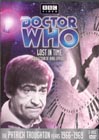
There was already a bit more "out there" however. Episode One had been released previously
with an audio commentary by actress Deborah Watling (Victoria), producer Derrick Sherwin,
and moderator Gary Russell. That originally came out on the 2004
"Lost in Time" box set. See below for details.
|
| 
|
|
Personally, I'm not going to be too hard on anyone for the plainness of the 2014 release,
but rather grateful that other releases have given us so much. I think we have to recognize
that most of the special features were put together from interviews planned far in advance....
For example, it is clear that Edward Burnham was interviewed once in an outdoor garden
and the footage used in the making-of documentaries for both
"The Invasion" (story no. 46) and
"Robot" (story no. 75),
and whoever interviewed him knew it was best to get his take on both of those
stories that he had participated in. But the bonus feature team probably hadn't planned
to ask participants all that much about lost episodes, and I'm guessing the interview
footage cupboard is pretty bare by now, everything used up elsewhere. Plus, I half-suspect
that many of the unofficial "Restoration Team" members are feeling a bit burnt out and keen
to move on to other things.
|
|
|
While I did suspect that a Special Edition of this story with many more special features
would indeed come out at some point, I didn't think it would be soon. And besides,
"The Web of Fear" is such a classic, I didn't mind so much if I ended up double-dipping
on this story. Well, some seven-to-eight years later, the Special Edition has now
appeared on the market, though still not with the REAL episode three, and possibly with some
less satisfying ways of assembling new audio commentaries.
|
"The Web of Fear" is a true classic, and
one of the very best of the Troughton Era, though I think
"The Tomb of the Cybermen" (story no. 37)
is still better. Though a case could be fairly easily made to give
this story absolute top rank among all of Troughton's Doctor Who
work, it does still embrace the horror genre a bit too much for my personal
tastes, and I think third place still feels about right for it.
At any rate, the seed of the UNIT formula was firmly planted
here by Haisman, Lincoln, Camfield and Co., to sprout and bloom later
on, a more interesting legacy than the Yeti themselves.....
International Titles:
Deutsch: "Das Netz der Angst"
Magyar: "A félelem hálója"
Français: (Le Réseau de la peur)
Русский: "Паутина страха"
"The Web of Fear" is not known to exist in its original format
(6 black-and-white 25-minute TV episodes) in its entirety.
The five existing episodes from this story
are now available with an animated episode & bonus features on this DVD Special Edition:
|
|
|
DVD NTSC Region 1 U.S.
NEW for
Feb. 1, 2022!
|
DVD NTSC Region 1 Canada
NEW for
Feb. 1, 2022!
|
DVD PAL Region 2 U.K.
NEW for
Aug. 16, 2021!
|
DVD Special Edition coverage on The Web of Fear now includes:
- Five digitally remastered complete original episodes (#1, 2, 4, 5, 6)
- A new animated recreation of the missing episode (#3),
synchronized to the original television sound.
- The "telesnap" recreation of episode 3 using the original TV audio
over a montage of still images.
- Plus extra features, see top of page for full list.
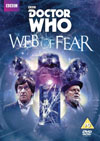
When four more of the episodes were first rediscovered and returned to the BBC in 2013,
it allowed the new total of five existing episodes from this story (#1,2, 4,5,6)
to be rushed to a fairly plain DVD release for 2014:
|
|
 |
DVD NTSC
Region 1 U.S.

NEW for
Apr. 22, 2014
|
DVD NTSC
Region 1 Canada

NEW for
Apr. 22, 2014
|
DVD PAL
Region 2 U.K.

NEW for
Feb. 24, 2014
|
The DVD's include:
- Five digitally remastered complete original episodes (#1,2, 4,5,6)
- A "telesnap" recreation of episode 3 using the original TV audio
over a montage of still images.
- "Also Available" trailer for "The Enemy of the World" (the previous story) (1 min.)
|
|
Doctor Who: Lost in Time - Patrick Troughton
2 DVD discs
(also included in Lost in Time Boxed Sets) |
Coverage on The Web of Fear includes:
- Episode 1
- (with optional commentary
by actress Deborah Watling (Victoria Waterfield),
story editor Derrick Sherwin,
and moderator Gary Russell)
- censor clips from episodes 2, 4 & 5 with full sound
More details & buying options for "Lost in Time" DVD's
This audio CD set features the complete audio tracks of all
6 television episodes of this story, narrated by
actor Frazer Hines (who also played Jamie)
to help listeners follow what used to be visual aspects
of the story.
This version
is playable in any normal audio CD player.
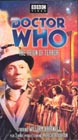 |
Doctor Who: The Reign of Terror - Collectors' Edition
2 VHS video tapes |
Coverage on The Web of Fear includes:
- One complete episode:
- Episode 1
- short clips from episodes 2 & 4
More details & buying options for missing episode VHS videos
Comments on this article are welcome. You may contact
the author from this page:
Contact page
|