Original DVD Extras include:
Special Edition DVD extras include:
Dudley Simpson gains another complete monopoly on the show's music this season, but unfortunately does not accomplish anything near as interesting as in season eight. Although the season's music is mostly decent and tasteful, very little of it stands out.
The Three DoctorsSeason Ten kicks off with yet another fun story, which does not altogether seem to take itself too seriously, despite all the heavy series mythology and landmark events it portrays. Humour abounds to make it all work in the end, thanks in large part to Patrick Troughton and a slightly less realistic Brigadier.The story starts off on an unusually quiet note, out in the middle of nowhere where a weather balloon has gently crash-landed. The pace soon picks up as Jon Pertwee's Doctor and his UNIT friends are brought into an investigation by Dr. Tyler, and a wonderful video-effect of a blob creature oozes out to threaten all of UNIT. A few good men in gelatin costumes soon swell the ranks of the antagonists, and the new creatures seem to work here thanks to an effective mix of sound effects and music during their entrance, an ogre-deep, threatening vocal sound for the creatures, and good fast-paced editing during an action sequence showcasing their effectiveness against the UNIT troops. Well done. Sgt. Benton is given his first introduction to the fantastical relationship between the interior and exterior of the TARDIS, making it all crystal clear for those in the audience who might not have understood it yet - all this in a season opener and stand-alone classic. Lennie Mayne has earned his points for visual literacy here. All this is but a prelude to the main gimmick of the story. The real fun begins when Patrick Troughton appears on the scene and has a chance to interact with all the regulars of the Pertwee era who at best only appeared briefly in Troughton's own. William Hartnell is also thrown in for highly-nostalgic good measure, but alas only appears on scanner screens, and mysteriously loses most of his colour in the process, needlessly trapping him back in his monochrome era. Of course it seems ridiculous now to think of Time Lords and all manner of other future and off-planet civilizations all making do with black and white TV's, monitors, and scanners, but 1970's mentality rules this and many other productions of the day.
"Seems to be your forté, Doctor: confusing people."Touché. Writers Bob Baker and Dave Martin know the science they want to impart and how it relates to their story, but their preoccupation with characters who have trouble "getting it" often results in dialogue that is confusing by design. This becomes one of the staple devices they use to create some humour in the script; unfortunately it only produces quality lines about 50% of the time.
Jon Pertwee's Doctor is mostly occupied with filler by comparison. When he finally gets some screen-time, he does alright at first with an alien landscape to explore, but there's not much to get excited about here. Then there's poor Dr. Tyler, trying to come up with some fabulous equation to explain the traditional Dr. Who location landscape to himself. It's just a bloody quarry for cryin' out loud. How mysterious is that? "Ah, that was a bit of a waste of time, wasn't it?"Things look like they're picking up when the good guys are suddenly surrounded by blob creatures and pyrotechnics, but Pertwee's episode two segments then sink to their worst - a load of silly running around in some cheap corridor sets, along with some bland dialogue that tries to pass the time. This is where the blob creatures come off as extremely lame. They bobble around meekly and cutely like a bunch of Chumbleys on happy drugs. Dudley Simpson's music is at its worst for the story here, light and tinkly as though scoring an episode of the children's program "The Polka-Dot Door". As the creatures chase Tyler, Simpson tries to build a suspenseful mood, but all his sounds are so high-pitch and lacking in resonance that he is really just ensuring that the viewers can't take any of it too seriously. Dingle-berry music. Not effective. The blob-men don't seem to mind whenever Pertwee's party decides to stop and talk for hours either, instead of urging them forward with grunts and threats. Mysteriously absent are the deep-vocal effects that would have kept them menacing. Also mysteriously absent from episode two are any of those excellent composite exterior and interior shots of the entrance to Omega's lair - we certainly have enough screen time to spare to drop in such quality shots. As it stands, the cut between quarry and corridor scenes feels like something important has been left out. Mayne loses some of his marks for visual literacy here.
Which came first, the Alpha or the Omega?Having first seen the 80's story "Arc of Infinity" (story no. 124) several times, I entered the run of Pertwee stories hoping that Ian Collier would be playing Omega right from the beginning in "The Three Doctors". When Collier popped up in the previous story "The Time Monster", my hopes soared even more. But alas, Stephen Thorne, who also played the Daemon Azal, had the role here instead. The result is more volume and less feeling, and Omega is harder to sympathize with here. But then, that's not quite the intent this first time around, is it? Thorne goes over the top several times in his performance, but yet still succeeds in making Omega a worthy and memorable adversary, and in the end, it's one of Thorne's better performances on Doctor Who.Episode Three houses the most obvious captivity dynamic of the story, and thankfully it doesn't last very long at all. After an inventive escape, everyone is running around freely again, getting into action or exploring new scientific concepts once again. Well done. Bessie continues to see action as well. Simpson seems to be using a new version of a piece of music composed during the previous story to accompany scenes of the little yellow roadster in action, so it would appear that Bessie now has a theme of her own. Although a more serious type of instrumentation might have helped it stand out here and be better appreciated, it is actually a nice little composition. You'll have to check out "The Time Monster" (story no. 64) episode 1 for a more definitive and enjoyable version of it though. A strange thing about Bessie is that she seems to slow people down. The Doctor's friends are happy to use her to speed from Omega's lair back to UNIT headquarters, yet when the two Doctors themselves run the same journey on foot, they take far less time to get there. Go figure. The Time Lords are quite busy on their own planet, offering an important perspective on the story's events to the audience. Unfortunately, the characters there don't really get to interact with anyone else, and the closest that the Doctor gets to visiting them and their set is William Hartnell having an extremely brief conversation with them over the scanner screen. Nice, but not quite all one would hope for, and raising the potential for continuity problems as well as the Hartnell and Troughton Doctors spend their eras on the run from and in hiding from general Time Lord civilization. But at least the Time Lords own strict laws about time, regardless of whether or not they make any good sense, are in place to prevent them trying to retroactively capture or convict the two earliest Doctors. After all, they've served sentence to Pertwee's Doctor, and that's more than good enough for now. The TARDIS finally gets to do its materialization thing in the final episode. Short hops are always a bonus, and Baker and Martin have the knack of writing them in, but it is rather odd that it makes neither the long journey to nor from the planet in the other universe under its own power, which would perhaps have been more justifiable. Unfortunately, recording block ten has reverted to using the over-echoed materialization sound again, and adding unnecessary echo to dematerialization as well. (New sound man Dick Mills seems keen to leave his mark, even if it means fixing what ain't broke.) All the Doctors put their heads together to outwit Omega in the end, and Pertwee and Troughton are on hand to deliver the final blow personally, first making sure their friends are all away and safe. The Doctor's a proper hero here, in all his incarnations, proving adept at understanding his enemy's character, negotiating, and if not providing a peaceful solution, at least a merciful one. And of course we know from "Arc of Infinity" that Omega is still existent and kicking. Which begs the question: did anyone at all buy the proverbial farm in this story? I can think of only one possibility concerning the UNIT soldiers battling the blobs in episode one. A few are lost from sight in the smoke of enemy fire, after which some of them can clearly be seen running away. I suppose it's up to each viewer's imagination to decide whether or not they all got away safely, or whether one of them became that large puff of smoke itself. And finally comes the biggest landmark of all. The Time Lords forgive the Doctor of his "sins" and his exile on Earth comes to an official end. The show's adopted format of half UNIT-based and half wandering time-traveler stories continues as it had since the middle of season eight, but at least now the writers don't have to come up with new excuses for the Time Lords to allow the Doctor's extra-curricular jaunts. In fact, UNIT's heavy influence on the scripts is barely half over, even if one can argue that most of their best material is now past.
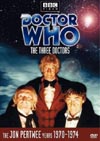
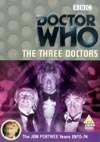
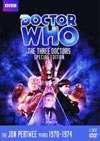
DVD EditionsI have to admit, when I first discovered that there was to be a special edition DVD for this story, I compared the bonus features and quickly rushed out to get the old one before it became a rare discontinued item. Why? The only real draw for the new one might have been the making-of featurette, and though I always enjoy these, after a time they all become quite similar to each other. What is far more rare is Jon Pertwee's participation in the extras, since he sadly passed away just before DVD's started coming out. And apparently only the older DVD has his lengthy and revealing Panopticon 93 interview panel, which I thoroughly enjoyed. Pertwee is on form for the whole 30 minutes, while Manning joins him about halfway through, and Courtney barely shows up to apologize before it is all over. The older DVD also has a much better cover photo, particularly the North American version. I'm sure the newer Special Edition DVD is good, but I think the old one may be slightly better and definitely worth collecting.
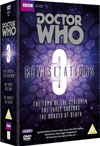
International Titles:Deutsch: (Die drei Doktoren)Magyar: "A három Doktor"Français: (Les Trois Docteurs)Русский: "Три Доктора"This story has become available on DVD and VHS video. Click on the Amazon symbol for the location nearest you for pricing and availability: Original release:
Comments on this article are welcome. You may contact the author from this page:
|
||||||||||||||||||||||||||||||||||||||||


 in the U.S.
 in Canada
 for the U.K.