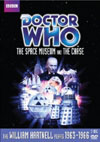
DVD Extras include:
Episode One - The Space MuseumThis half-hour episode is truly exceptional. An intriguing sci-fi mystery is presented for our four main characters, and Mervyn Pinfield does his best work as a director here, with a nearly flawless execution of a very well-written script. Many complicated effects are achieved with no sacrifice to the drama and no tell-tale signs of "okay, we're setting something up, viewers at home, so please be patient and bear with our shoddiness." As with other Pinfield productions, a bit of silence creeps in, yet this time it is all part of the story, yet another clue for the four travellers to investigate. The sparse interaction, or non-interaction, between the main characters and the fleeting guest characters is unique for any Doctor Who story. The music is good and interesting once more, lending both alienness and grandness to the proceedings where appropriate. The acting by everyone is on par, perhaps even a little above. One begins to hope that we will finally get a really outstanding season two Hartnell sci-fi story.
Episode Two - The Dimensions of TimeThe guest characters are introduced and developed in this episode, and they are fairly interesting. Ever wondered what Star Wars' Boba Fett looked like under his mask? Here he is, unmasked, young, and green. Jeremy Bulloch plays the rebel leader in this adventure. In terms of both acting and appearance, he stands out and a bit above the rest of the rebels in this adventure. Altogether, it seems a shame that the entire population of the planet Xeros, that we can see on screen, is male and adolescent. Where are all the subjugated Xerons that are spoken about? Not too believable.Sir Ian Chesterton, Barbara, and Vicki actually accomplish very little by contrast with the guest characters, spending the entire episode wandering aimlessly through the museum without meeting anybody. Whilst the Doctor is still with them, their grappling with the temporal paradox that faces them remains interesting. After that, it begins to get old real fast - becoming more story padding than conflict, as it causes our characters to constantly pause and try to second guess themselves, and as a result they end up doing very little. Star Trek The Next Generation would later commit the same mistake in its season two episode "Time Squared". The Doctor is the only regular character with something truly interesting to do in this episode, and it's a great pity that this is by-and-large forced upon him rather than as a result of his own choices. Still, it's his Achilles' heel of indulging his greater curiosity that gets him singled him out from the others. The young band of rebels try the wrong approach with him, and he outwits them and makes them pay for it. Nice to give the Doctor more action again - too bad it was all off-screen. Out of the frying pan and into the fire, the Doctor next finds himself forced to confront Lobos, the top official on the planet. Our favourite time traveller makes fun of this villain as well. Right on! Unfortunately he doesn't get away with it. Even more unfortunately, that's the end of the Doctor's contributions to the story's resolution as well. His journey, for all its high entertainment value, comes to a dead end.
Episode Three - The SearchHere we go again with another sinful Doctor-less episode. Okay, so William Hartnell deserves a holiday or two this year. But why can't the main character of the series appear on a few good pre-filmed inserts in the meantime, like Susan did in "The Aztecs" (story no. 6)? Sir Ian Chesterton always gets a pre-filmed insert when William Russell needs a holiday. The Doctor is the title character, for crying out loud. Well, at least the absence has a good story excuse, and a sense of horror creeps into the proceedings as one wonders exactly what process he is having to endure that would keep his obviously bright spirit from view for a whole episode.The remaining three regulars waste a bit more time second guessing themselves, while the villains get good and organized. Things improve when a single guard tries to take them prisoner. Action and pandemonium ensues, and three more journeys begin, one for each of the regular characters. It is worth noting that this Doctor-less half-hour undoubtedly has the most believable and exciting hand-to-hand combat scenes in all of season two - quite a few of them to boot. Excellently directed, Mervyn Pinfield! Sir Ian Chesterton proves as handy with a futuristic gun as he is with a sword, and proceeds to mount a one-man rescue mission in his search for his good buddy, the Doctor. He delivers plenty of action and cunning, and makes the episode interesting. Barbara gets the worst luck of the draw for her journey. Not having done much of anything on her own yet, she is now trapped in the museum once more with a lost rebel, and they get gassed. A waste of screen time. She could have taken the Doctor's place on holiday and in motivating Sir Ian's rescue attempts, although having done that so often recently, the idea is in danger of becoming really old. It's nice to see Ian caring for the Doctor as much as he usually does for Barbara. Ultimately, it is Vicki who gets the best plot journey, teaming up with the rebels, learning all about them and the history of their planet Xeros, lending them her optimism, doing most of their planning for them, and becoming the hero of both their cause and her own. This would have been the Doctor's role if he hadn't mistrusted the rebels in the last episode, but who can blame him after the way they behaved? And here it is: the one, the only, the final heroic action to end the temporal paradox for the four time travellers: Vicki uses foreign wisdom and technical skills to open the enemy armoury for the rebels. That's it, we're done. They can take over and make Xeros a friendly place now. It's just a matter of time. This action is precisely one episode too early, if it was meant to be part of a tight and riveting plot. Sir Ian's quest meets with success, then shock as he lays eyes on the Doctor. Unfortunately, the audience has to wait until next week to see what Sir Ian finds so shocking about the Doctor's appearance, and of course, William Hartnell has to come back from his holiday. The episode endings have been pretty good all through this story, relying more on unanswered questions than straight menace. Refreshingly unusual.
Episode Four - The Final PhaseOur four main characters don't really get much of anything worthwhile to do in what should be their ultimate confrontation with their temporal paradox. As a result, the episode is quite a let-down.Sir Ian succeeds in rescuing the Doctor from the embalming process, but not from captivity. The Doctor is still not on form. Fighting to shake off the effects of the process, he only manages to hurl a few clumsy insults at the Moroks. He and Sir Ian have the upper hand on Lobos and his cronies for a while, but it all comes to naught as they are quickly recaptured and Sir Ian is disarmed. Sir Ian's journey finishes in the same dead-end as the Doctor's. Barbara manages to not contribute anything to either the plot or to the entertainment value of the adventure as she too is captured and stuffed in with the Doctor and Sir Ian. Her journey ends. Vicki is still trying to be the hero, but she only manages to get Sito killed before she herself is captured. She manages an act of bravery in sacrificing her freedom to help the other rebels, but this doesn't really contribute anything to solving the temporal paradox. The four separate journeys come together, all suffering deflation. Reunited in captivity, the four travellers are reduced once more to second-guessing themselves and philosophizing about time. The philosophizing works, the second-guessing does not. Thanks to Vicki's efforts in the previous episode, Jeremy Bulloch's cavalry is on its way. The shoot-'em up action is not as riveting as that of the previous episode. Although the effect for the guns is not altogether satisfying, it is better than anything we have been dealt with on Doctor Who before in terms of laser beams, and that includes the silly old Dalek negative picture effect. Only the Dalek extermination gas in the Peter Cushing movies rates better. At least the farewell scene outside the TARDIS is decent, interesting, and satisfying. Although this story is about other things, the Daleks manage to make minor cameos in three out of four episodes. Adding a casing to the museum is a nice touch, as is having the Doctor play around with it with Yoda-like glee. But there are also much more real Dalek credits at the end of episode four. If you've only seen this story on television in syndication, you might not have seen it all, as someone between Australia, New Zealand, and Lionheart (the BBC in America) must have decided to cut the final scene for their own inscrutable purposes on the first version I ever saw. I felt gipped once again. Beginning with its official BBC VHS release, the proper cliffhanger ending to episode four of "The Space Museum" has been restored, and features the best ever view of Skaro from space on the series in a wonderful lead-up that does much to take away from the cheapness of the set in which the Dalek appears. (No, I do not like the shot of Skaro from the opening of Paul McGann's "Enemy Within" story (no. 160) - it just wasn't as believable for me, as Skaro never seemed so ridiculously red in the BW days or in later colour Tom Baker stories.) And even if we have seen this view previously on the TARDIS scanner screen in "The Edge of Destruction" (story no. 3), it looks even better here as a full-screen "current" view where it has an added atmosphere of suspense. This cliffhanger should be syndicated with the rest of the story, especially as "The Chase" (the next story) is a complete and syndicated story as well! In fact, "The Chase" should also have opened with a re-use of this approach-from-space sequence, hopefully to replace Vicki's "uselessness" scenes.
The Season Two FormulaA recurring problematic theme for late season two Doctor Who seems to be developing here. The last three stories have all been ripe with possibilities, and mounting excellence as well, yet all have been disappointing in their concluding episode, sometimes marginally, sometimes becoming complete wash-outs. Don't people know how to finish a script anymore? This one in particular needs at least one more critical action for one of the four regulars to perform to resolve their temporal crisis, and it needs to happen during episode four's climax. Ideally, it would be something the Doctor figures out and performs, and considering the subject matter brought up in this story, it should be a trick answer that might easily be overlooked or handled in a different unsuccessful way. Putting their only successful action in the previous episode just creates a limp and unsatisfying drama. And once the writer has figured out what this action is, it might help him put some substance into all the second-guessing dialogue leading up to it, elevating such scenes above mere padding.At least "The Space Museum" now ends by giving us a healthy appetite for the next story. Anticipation remains a key ingredient to season two's ratings success - whether a story turns out to be good or not, viewers are at least given plenty of incentive well in advance to tune in and find out for themselves. Even if you didn't like the conclusion of "The Space Museum", it does leave you wondering what major Dalek confrontation will occur in the next couple of weeks, so you tell your friends and you all tune in again next week. For TV networks, this is the most important element of the show. For us die-hard fans, something that holds up a bit stronger under repeat viewing would be preferable.
International Titles:Deutsch: (Das Kosmische Museum)
Meanwhile, Spanish translators chose to call episode two "The Dimensions of Space" instead of "The Dimensions of Time".
This story has become available on DVD (bundled with the next story) and VHS video (bundled with material from the previous story). Click on the Amazon symbol for the location nearest you for pricing and availability:
Comments on this article are welcome. You may contact the author from this page:
|