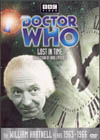
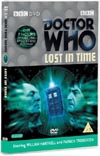
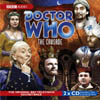
The DVD's include:
Now, the much more recent release of the newly re-discovered first episode of this story, along with the rest of the soundtrack to complete it, sheds some welcome new light on this classic tale, enhancing its status in several ways. Season Two has only two "purely historical" stories, and for the second time, this very type of story features a strong script, full of dramatically meaty scenes.
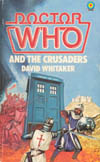
That done, the TARDIS seems to think that they have hit upon an excellent idea, and promptly lands them in the thick of Lionheart King Richard the 1st's crude Christian crusade against the Saracen leader Saladin and his hordes of Turkish Muslims. Apparently these opposing leaders are our two men who are both right. The plot digresses predictably, however, as Barbara barely steps out of the TARDIS before she is captured by a rogue Saracen captain who is not right in any sense about anything. Fully half of the plot will now revolve around a pure villain, which violates this story's well-advertised mission statement a little too much for my tastes. "You shall be Joanna, my sister, and help me in my lies."We move back to the rusty old rescue and escape routines, replacing honesty with deception as desperation mounts. Even with such unimaginative plot devices, our first rate writer manages to provide something of a definitive version of all this and make the proceedings among the most interesting of all season two Doctor Who stories.Both Ian and William Hartnell's Doctor are every bit the hero in the opening, as they plan Barbara's eventual rescue, and more immediately aid a fallen Crusader and save his life, much to King Richard's approval. Vicki helps as well, but she will be relegated to the side-lines for most of the novel. The Doctor has many interesting scenes in the book's first half, expertly and often humorously talking his way out of trouble and having his way with the clothing shop-keeper, the palace Chamberlain, and even King Richard himself. Barbara maintains a sharp wit throughout her captivity, and finds herself among intelligent guest characters in Saladin's court, all of which helps keep her scenes quite riveting. Sir Ian Chesterton is knighted, no less, by King Richard before departing on a double mission as Barbara's rescuer and as the King's Ambassador to Saladin, ensuring, for those who had any doubt, that Sir Ian is the dashing, physical, athletic, gallant, romantic type of hero on the show. The Doctor's handiwork in bringing the king around to this way of thinking should also be noted - he is every bit the more subtle hero of diplomacy, which many viewers (myself included) find slightly more interesting. Nicely balanced, in theory. William Russell's contributions to the third episode amount to one short pre-filmed insert, so he can go off for a holiday. One is tempted to believe that finally we've got a good story centered around the Doctor instead of Sir Ian for once.....
As a hero, the first Doctor is a hurting unit once more after the novelization is finished with him. The story appears here to be a great idea with an exceptional lead-up, but little idea of where it was really going. This definitive collection of the worst of early Doctor Who clichés is a disappointment, and being one of the very first Doctor Who stories to be novelized, the book probably did much to turn fans off of the historical stories that were so prolific in the early years.
Episode One - The LionThe first most notable difference from the novel is the total absence of any scene in the TARDIS. This time, we are not set up to unsuccessfully argue time travel non-interference ethics, or try to learn from characters we are too afraid to interact with. We delve straight into the forest. Julian Glover's performance is good from the start, but too easily upstaged by a host of less interesting minor characters. Although the confusion surrounding the King's identity is a major ingredient in the later drama of this episode, it takes much away from the opening scenes by helping to confuse the audience as well. The action scenes work, and are a study in themselves on how to make cheap, low budget, safe fighting scenes remain as surprising and emotionally effective as possible, but it could have gone up yet another notch from the script's point of view if we could be rooting for some of the guest characters after having them better established.
The brothers Saladin and Saphadin get themselves superbly introduced here, and at last Barbara is allowed to show the strengths of her character in their court. Her explanation of her origins seems to indicate that there was no time in between the television adventures in Rome and on Vortis for any silly "talking stone" adventure, an idea that can gladly be put to rest. The Doctor's antics in the clothing shop are a joy to watch, and Vicki is put to good use as his accomplice. At last we know how the TARDIS's huge wardrobe became so nicely stocked! At last, at the end, King Richard gets his due, as our main characters meet him properly and he agonizes over his entire life's situation, nicely informing any audience that might not be acquainted with this period of history.
Episode Two - The Knight of JaffaThe story's structure continues to prove much better on television than in the novel. The Saracen court is well occupied by an abduction mystery that nicely confines itself totally to this episode, while the Doctor, Vicki, and Ian continue to have plenty of good scenes in King Richard's court. The knighting is not rushed, but properly built up in the drama, and Ian then covers a lot of ground near the end of the episode, getting to and moving beyond the Saracen court. The Doctor's arguments over the theft question make less sense and less good humour here than in the novel though. Vicki is done justice all throughout the television version, despite the novel practically forgetting about her altogether and making me suspect Maureen O'Brien might have taken a holiday for an episode.
Episode Three - The Wheel of FortuneThis episode works even better than before when surrounded by the rest of the story once again. The clothing shop keeper Ben Daheer easily stands out better now, his character much more understandable.Douglas Camfield made a classic out of his first full story as a director, and episode three contains what is probably the finest bit of acting in the entire season. Julian Glover (King Richard) is also known for playing the villain Scaroth in "City of Death" (story no. 105), the capable commander of the Imperial Walker attack on Hoth known as General Veers in "Star Wars V: The Empire Strikes Back", and as the key character Donovan in "Indiana Jones and The Last Crusade". Jean Marsh (the King's sister Joanna) went on to play single-story companion Sara Kingdom in "The Dalek Masterplan" (story no. 21, also directed by Camfield), and later returned to Doctor Who to play Queen Morgana in "Battlefield" (story no. 156). She also played similar evil witch villains in "Return to Oz" and "Willow". Taking all that into account, Doctor Who's "The Crusade" is still the finest moment for both of those actors, as King and sister clash, and William Hartnell turns in one of his finest performances as the Doctor finds himself caught between them. This moment is not to be missed by any serious fan of the show. Indeed, the whole episode is well done, also featuring a solid performance from Doctor Who veteran Bernard Kay as Saladin. Kay had appeared as Tyler in "The Dalek Invasion of Earth" (his performance is much more inspired here) and would go on to play Inspector Crossland in "The Faceless Ones" (story no. 35) and a conscientious miner in "Colony in Space" (story no. 58). He can also be seen in David Lean's epic film "Doctor Zhivago". All this acting talent does not go to waste, as director Douglas Camfield encourages each performer to give his or her best, and captures it masterfully on videotape with angles that draw the viewer right into the depths of each character's emotions and motivations. Beautiful! Another item to note is that this story actually features Douglas Camfield and musical composer Dudley Simpson working together. It would not happen again on Doctor Who, as soon after they got into an argument at a dinner party and Camfield refused to use Simpson ever again. However, Simpson has undoubtedly written his best season two score here for this story, and I suspect the Camfield influence deserves some of the credit. The music fits the story's darker moods like a glove (and it is mostly during dark, moody bits that the Doctor Who program requires music). The subject matter of Barbara's plot is not altogether thrilling, however well it was acted and directed. Is that a dagger she sees before her? She is encouraged by a guest character to ponder mercy-murder and suicide, not the most inspiring plot-line for a show about exploration.
Episode Four - The WarlordsRedemption at last! Contrary to the poor excuse for a novelization, King Richard does appear in the final episode of "The Crusade", and his scene with the Doctor makes an enormously important contribution to understanding, enjoying, and completing the story. Remember that slow turn King Richard makes after the Joanna explosion, studying each member of the court in turn before settling on the Doctor at the end of episode three? Apparently there was more cool calculation going on in his mind there than he at first let on, as he now explains in episode four. Great performance, Mr. Glover; you had us all permanently fooled! When all is said and done, King and Doctor are once more on excellent terms, resolving the most important need set up in the television version, and the Doctor's self-removal from the court now doubles as a noble mission for the King. Joanna is not seen, but will no doubt be satisfied by the outcome here and enjoy her brother's confidence once again. Another additional scene featuring only the Earl of Leicester and his cronies adds the danger and suspense to this part of the storyline.Also, we are spared an overdose of Sir Ian, as the restraints of time and budget do not provide for excess traveling scenes. Can you say "harem"? Nobody in "The Crusade" can, preferring the pronunciation "harEEm" for reasons I don't understand. I prefer something closer to the Hungarian word "három" which means three, and which probably has a common origin with "harem". Joanna and the Saracen brothers may be absent, but we are given a comic relief character who manages to get fully developed in just one episode. Ibrahim is hard to like at first, since his honey and ant hill trick is quite nasty and appears to be slowing down Sir Ian's plot unnecessarily. However, the actor throws a lot into this part, and the ant-trick is important to make Ibrahim's later turn around such an enjoyable display of spineless, charismatic opportunism. This then demonstrates Sir Ian's best quality - turning enemies into friends. El Akir meets his match, amongst the typical Whitaker display of screaming women. Barbara's hammy scream is unmistakable, but somewhat covered up by more real ones from the extras. No, Sir Ian does not stoop to murder, he lets it get done by Barbara's fatherly friend from episode three, who was not fatally knifed in the street as you might have suspected, but was merely punched - another Camfield cliffhanger trick. The Arab family we came to know is now reunited once more. We only join the Doctor again in the woods near the TARDIS. Sir Ian begins to resolve the Doctor's problems expertly here again, but this time the Doctor is alert and quick to add his own touches and be responsible for getting himself out of the predicament. I can't think what made David Whitaker novelize the scene with:
         "The Doctor stood silently, making absolutely no contribution
         to the conversation, his eyes staring steadily into [Sir] Ian's."
This line, added to the fact that the only thing the Doctor does
eventually say has to be pried out of him by Sir Ian, is at the
heart of the concluding lameness of the book. William Hartnell
performed no such idiocy, as he and the script do the Doctor
justice on television. The final scene, now thankfully devoid of
the novel's cowardice, can be thoroughly enjoyed for its humour,
which is expertly played to by all. Wrapping things up is
a mysteriously silent cliffhanger leading into the next story.
International Titles:Deutsch: (Der Kreuzzug)
English TV: "The Crusade"English Novelization: "The Crusaders"
Comments on this article are welcome. You may contact the author from this page:
|
||||||||||||||||||||||||||||||||||||||||||||||||||||||||||||||||||||