The Talons of Weng-Chiang
Special Edition:
 |
 |
 |
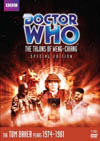
DVD NTSC
Region 1
Special Edition


|
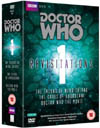
DVD PAL
Region 2
"Revisitations 1"
Box Set


|
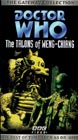
VHS Video
NTSC
A

NTSC
B

PAL

|
|
(Doctor Who Story No. 91, starring Tom Baker)
- written by Robert Holmes
- directed by David Maloney
- produced by Philip Hinchcliffe
- music by Dudley Simpson
- 6 episodes @ 25 minutes each
|
Story: While jungle-born
companion Leela humorously struggles to master
Victorian wardrobe and etiquette, the Doctor dons
his best Sherlock Holmes outfit to investigate the
disappearances of young women in a London district.
Do the rumours of Jack the Ripper hold any water?
What is the mysterious phantom that has been haunting
Henry Jago's opera house? Is his star oriental
master of mesmerism one of the leading members of the
Tong of the Black Scorpion? As the Doctor digs deeper,
the answers may have more to do with the 51st century
than the 19th....
|
|
"Special Edition" DVD extras (on 3 discs, no less) include:
- Audio Commentary by actors
Louise Jameson (Leela),
John Bennett (Mr. Chang),
Christopher Benjamin (Henry Gordon Jago),
director David Maloney,
& producer Philip Hinchcliffe.
- New retrospective making-of featurette (32 min.) with
Jameson, Benjamin, Maloney, Hinchcliffe,
Tom Baker (The Doctor),
Trevor Baxter (Professor Litefoot),
designer Roger Murray-Leach,
and costume designer John Bloomfield.
- "Whose Doctor Who" (59 min.) -
a 1977 documentary
focusing on the British audience's appeal for
and reaction to the horror elements of the show.
Features many clips from earlier years of the
show and some behind the scenes footage from
"The Talons of Weng-Chiang".
- "The Foe from the Future" concept idea featurette (7 min.)
with writer Robert Banks Stewart.
- "Now and Then" location featurette (11 min.)
- Raw video tape studio footage in BW (24 min.)
- 1977 Philip Hinchcliffe interview (11 min.)
- "Moving On" Philip Hinchcliffe's unused ideas interview (4 min.)
- Blue Peter: Make Your Own Doctor Who Theatre (26 min.)
featuring Peter Purves and a segment on
sound effects with Dick Mills
- "Victoriana and Chinoiserie" literary reference featurette (8 min.)
- "Music Hall" featurette (22 min.)
- "Limehouse" story setting featurette (19 min.)
- "Look East" 1977 Tom Baker interview during filming (4 min.)
- New Photo Gallery montage
- Pop-up Production Note Subtitles
- TARDIS-Cam No. 6 (2 min.)
In-Depth Analysis Review
by Martin Izsak
|
|
WARNING: This review contains "SPOILERS", and is intended for
those who have already seen the program. To avoid the spoilers,
read the Buyers Guide version instead.
|
Sherlock Holmes meets My Fair Lady meets Jack the Ripper meets
The Phantom of the Opera meets yet another reinvention of the Master.
That might sum up this story's varied elements fairly well, but yet
the whole manages to be somewhat greater than the sum of its parts, thanks
in large part to Holmes' wittiest character writing to date, which leads
to some outstanding performances.
A re-invention of the Master? Well, just look at Li Hsen Chang,
with his sinister beard and mustache, elegant clothes and gait, confident
and secretive mannerisms,
and unbelievably overpowering skills at hypnosis - in essence, the aspects
of the Master that we didn't get in
"The Deadly Assassin" (story no. 88).
And then Magnus
Greel takes care of some aspects that we did get earlier this season,
approaching the end of his life cycle and focusing his energies on
recovering and repairing his TARDIS-sized time cabinet and escaping the
scene. Between the two of them, they are the Master all over again in deed,
even if we are denied the name this time around.
The Doctor's TARDIS makes a poor showing in this adventure. The
materialization
effect is skimped on, although its introductory shot retains a wonderful
atmosphere, and the dematerialization close up at the end has virtually
no background to clearly show an empty bit of street after the police box
leaves. They may just as well have faded the picture to black. The
interior is also ignored, perhaps just as well as this spares us the
dark secondary control room.
Even though so many bits of traditional classics are borrowed and
successfully woven into this single story, the actual on screen plot is
not altogether very creative entertainment - a bit of a mish-mash of running
around between what seems to be on the surface completely unrelated things.
The silliest of
these elements are the giant rats - particularly since the Doctor and Leela
have specially dressed up to go to the theatre, it becomes both ridiculous
and disgusting to see them end up strolling through sewage instead, never
mind the cheesy realisation of the rats themselves down there. Filming
of real rats in the false-scale model of the tunnels should at least have
had an adjusted film speed to allow the rat's movements to aid the illusion
of size. The on-screen
plot develops at not too quick a pace, several times covering the same
ground again, but we can be very thankful that the prisoner dynamic
does not rear its ugly head, and that the Doctor and Leela jump right in
and interact with the guest characters the whole time.
In the end though, it doesn't matter how much fluff the plot contains,
because the characters are so entertaining in their own right, you stop
caring what they're doing and just enjoy the fact that you get to see them.
Henry Gordon Jago is a real treat, well written by Holmes and beautifully
portrayed by Christopher Benjamin, last seen as Sir Keith Gold in
"Inferno" (story no. 54).
Tom Baker, Louise Jameson, and the rest of the cast are all in fine form,
bringing a delightful ensemble to life. Leela is probably at her most
entertaining here on the "My Fair Lady" character arc, straining to grow
beyond her tribalism to embrace old English etiquette and grace as well.
Unfortunately, the deadly poisonous Janis thorns are back, and considering
his previous opinion of them, the Doctor seems sadly and uncharacteristically
lax in his disapproval of them here.
As with
"The Brain of Morbius" (story no. 84),
many of the most interesting events
do not happen on screen, but rather get narrated by characters unveiling
their backstory. Li Hsen Chang gives us a good first dose of this with
his tale of meeting Weng-Chiang, a moment most beautifully underscored
by Dudley Simpson. But Magnus Greel's origins in future history easily
steal the show in the final episode and upstage the main action. All
the talk of Zigma beam experiments builds up viewer anticipation for
seeing the time cabinet in action, an element that the story sadly
can't deliver on. Set design is good all through the
story, but the final grandiose set appearing in the last two episodes
as Weng-Chiang's shrine is exceptionally impressive. Whether it and
the prop furniture really work well during the shootout, providing
believable, slowly disappearing cover, is another matter.
We do get proper visual beam effects for weapons fire in this story,
but this is played far too safely and minimally to receive much praise.
The single hand gun shot in episode three works all right, but the massive
shoot-out at the end is not all it should be, with a single close-up of
the dragon head firing two parallel beams out of the frame, used over and
over again no matter who, what or where it is shooting at, never any
beams hitting their targets even when shots like the massacre of
Chinese henchmen really need it, never any long shots showing a complete
action. Disappointing. Say all you want about the production limitations
of the time, Pennant Roberts raised the bar on
"The Face of Evil" (story no. 89), and
David Maloney neither approaches it, nor matches his own superior work
on "The Deadly Assassin" (story no. 88).
At least it's better than the blob effects of previous years.
In the end, this turns out to be one of the better and more watchable
stories of the Hinchcliffe era, and a good epic-length one for Hinchcliffe
himself to bow out on. Although he and Holmes seem to be repeating the
same horror/apocalypse elements over and over, they did at least get good
at presenting it in better packaging in this late season fourteen run.
In large part thanks to Jago's character, this story is good to the very
last scene.
The David Maloney Stories Ranked (from best to worst):
  -Genesis of the Daleks (story no. 78)
  -The War Games (story no. 50)
  -The Deadly Assassin (story no. 88)
  -The Talons of Weng-Chiang (story no. 91)
  -Planet of Evil (story no. 81)
  -The Mind Robber (story no. 45)
  -The Krotons (story no. 47)
  -Planet of the Daleks (story no. 68)
International Titles:
Magyar: "Veng-Csiang karmai"
Français: (Les griffes de Weng-Chiang) ou (Les serres de Weng-Chiang)
Русский: "Когти Венг-Чанга"
Español: "Las Garras de Weng-Chiang"
Season Fourteen Rankings:
Best Story:
- The Deadly Assassin
- The Face of Evil
- The Talons of Weng-Chiang
- The Robots of Death
- The Hand of Fear
- The Masque of Mandragora
Best Writer:
- Robert Holmes
- Chris Boucher
- Bob Baker & Dave Martin
- Louis Marks
Best Director:
- David Maloney (The Deadly Assassin)
- Michael E. Briant
- Pennant Roberts
- David Maloney (The Talons of Weng-Chiang)
- Lennie Mayne
- Rodney Bennett
|
|
Best Music (during a Dudley Simpson monopoly):
- The Deadly Assassin
- The Robots of Death
- The Talons of Weng-Chiang
- The Masque of Mandragora
- The Hand of Fear
- The Face of Evil
Best Laser Effects:
- The Deadly Assassin
- The Face of Evil
- The Talons of Weng-Chiang
- The Masque of Mandragora
- The Hand of Fear
|
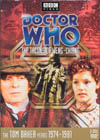
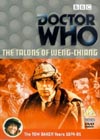
This story has become available on DVD and VHS video.
Original release:
 |
 |
DVD NTSC Region 1
for the North American market:
 in the U.S.
 in Canada
|
DVD PAL Region 2
 for the U.K.
|
|
Original DVD Extras (on 2 discs) include:
- Audio Commentary
- "Whose Doctor Who" documentary (59 min.)
- 1977 Philip Hinchcliffe interview (11 min.)
- Raw video tape studio footage in BW (24 min.)
- Blue Peter: Make Your Own Doctor Who Theatre (26 min.)
with Dick Mills
- TARDIS-Cam No. 6 (2 min.)
- Pop-up Production Note Subtitles
- Photo Gallery (3 min.)
- "Who's Who" text biographies (may feature on Region 1 discs only)
|
New Special Edition "Revisitations Volume 1" re-release:
|
|
|
|
|
DVD NTSC Region 1
for the North American market:
in the U.S.
in Canada
|
DVD PAL Region 2
for the U.K.
|
VHS Video
NTSC
A
for North America
NTSC
B
for North America
PAL
for the U.K.
|
Comments on this article are welcome. You may contact
the author from this page:
Contact page
|