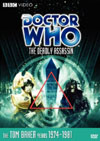
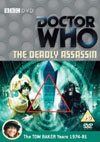
DVD Extras include:
The Doctor, his TARDIS and the society of Gallifrey are all most expertly introduced, with the police box making a solid normal materialization at the beginning and an extra appearing act later on, with the Doctor coming out and commenting "What a way to travel!" Brilliant. The interior/exterior relationship comes across best through the liberal use of the scanner screen, which is particularly well done in this story. An establishing model shot of the Capitol and tower complex might have been a nice extra touch, but the setting comes across well from the dialogue between Castellan Spandrell and Commander Hildred. Spandrell and Commentator Runcible end up fulfilling the usual explain-the-plot function of the Doctor's companion, since the Doctor is traveling alone in this story. They must do so in particularly clever ways during this first episode, as the Doctor necessarily has as little contact with anyone as possible. Director David Maloney is in top form, in keeping all the Doctor's motivations crystal clear all the way through. The episode's only real drawback is that it has to make do with the dark substandard secondary console room in the TARDIS instead of the proper one. This was the first season fourteen story I ever saw, and I was shocked and horrified to see that the white control room described in the novelization was not used on TV. How many more stories would suffer this room before the white one returned to rule? I had a most sinking feeling about how something disappointing always seems to happen on the Doctor Who screen where the novelizations carried through perfectly.
As if that wasn't enough, Keanu Reeves and the Wachowski Brothers can eat their hearts out - Doctor Who did "The Matrix" 23 years earlier. Where Neo takes an entire movie to figure out that he should deal with the environment with his mind instead of his muscles, the Doctor figures it out in his first ten minutes and quickly levels the field between himself and his adversary. And then there's Time Lord mythology, for which this has been the defining story ever since it first came out. Did it really upset what had gone before? Omega went out to a black hole, altered it for Time Lord use (possibly sending it homeward), and got lost in it in the process. Rassilon stayed closer to home, capturing and harnessing the black hole on Gallifrey, and taking far more credit. It's silly to think either one worked alone; there were probably untold assistants and specialists in various fields involved as well. And it is perhaps the Doctor's experience with Omega that allows him to figure out what Rassilon's Eye of Harmony is when every other Time Lord dismisses the legends as meaningless stories. Gallifreyan society does become much more 3-dimensional and real here, as characters who remain at home on the planet now seem just as capable of personality quirks and fatal flaws as some of the traveling rogues we have met previously like the Doctor, Susan, The Meddling Monk, the War Chief, the Master, or Omega. In "The War Games" (story no. 50) and "The Three Doctors" (story no. 65), we saw little more than the propaganda of a bland Zen-like mystical portrayal. Here for the first time we scratch beneath that surface and find out what is underneath the veneer. It is no less alien, particularly for a species that looks close enough to Human to be easily mistaken for us and no doubt can share some of our capacities for bio-chemical addictions. At last, this alien culture is fleshed out and made real, while retaining and I think enhancing its mystical attraction.
He and Bernard Horsfall lead a superb guest cast, everyone giving a solid portrayal. The Master's mask is quite limiting and not altogether believable - the only real weakpoint in the production that stands out today. The irony is that while Hinchcliffe wished to bring back a villain from Doctor Who's past without going for a bug-eyed monster, the re-working of the late Roger Delgado's Master character has now made him into a bug-eyed monster. Peter Pratt does a fine job in the role despite this, and Maloney keeps the Master nicely shrouded in darkness wherever possible to maintain the best effect, but even then, it seems far more darkness would be necessary should they really have wanted to make us believe in that look. We get a very unique special effect for the weapons fire in this story - obviously the script demands something other than a visual beam that shows where and who it came from. The four-pointed star effect on the target, complete with soft edges, movement, and the ability to grow and shrink as the intensity of the blast climaxes and fades away, is far better than the usual blobs we've had to put up with in the previous two seasons, and it integrates perfectly with the footage Maloney directs. The sound effect is good too, lots of energy and dynamic harmonics, fading away with a good echo. The music is excellent. Only it is a great pity that Dudley Simpson was not allowed to re-use his Master music from season eight as logic would normally dictate; that would have been the icing on the cake. Another good point: Holmes finally allows the Doctor to undertake the final climactic, heroic act of the story, instead of giving it away to other characters as he has done so often in previous stories. Nice. And for all the wrestling simplicity of the climax, the production is surprisingly excellent at this point, putting more energy and dramatic tension into it than I would have guessed at by merely reading the script. Very well done.
DVD BonusesThe commentary is enjoyable and charming, with producer Philip Hinchcliffe leading the discussion with his usual intelligence and candor about the creative side of the show. Although both he and Tom Baker inevitably repeat some things they have said elsewhere, (perhaps, as with many of the other DVD's from their era, fostering the danger of telling the audience how to interpret Doctor Who as whole instead of letting the audience come to their own opinions about it), the highlight is definitely Bernard Horsfall challenging one of Hinchcliffe's common assumptions in part four, and putting him away a bit, amicably but firmly. Nice!The material surrounding "The Manchurian Candidate" is very appropriate for this disc without being all that grand. The making-of featurette satisfies by covering the most basic areas that it needs to, but gets a bit distracted by critics. What the commentary and making-of seemed to need most was input from a few more cast members, and with this story being such an acknowledged classic, it seems bizarre that such never happened. The "Frighten Factor" featurette is an utter waste of time. As is common on Hinchcliffe Era DVD's, we see people absorbed in the distraction of trying to figure out how scary a story should be and what makes it scary, without questioning whether being scary is either an important or worthy goal in the first place and I think de-valuing all the other more worthy elements that draw viewers in. This featurette is even more plagued, because the interviewers really aren't making clear what they are asking of their interviewees, and the featurette is all over the place in terms of not being able to make a valid point. It asks, "What is Doctor Who's 'frighten factor'?" Well, you invented the term. You tell us what you mean. A lot of random people seem to be interviewed here who weren't involved in "The Deadly Assassin". Mind you, you won't go wrong with the main features or bonuses on this DVD, as the main story, commentary, making-of featurette, photo gallery sound effects montage, and Manchurian Candidate material are all highly worthwhile. Some extras deserved to go up another notch, but still satisfy nicely as they are.
International Titles:Deutsch: (Die gallifreyische Verschwörung)Magyar: (A Gallifreyan összeesküvés)Français: (La conspiration gallifreyenne)Русский: (Галлифрейская конспирация)или (Галлифрейский заговор)Español: "El Gran Reto del Amo"This story was dubbed into Spanish and broadcast in Mexico as "The Great Challenge of the Master".
This story is now on DVD and VHS video. Oh yes. Click on the Amazon symbol for the location nearest you for pricing and availability:
Comments on this article are welcome. You may contact the author from this page:
|