Time Crash
 |
 |
 |
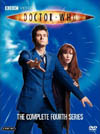
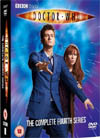
DVD NTSC
Region 1
14-episode
box set


|
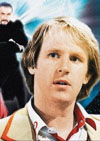
DVD PAL
Region 2
14-episode
box set


|
|
|
(Doctor Who Season 30 prequel scene
starring David Tennant and Peter Davison)
- written by Steven Moffat
- directed by Graeme Harper
- produced by Phil Collinson
- music by Murray Gold
- 1 scene, 8 minutes
|
Story: When the unshielded TARDIS crashes into
a prior version of itself, it brings the tenth Doctor
(David Tennant) face to face with the fifth (Peter Davison).
|
|
Buyers' Guide Review
by Martin Izsak
|
|
(A more in-depth analysis, containing "SPOILERS" and intended
for those who have already seen the program, can be accessed
here.)
|
This little gem is buried
as an extra on the first disc of the Season 30 box set....
It should really come first in the
"Play All" or "Episode Selection" sequences, or perhaps better yet have been
included on the previous year's box set as an extra, since the narrative
clearly squeezes the entire thing into the last few moments of episode two of
"The Sound of Drums" (story no. 192).
Although not as involved as the full-length stories
"The Three Doctors" (story no. 65),
"The Five Doctors" (story no. 130), or
"The Two Doctors" (story no. 141),
"Time Crash" does bring about a scene of the kind of fun and humorous banter
usually witnessed whenever the Doctor meets up with previous versions
of himself. If anything, it's a pity it's so short, and feels a bit
rushed in places.
|
Steven Moffat's writing for the tale rests on sound story structure,
but there isn't enough scope here to allow for his usual complex intellectual
puzzles. A simple one will have to do.
The story is really about character at its heart, which turns out
a bit hit and miss at first, but ends better and satisfies before the end.
Peter Davison
only seems to display his better characteristics about 50%
of the time. Humour is attempted through misunderstanding
and I don't think it works well enough to justify the amount of
screen time given to it.
Davison's Doctor
also takes more than his share of flak from Tennant, but nicely gets
to hit home with some of his own comments about Tennant's babbling.
And the banter is on and underway.... enjoy. Particularly good
is the reduction of the new TARDIS interior's design to a "desktop theme",
finally giving a nod to the computer-generated
"architectural reconfiguration system" that Christopher H. Bidmead
came up with to control such things story-wise in
"Logopolis" (story no. 116) and
"Castrovalva" (story no. 117).
And Davison's comments
are suitably critical of the latest "desktop" choice.
The characters balance their shenanigans with much genuine appreciation
of each other as well - something perhaps no other multi-Doctor story has
previously achieved. Nice one.
|
Music by Murray Gold
"Martha Triumphant", and
an alternate version of: "The Doctor Forever"
are available on:
|
|
"Clockwork TARDIS"
is available on:
|
|
Timey-Wimey
What plot there is, involves a loop of memory that challenges
traditional time travel theory. Moffat glosses over any decent discussion
of this with a throwback to one of his favourite phrases from
"Blink" (Doctor Who story no. 190).
Not so funny. Or credible. Or understandable.
Without giving too much away, let's just say that the script leaves one
of the Doctor's original ideas chasing its tail and disappearing up its
own rear-end like the oozalum bird and ceasing to exist..... if we only
look at time traditionally.
If, on the other hand, we remember that
"Every single decision we make creates a parallel existence,
a different dimension", and
factor in the principles of Heisenberg and modern quantum physics
to know that even being present to perceive something or
making a judgment as to what it is you're looking at is
itself enough to change the outcome,
it becomes very difficult to relive a history that you're
familiar with and make all the "correct" decisions to have it
turn out in exactly the way you remember it....
Instead you end up reliving a PARALLEL version of it.
'Nuff said here. For the full explanation,
come back here after seeing the story and read the
In-depth Analysis version
of this review.
But Moffat doesn't seem to realize what he's got here by the tail.
Pity, as it's the most fascinating concept
the story would have to offer.
In the end, this is a fun little piece, and very enjoyable
for fans of the classic show. Here's to more involved multi-Doctor
collisions in the future. Cheers!
This story has become available on DVD.
Click on the Amazon symbol for the location nearest you
for pricing and availability:
|
|
 |
DVD NTSC Region 1
14-episode boxed set
for the North American market:
in the U.S.
in Canada
|
DVD PAL Region 2
14-episode boxed set
for the U.K.
|
|
Note: The full season sets
contain commentaries, behind-the-scenes
featurettes, and other extras.
The smaller volumes only feature the plain episodes.
Comments on this article are welcome. You may contact
the author from this page:
Contact page
|