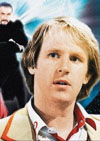
Only after that particular multi-Doctor hope had been dashed did I find this little gem buried as an extra on the first disc of the Season 30 box set.... It should really come first in the "Play All" or "Episode Selection" sequences, or perhaps better yet have been included on the previous year's box set as an extra, since the narrative clearly squeezes the entire thing into the last few moments of episode two of "The Sound of Drums" (story no. 192). Although not as involved as the full-length stories "The Three Doctors" (story no. 65), "The Five Doctors" (story no. 130), or "The Two Doctors" (story no. 141), "Time Crash" does bring about a scene of the kind of fun and humorous banter usually witnessed whenever the Doctor meets up with previous versions of himself. If anything, it's a pity it's so short, and feels a bit rushed in places.
Timey-WimeyWhat plot there is, is resolved with a loop of memory that challenges traditional time travel theory. Moffat glosses over any decent discussion of this with a throwback to one of his favourite phrases from "Blink" (Doctor Who story no. 190). Not so funny. Or credible. Or understandable. Exactly when does the Doctor ever come up with this incredible solution to the problem at hand? Davison is clueless, while Tennant remembers it only because Davison saw it. Thus the original idea chases its tail until it disappears up its own rear-end like the oozalum bird and ceases to exist..... if we only look at time traditionally.If, on the other hand, we remember that "Every single decision we make creates a parallel existence, a different dimension", and factor in the principles of Heisenberg and modern quantum physics to know that even being present to perceive something or making a judgment as to what it is you're looking at is itself enough to change the outcome, it becomes very difficult to relive a history that you're familiar with and make all the "correct" decisions to have it turn out in exactly the way you remember it.... Instead you end up reliving a PARALLEL version of it. So the chain of this idea probably started out with an experienced ALTERNATE Tennant Doctor coming up with it, witnessed by an alternate Davison Doctor, who later remembered it as Tennant and passed it on to yet another Davison Doctor. Somewhere along the line OUR canon Davison Doctor learned it from a parallel Tennant, and now in this story, we watch our canon Tennant Doctor pass it on to an ALTERNATE Davison Doctor. So in effect, the idea isn't just looping in time, it's also sliding sideways into alternate parallel universes through the minds of both Doctors' many doubles. Heavy. But Moffat doesn't seem capable of expressing this yet, if he's even aware of it. Pity, as it's the most fascinating concept the story would have to offer.
This story has become available on DVD. Click on the Amazon symbol for the location nearest you for pricing and availability:
Note: The full season sets contain commentaries, behind-the-scenes featurettes, and other extras. The smaller volumes only feature the plain episodes. Comments on this article are welcome. You may contact the author from this page:
|