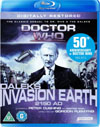
Daleks' Invasion Earth 2150 A.D.
 |
 |
 |
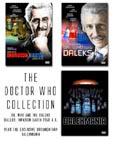
DVD NTSC
Region 1
in a 3 feature
boxed set


|
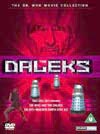
DVD PAL
Region 2
3 feature
boxed set
 A A

B

|
Blu-ray
Region B/2
for the U.K.


NEW for
May 27, 2013.
|
(See bottom of page for more options)
|
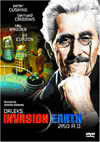
(Theatrical remake of Doctor Who Story No. 10,
starring Peter Cushing)
- screenplay by Milton Subotsky,
with additional material by David Whitaker.
From the original BBC-TV serial by Terry Nation
- directed by Gordon Flemyng
- produced by Milton Subotsky and Max J. Rosenberg
- music by Bill McGuffie and Barry Gray
- approximately 90 minutes, colour
|
Story: A policeman in an emergency discovers
Dr. Who's time machine - TARDIS - and is transported
along with Dr. Who, his granddaughter Susan, and his
niece Louise to London, 2150 A.D. The city
has been devastated by bombs, and the Daleks are enslaving
mankind. What is their real purpose in coming to planet
Earth? And what secret project are they undertaking in
the mines of Bedfordshire?
|
|
DVD Extras include:
- "Dalekmania" documentary chronicling the making
of this film and its predecessor (box sets only!)
- French language track (NTSC Region 1 discs only!)
- Photo Gallery
- Trailer
- Peter Cushing biography
Blu-ray Extras include:
- Restoring "Daleks' Invasion Earth 2150 A.D."
- interview with actor Bernard Cribbins (Tom Campbell - who takes over the role
written for Ian Chesterton in the TV version).
Cribbins also played Donna's grandfather Wilfred Mott in
season 30 and its surrounding specials,
opposite David Tennant.
- interview with author (of what?) Gareth Owen
- Photo Gallery
- Trailer
Buyers' Guide Review
by Martin Izsak
|
|
(A more in-depth analysis, containing "SPOILERS" and intended
for those who have already seen the program, can be accessed
here.)
|
As with the previous Dalek story, two versions exist of this
tale thanks to yet another bigger budget feature film, and one
version generally works while the other generally doesn't. This
indicates that the story itself has great potential, but
requires good dialogue, a strong cast, a fair standard of
production values, and most importantly a competent and creative
director. In terms of the writing, like
"The Chase" (story no. 16) and
"The Dalek Masterplan" (story no. 21)
which follow, and
"The Keys of Marinus" (story no. 5)
which preceded it, the story is a bit of a
collection of separate little tales and scenes, however there
is greater unity among them here because they are tied together
in theme and in situational origin: humanity is suffering
global hardship and subjugation, and there are as many ways of
dealing with that as there are people on the planet. Writer Terry
Nation then shows us some of the characters that he finds most
interesting, all the while stringing them into a cohesive plot
concerning our four time travellers and their first returning
enemies. How well does this work in a cinematic format? Let's
continue to compare the two versions:
Thankfully, this film is an improvement both on
the previous film
made by the same people, and
the television version
of this story. Let us count the ways.....
In terms of prop design, set design, effects design,
and dramatic design, the film offers us the definitive version
of this story's most famous elements. The Robomen both
look and act exactly the way they should: they are menacing,
while still being a bit zombie-like, and they are believable
high-tech conversions of normal people. The spaceship is no
longer a dinky pie plate on a string, but a decent looking
model that flies realistically and gets composited with footage
of the main characters in several inlay shots, not to mention
a few well-done wide angle establishing shots of the ship on
the ground for the "heliport" scenes. All of the major Dalek
colour ranks are definitively introduced, and the flashing on their
brilliant, large head-lights is solely and rightly reserved
to indicate speech. The still uncredited voice artists provide
the best Dalek voices of the entire 60's era, allowing one to
believe that while the Daleks' prime motivation in life is their
fear of being out of control and at the mercy of inferior
creatures, they channel this fear into aggression and
bulliness, and deliver a true sense of menace, threat and
danger to the proceedings. Their foam-gas weaponry looks
decidedly poisonous, and the stuntman who becomes their first
on-screen victim in the film really sells the effect in a
dramatic action sequence which was designed to highlight
the Dalek menace, and finally does so in this version.
This is the story that really promotes their favourite
battlecry of "exterminate", which alongside their bug and garden
gas spray, highlights their callous attitude in eliminating
all the "lower" life forms of the universe as if they were
simply going about their house-cleaning duties. After all,
what would the universe be coming to if they let hordes of
humanoids over-run it?
The dialogue introducing the word definitively occurs
during the first Dalek radio broadcast, and its importance
is reinforced as the Daleks surround the fallen stuntman,
and repeat their battle-cry. Compare the voice performances
of the movie and the TV episodes in these two scenes, and see
which ones you like best. Is the difference a matter of time
and budget, or one of proficiency of actors and directors?
The TARDIS is introduced well, even though it is hardly
used in this story. The sound effect during its one disappearance
isn't bad, especially considering that a lot of dialogue needs
to be spoken at the same time, but it's just not as satisfying
as the standard effect we all know and love.
The "magnetism" concept is more prolific in this version,
and more believably done as well. There is mention of magnetic
doors operating in Peter Cushing's TARDIS. Magnetism is discussed
once more in the cell on the Dalek saucer - and the
explanation makes sense this time, as does the idea of the
Dalek test (not to mention the fact that these scenes are now MUCH
more dramatic). Delving into this more would involve spoilers,
so I'll save that for the
In-depth Analysis version of this review, but suffice it
to say that those examples are further emphasis
that the movie is the definitive version of this story.
|
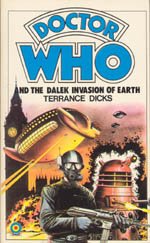
Perhaps the best proof of the movie's reign in the
definitiveness department is on the cover illustration of the
1984 edition of the novelization. Although Terrance Dicks
quite rightly novelized the television version to detail the
events occurring to the series' regular characters, the
cover shows the movie's Robomen, the movie's Dalek flying saucer,
and a red Dalek with large dome-lights that features only
in the movies. The best of both worlds.
The movie is also much better at involving the Doctor
and giving him the most interesting and heroic role. The whole
robotizing process is believable and dramatically demonstrated,
and the story beats surrounding the process are realized
much more believably and tensely. Where William Hartnell's
Doctor had little of anything to do in the middle of the story,
Peter Cushing's Doctor remains alert and quite active throughout
the mid-sections, gets to confront and pit his wits against
Philip Madoc (in his first and possibly best
creepy villain role in Doctor Who), plan the entire organized
attack by the good-guys, confront the Daleks face to face for the
finale, and do much of what was left to Barbara in the TV version.
Well, right on! And if certain last-minute rewrites hadn't
happened to the TV version, you could bet Peter Cushing would
have had yet another heroic beat to busy himself with too.
|
Sadly missing is the classic sequence of Daleks patrolling
London's famous landmarks, but there is a good reason for leaving
this out - nothing really happens in the sequence, and it has no
impact on the plot whatsoever. It just looked cool. In the
movie, one is tempted to believe that London's landmarks are
so badly bombed and scorched, that maybe we are looking at what's
left of them anyway, and not recognizing anything at all.
Something that does work much better are outdoor Daleks
versus the speeding van. The way it was shot, one can believe
that fancy maneuvering was required as the Daleks responded
to the van, and having a Dalek
move and talk after the incident also keeps the sequence
believable in terms of Dalek character.
|
Musically, the film is okay - most of the music works, and
is lively enough to be a big improvement on the previous
feature film. The orchestral portions convey action and suspense
well, while the montage of saucer sounds and electronic "whine"
music lend a nice atmospheric touch of creepy-alienness to many
scenes. The orchestra goes a bit over the top on a few occasions,
practically hitting the audience over the head with harsh sounds
as the mine is introduced, and of course the beloved theme song
is once again missing, so there is still room for improvement.
|
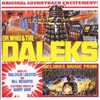
Music by Bill McGuffie and Barry Gray
has been made available on:
|
|
All in all, I will probably always prefer the movie
version of this story to the television one. Having a familiarity
only with the
Key To Time stories
and early eighties Doctor Who,
this movie gave me my first view of Daleks, not to mention
Doctor Who from the 60's, so the nostalgia factor is high for me.
Also, Richard Martin's television directing techniques
(seen in the TV version of this story)
often make
me cringe, so my mind is set. This movie is THE Dalek Invasion of
Earth, and one of the best Dalek stories.
This story has become available on DVD and VHS video, and is also on Blu-ray for Region 2 only.
Click on the Amazon symbol for the location nearest you
for pricing and availability:
| Single Story versions: |
|
 |
|
 |
DVD NTSC Region 1
single feature
for the North American market:
in the U.S.

in Canada

|
DVD PAL Region 2
for the U.K.

|
Blu-ray Region B/2
for the U.K.
NEW for
May 27, 2013.
|
VHS Video
NTSC
A
U.S./Canada

NTSC
B
U.S./Canada

PAL
for the U.K.

|
Peter Cushing feature film box sets:
(remakes of story nos. 2 & 10,
plus "Dalekmania" documentary)
|
|
|
|
|
DVD NTSC Region 1
3 feature boxed set
for the North American market:
in the U.S.
in Canada
|
DVD PAL Region 2
3 feature boxed set
A
for the U.K.
B
for the U.K.
|
|
Comments on this article are welcome. You may contact
the author from this page:
Contact page

LYRATEK.COM
|
Read the Buyers' Guide Review for the next TV story:
"The Rescue"

|
|