DVD Extras include:
Episode One - The WatcherTo start with, we get a beautiful angle of the TARDIS materializing in a nice, atmospheric sequence. The Monk's watchful eye helps focus attention on the effect as well. Too bad Camfield didn't pick up on the idea of reversing the sound for landings, though - Richard Martin still has one tiny one up on him. I also don't know about the superimposed titles for episode one - there's a bad risk of totally blurred whitewash if the recording drops a generation or two. Luckily, credit legibility improves for the remaining episodes.Steven joins the crew properly at this point, and his perspective allows the story and the episode to stand alone and be watchable to anyone who has never seen the series before. Excellent. The sub-plot about whether or not he will believe in the TARDIS's time traveling ability is a good source of thoughtful drama as well. William Hartnell turns in a good performance, as the Doctor has plenty of interesting scenes this episode and gets nicely intrigued by a mysterious set of anachronisms that only he and his friends can really notice. His interaction with Edith is refreshingly pleasant. The Gregorian chants lend a wonderful atmosphere to the episode, apart from providing yet another important clue. This is an excellent half-hour.
Episode Two - The Meddling MonkHere we get a Doctor-less episode, and a disappointing one at that. This one needs the presence of the Doctor via a good pre-filmed insert or two even more than episode three of "The Space Museum" (story no. 15). Sorry, a couple of pre-recorded lines on voice-over and a flying pan of liquid egg just don't cut it. We need the Doctor confronting the Monk - full visual face to face confrontation to keep the story moving, but this the script denies us.Well then, it's up to the companions to keep the story moving. They don't. Their focus isn't really on the story, it's on finding the Doctor, and thus they lead the audience to focus on the Doctor's absence as well. Bad scripting move. Well, what's left? The subplot of belief in time-travel threatens to become old, so thankfully it comes to an end in this episode while it's still fresh and the companions have all the time in the world to kill. In fact, it's truly emotional when Steven feels he has to accept the kind and friendly villagers at their face value - nice moment! Peter Butterworth begins to get more speaking scenes, and the Monk begins to shine - a worthy and very watchable recurring adversary for William Hartnell's Doctor, if only he were here.
Episode Three - A Battle of WitsThe Doctor's back, and the Monk's no longer hiding in the shadows, so the real main conflict of the story finally has a chance to build. Too bad it barely goes anywhere. The Monk has a plot, but the script doesn't. Plotwise, the Doctor merely repeats his episode one movements, then when he gets to the Monk, their conversation gets distracted into deceptive, illogical silliness by the pair of rogue Vikings. At least the Doctor is seen to get the upper hand in a lot of action this episode. Right on, thank you Dennis Spooner! Vicki and Steven make a couple of new discoveries, but enough of this already. Most of us long-time fans already know what the Monk is all about, and we're waiting for some kind of tangible conflict to arise out of the situation. So far all we've got is a lot of characters running around and missing each other, and when they do find each other, they then miss out on the opportunity to talk to each other.Reportedly, script editor Donald Tosh was a bit upset when William Hartnell decided to provide more background information about the time period to the audience in a little soliloquy just out of Edith's earshot. Giving away the whole plot prematurely, was he? Well, he doesn't say anything that anyone couldn't have got out of a history book, so if that's your whole Doctor Who story plot, then you haven't got much of a plot. My point exactly. I think the story is better with Hartnell's little addition and it makes a great and interesting scene. The writer should have given us that at this point anyway, and then built on top of that. The absence of plot finally comes to an end with the cliffhanger, which for once has nothing to do with the mechanics of an absent Doctor. It's an excellent cliffhanger, but somehow I feel it's at least one half hour too late.
Episode Four - CheckmateNow that all doubt about the Monk's time-traveling background has been vanquished, we can finally get to some serious conflict. At last, the Doctor and the Monk confront each other on the main issue at hand. These are some of the best scenes in the story, as philosophies about changing history are batted about. It's good, but not as good as the banter with Barbara in "The Aztecs" (story no. 6), which took place mostly in the second episode, leaving two more to build on the juicy conflict. Notice that what really gets the Doctor upset is not so much the Monk's meddling in time as is the part about him blowing up a lot of human beings with atomic weapons - even the Monk is embarrassed at that part, knowing he's not putting his best foot forward or staying true to his pretense of common goodness. That's pretty much all the conflict this story has to offer on this level though. As our three friends decide that they must stop the Monk, they are soon captured and tied up. By the time they are released, the Monk's plans are already in shambles. Well, how did all this come about if they haven't had a chance to do anything yet?You have to look right back to the beginning of episode three for your answer - yes, that's right, all the way back to the middle of the story. William Hartnell's first scene with Edith, after coming back from his holiday, the part in which he expertly imparts his knowledge of historical plans without breaking out of his character as a medieval traveller - this scene gives Edith the clue she needs to become suspicious of the Monk's motives later on in the episode. This eventually leads to her cavalry saving the day at the end of the story, although they remain totally in the dark as to the Monk's true motives or plans.... and if they knew they might well let him blow the Vikings up into atomic dust! Knowing the Monk's glib tongue, I'm surprised the Doctor doesn't do more to ensure that no anachronistic detonations occur in this time period. The comedic deceptions concluding this story weigh heavily against the philosophical arguments that form the main subject matter of this story's plot. Although the stopping of the Monk's current plan leaves a lot to be desired, we can at least enjoy the Doctor's prank in stranding the Monk where he is, and leaving him to the mercy of the angry villagers. This is well done, and gives a much needed dramatic satisfaction to the story's conclusion. No wonder this is so much better remembered than how the Doctor stopped the Monk from actually "changing" history.
Good Characters vs. The Plot's Missing Role:This story is generally good for the regular characters, especially for firmly establishing Steven Taylor, and creating the beloved old Meddling Monk. Edith is also a strong and well-developed character who makes a good appearance. One of the big problems with this story though, is the lack of any other really good memorable characters, particularly a local, powerful one to be feared and swayed with convincing arguments. (Shall we bring back Tlotoxl?) The Viking ship captain who appears in episode two looks like a formidable opponent who could create many obstacles for the TARDIS crew and/or the Monk to overcome, upping the stakes and building the plot, but sadly he never appears beyond his initial scene. Neither the other Vikings nor the restless Eldred can manage the job either - they're all too visionless, and all become less powerful and interesting as the story moves on. Wulnoth is a pleasant and reasonable guy, capable of calming others and keeping everyone focused on the task at hand, but he still has only a pawn's role to play in the larger plot, and he remains largely in the dark throughout the story. Douglas Camfield and his troupe of actors do a fine job of realizing the characters and squeezing as much drama as possible from them, but the right essence just isn't in them in the script to begin with.
ConclusionsSo.... The Time Meddler is a rather quiet story with quiet characters and not much plot, but is on the whole very enjoyable anyway. As the TARDIS leaves and a very interesting superimposed shot leads into the credits, a very odd and mismatched season of Doctor Who comes to a close. With Sir Ian gone, the Doctor will now have a much greater chance to play the solidly heroic main character.... if William Hartnell can only remain present during the episode recordings. With this new challenge in mind, season three is set to bring us much closer to the sort of story that Doctor Who thrived on for years to come......
International Titles:Deutsch: (Der Zeitseinmischer)Magyar: "Az időbabráló"
Русский: "Вмешивающийся во время"
Italiano:
Français: (Le manipulateur temporel)Strange that the French translation sounds more like a device (of Silurian origin?) than a person....
Season Two Rankings:
Absences:
    The Doctor:  - Dalek Invasion Earth 4  (Accident - fainting double)
                 - Space Museum 3          (Holiday  - absent)
                 - Time Meddler 2          (Holiday  - voice over)

    Barbara:     - The Web Planet 3        (Holiday  - absent)

    Ian:         - The Crusade 3           (Holiday  - filmed insert)
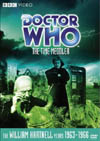
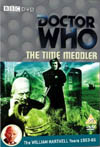
This story has become available on DVD and VHS video. Click on the Amazon symbol for the location nearest you for pricing and availability:
Comments on this article are welcome. You may contact the author from this page:
|