Special Edition and Region 2 DVD Extras include:
First ImpressionsLike Romana, I too got my first introduction to the Earth of the Doctor Who universe through this story, and I was slightly surprised that it was a present-day Earth and not a futuristic one as might have been suggested by dialogue in "The Ribos Operation" (story no. 98) or the spacey settings of the show in general. I didn't realize Earth was so primitive either, and I anticipated some disappointment and boredom during the search for this third Key to Time segment.However by the time Part Three was finished, I was so pleased with the plot's surprise twists and escalations and new interesting settings, that I thought it was turning out to be even better than "The Pirate Planet" (story no. 99). Doctor Who was a show that just kept getting better and better. I was hooked as a fan for life, and have always held a special place in my love of the program for the Key to Time stories that initiated me.
Stones In-depthThat said, the earlier parts of the story are a bit lacking. There is a lot of exposition near the beginning, which rightly needs to be what it is. However, more gripping questions would improve things a lot and help to engage the audience's curiosity in all that gets explained. If you're already interested in the cultural or scientific possibilities behind stone circles, it's great stuff. If you're not, it's doubtful that episode one will grab you. Professor Emilia Rumford's absent-minded ramblings to the bored and unusually patient Doctor epitomize the stagnant pace of the first episode's exposition. However, I do want to give a nod to the first scene in the TARDIS dealing with the Key to Time and say that I welcome this scene far more than the birthday party idea that producer Graham Williams rightly vetoed. First of all, we didn't get to see the second segment at the end of "The Pirate Planet", so this scene nicely satisfies those of us who were looking forward to that. Secondly, it is good to have the entire quest explained again for those who might have missed the first episode of "The Ribos Operation" and joined the season later on, while at the same time this allows "The Stones of Blood" to be completely understandable to anyone as a stand-alone story. Thirdly, this first scene with two segments complements the final scene with three segments being put together, tying the story together like a well structured pair of book-ends. The birthday idea offers little beyond inside-joke indulgence by comparison, and probably would have come off as really silly to the non-devoted viewer. But scene-swapping aside, what we get throughout most of the episode could still be improved with a sharper line of questioning to generate more interest in the flow of information and exposition. Although lacking a good satisfying materialization for the TARDIS, this story is perhaps the best yet for demonstrating the interior/exterior relationship, thanks to all the logical mid-story returns to the vehicle. Early on, "The Stones of Blood" features the most common story-crutch brought to over-use by the era of producer Philip Hinchcliffe (seasons 12-14), a gothic dark-arts cult, in this case a Druidic chapter led by Mr. & Mrs. deVries, who worship the mysterious Callieach. The deVries's turn out to be very melodramatic characters, and the cultish angle lacks interesting substance. However, the cult is of little importance in the true grand scheme of the story, and thankfully the more important characters are allowed to treat it as such. It is fitting that the full throng of cult members can be frightened away by one old woman in the dark, like the substance-less cowards they must be at heart, and Mrs. deVries has a chance to demonstrate more backbone than mindlessness during a heated debate with her husband early in episode two. But most refreshingly, the cult is pushed far into the background and ultimately forgotten by the middle of episode two, as far more interesting elements take center-stage, and as writer David Fisher makes good use of as many other possible rumours and theories surrounding stone circles as he can. On the larger scale, Doctor Who TV productions never quite returned to the same mindless kind of gothic cults after "The Stones of Blood". Like the rest of this same story indicates, from now on, it's on to extra-terrestrials, physics, neater-looking space environments, and a more intelligent level of drama and humour. Much more to my tastes. That said, episode three of "The Stones of Blood" is perhaps the most excellent 25 minutes of the whole of season sixteen, at least in being so perfectly plotted and balanced in the script. From the early stone chases peppered with humour, to the scientific industry and more personal scenes between the Doctor and Emilia, to the tense standoff between the Doctor's party and the Ogri at the circle, to the exploration of the newly revealed spacecraft environment and its implications to the mystery and backstory at work, to the menace and legal satire of the highly unique Megara characters, episode three is packed full of all the best elements that give Doctor Who its unique charm. The effects are quite satisfying as well - lots of colourful, full visual beams where required, not to mention hyperspace backgrounds and optical picture mixes to make the spacecraft come alive. Electronics Effects Supervisor A.J. Mitchell does a superb job on this story, as does uncredited guest Sound Effects editor Liz Parker, who makes the menace of the Ogri stones come alive. I quite like that the Megara turned out so different than most of the creatures one usually sees on Doctor Who; they truly represent an exploration of something new and different, which the show so often needs more of. An odd disappointment is the editing during the stone chases - quite often too much of a shot of a pursuing Ogri is used, allowing the viewer to watch it start or stop at the end of its rush up to or across the camera, destroying the illusion of its continued pursuit and the unrelenting tension the chase needs to sustain. I do think Professor Rumford falls into a common misconception among scientists regarding the speed of light while she's trying to explain hyperspace, which I have great fun in detailing in my article on speed and e=mc�. Although writer David Fisher leaves room for this to not be the complete truth (thankfully it is Rumford who spouts it and not our more widely studied main character the Doctor), it is sad that this view doesn't really get challenged either. It is actually more interesting when you find out how in many ways it is really hyperspace that put the "c" in E=mc�..... Episode Four doesn't quite have the same excitement or logic of the previous episode. The Doctor's plea to save his own life from Megaran justice takes up the focus of this episode, not bad if only it hadn't quite upstaged the investigation of Cessair of Diplos and the third Key to Time segment quite so much. The Doctor also misses the most obvious and logical reason that the Megara would have for sparing his life - if he made the honest claim that he was a witness needed for Cessair's trial, surely he would be spared until after her trial had concluded. Ah well, one doesn't always think of everything under pressure, and the Doctor definitely called his witnesses in sequence of desperately being able to think of them, rather than in the sequence that would most help his case and convict Cessair instead. Romana, Emilia and K9 get a lovely B-plot of action and investigation this episode, to make up for what the court room drama on the ship may be lacking. While this delivers a good energy to the final episode, their noble efforts and hard work amount to little when the Doctor resolves the main issues before Romana can present the new evidence. What a pity. Add to that the writer's cop-out when it comes to finding the third segment and dealing with the Megara in the end. The clues from the Tracer in the earlier episodes don't really match up with what the segment turns out to be. And when would the Doctor have had a chance to set the controls on the Megaran ship, facilitating his last minute get-away? The ending doesn't satisfy logic quite as much as it should.
International Titles:Magyar: "A vérkövek"Français: (Les Pierres de Sang) Русский: "Камни крови" This story is the 3rd adventure in season 16's Key To Time quest. It has become available on DVD and VHS video. Single Story versions:
Comments on this article are welcome. You may contact the author from this page:
|
|||||||||||||||||||||||||||||||||||||||||||||||||
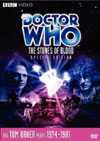



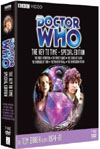



 in the U.S.
 in Canada



 in the U.S.
 in Canada