DVD Extras (on 2 discs no less) include:
Guardian Control of the GameThe opening shot introduces the metaphor of a chess game, which hints at the mindset of most of the major characters we will encounter throughout the story, and gives the adventure a boost in artistry and understandability. Nice move.Story structure is ideal for introducing main characters and settings, starting out with just our three regulars in their home environment, and only splitting off to meet new people as those three encounter them. Thus we get some of the best editing that appears during the 1980's, resulting in a story that is relatively easy to follow. Establishing shots are held back with good reason, waiting until our regulars would see something before showing it to the audience. The one casualty with this approach may have been the TARDIS, particularly as it misses out on the opening materialization effect that should ideally kick off a good adventure. Interestingly, I found that I could freeze-frame the version broadcast on TVOntario in the mid-1980's to find that the police box was missing from its initial landing-area in the first frame of its introductory shot, indicating that the required raw footage for an opening materialization effect was in the can, and that automated VT editing equipment can let you down if you don't program it with a few extra frames as a margin of error. Well, I looked for that extra frame again on the DVD release, but it looks like they've since removed it. Peter Davison's era is the one to turn to for viewing the deeper portions of the TARDIS interior, and we get another nice little bit here in this story. Darker lighting provides a spookier-than-normal look, indicating that something's not quite right today. It certainly isn't a template for day-to-day TARDIS operation, and everyone seems relieved when the lights finally return to normal. The stakes become significantly raised for this final story of the recent trilogy by the appearance of the White Guardian, who not only ensures that the Doctor is aware of the importance of what is to come, but also seems to make the Black Guardian insecure enough to tip his hand to the Doctor as well. Turlough too has a nice little underplayed moment where the discovery of the existence of a White Guardian intrigues him. Now both the Doctor and Turlough have been talking with their separate Guardians and neither is sharing all their information with the other. How much does each suspect? How will their slight but not-so-hidden distrust of each other affect the way they deal with the adventure ahead? The rest of episode one sustains itself with the exploration and discovery of the environment and situation the TARDIS has landed in. While this does actually work well, I won't pretend it's the greatest example of exploration in Doctor Who. The segments alternating between Tegan in the hold, and the Doctor and Turlough chatting up the crew, give little indication of where the story is heading, and aren't able to boast much in terms of visuals either. This sequence represents a bit of a lull in the narrative for me, but only a minor one. A lot of nice character moments come through with the crew; the better half of this sequence I think. The outright strangeness of the ship's officers becomes far more intriguing, and a better focus for the TARDIS crew's investigations. But really, it's only after the astounding revelation of episode one's cliffhanger that the real story can finally get underway.
Unique Playing FieldsSo many Doctor Who tales base their story on invasions and/or armies of nasty aliens up to no good, that it becomes REALLY refreshing to see a story so successfully based on a racing competition instead. This allows for pleasantries and good dialogue scenes as well as dangerous rivalries, uncertain outcomes, and exciting visuals.Efforts to make aliens truly otherworldly in science fiction movies and television often focus on external appearances more than anything else, while little is done to give them a different mindset, let alone one more advanced than that of brutal conquerors. This is another area where "Enlightenment" excels, chiefly by creating in the Eternals an alien culture that operates on an entirely different plane, and one that might be said to be much more advanced than typical sci-fi aliens. Their chief motivation - desperately trying to stave off boredom - sees them operating in ways and posing challenges to our protagonists that are very different from the usual. Also, how do you outwit an opponent that can read your mind? This puts the mockers on many of the usual sci-fi story beats, but because it has been well thought-out, a logically different playing-field takes over and proves both unique and equally interesting, if not more interesting. The good cultural exploration works both ways in this tale, with the Eternals equally interested in exploring what they call "Ephemerals", which include numerous Earthlings populating the adventure. Thanks to the arrival of the TARDIS, they can add the Time Lords of Gallifrey to their cultural explorations.... and one is left intrigued with even more tidbits pertaining to the culture of the Guardians, and to Turlough's still unidentified planet of origin.... "Enlightenment" enjoys a fairly rich cultural palette to wade through. Kudos. All this is achieved in old BBC TV studios, as an almost "Matrix"-like story device is cleverly employed to allow design to stick with historical sailing-ship decor and costumes, and have the entire cast appear human. Brilliant. The focus goes into the acting, where the inhumanness of the chief Eternal characters remains unmistakeable. Keith Barron, Christopher Brown, and James McClure aboard Striker's ship all give excellent held-back performances making the exploration of the Eternals work tremendously well, additionally hinting that Eternals that think alike end up sailing together. Lynda Baron gives an appropriately louder performance as the passionate Captain Wrack, which works great for her, but perhaps invites her first mate to go further over the top than he should. Mark Strickson ups his own game opposite her, giving a performance that chiefly continues to work only because she has been so strong that she seems to need him at that level. Fascinating stuff. The audio/visual excellence of this story is one of its major strengths. Beyond some great set design and costumes, we get a generous helping of fun model work and music that successfully combines the nostalgically nautical with the ethereal qualities of the stars, an absolutely sublime mixture.
Winning StrategiesThe plot continues to move well in later stages of the story thanks to a clever mystery slowly seeping up to the surface throughout the middle episodes. Stylistically, it seems to be the sort of thing that stories like "Black Orchid" (story no. 121) or "The Unicorn and the Wasp" (story no. 199) aim for, yet fail to achieve. Perhaps because the setting for "Enlightenment" is so much more interesting and the possibilities are more open, and perhaps because four half-hour episodes give the plot time to breathe, it is much more successful here. "Enlightenment" also holds back its biggest secrets and best visuals for the final episode, as it should be.From start to finish, Part Four quite rightly puts a lot of extra focus on Turlough's loyalty, giving him plenty of reasons and opportunities to choose varying sides, and keeping the audience guessing until the very end. Great stuff. Part Four is also the busiest episode for the Doctor, as one would want, giving him plenty of challenges to apply his skills to. It is good that he gets such an active heroic task mid-way through the episode, because shortly afterwards, one of his most decisive moments for the adventure happens off-screen, and we viewers have only Tegan and Striker's perspective on the event until later dialogue clarifies things - and perhaps not in the most proactive language one could hope for. The story's concluding beats offer us an unforgettable "summit" of the two Guardians, an unparalleled moment in Doctor Who's long history that offers vital clues as to the core of these two characters, helping define them in ways that were never managed back in "The Key to Time" season, but which help make better sense out of the events of that monumental arc, and help bring out elements that were in Graham Williams' original idea for that season but which never became as clear on screen. Peter Davison's Doctor also ends up demonstrating some excellent qualities here, effortlessly confident and in command during the final moments, yet surprisingly achieving this while being calm, peaceful, and still. It most closely resembles faith, perhaps in general that things will work out, perhaps specifically in what choices Turlough will make. And it makes you wonder who really has been in command of this "chess game" since the beginning. In particular, we know the Doctor can operate some pretty calculated long term plans himself, most famously during the reigns of Patrick Troughton and Sylvester McCoy, where such things often hinted at or brought out their darker sides. With Peter Davison, it seems it has brought out his more spiritual side. How aware has he really been all this time, of the Black Guardian's presence, and his plotting with Turlough? Has he been playing the gullible innocent on purpose all this time? Has he seen this as the best way to win Turlough over all along, this being the best key to ultimate victory? Particularly in this final adventure, acting oblivious, and indeed even thinking obliviously, may have been an important factor in preventing the Eternals from finding out what he knew. Little of this is articulated on screen though, and no doubt there will be viewer interpretations from horror / action fans who don't get this layer at all. Pity. This tale contains more of the reasons why Peter Davison remains my favourite Doctor after all these years....
Special Edition"Enlightenment" on DVD now comes with a new 2009 CGI-enhanced alternate edit of the story that offers some additional improvements and enticements. As I always believed since I first saw it, it is better to see the TARDIS materialize at the beginning of the story. YES! Nice one! Just what I would have done. The White Guardian's first disembodied voice-overs now also receive the audio treatment they always deserved, aiding the initial performances of the three regulars and helping draw one into the story a little better. And of course the opportunities to do more with CGI shots of the ships during the race are so enticing, that pretty much becomes the raison-d'être of the whole exercise. The bulk of the work is particularly excellent here (apart from one particular shot where all-too-obvious split-screen square can't hold a candle to the original shot, which was particularly majestic, well-realised for the time, and beautifully ethereal). And because the original effects shots are sometimes as short as they are due to limitations of what could be achieved then, the CGI team gains a lot of freedom to cut loose knowing that a whole new edit means that longer shots and more shots can now be stuck in. Awesome. Fiona Cumming has made sure that most of the new material does aid the telling of the story, and so there are a lot of enhanced story points being made, and it becomes even more of a visual treat.The CGI team is perhaps going a bit too far looking for new post-production effects to super-impose on the picture. Without there really being any substandard lasers anywhere in the Black Guardian trilogy (the obvious required upgrade on stories like "The Pirate Planet" [story no. 99] and "Resurrection of the Daleks" [story no. 134] ), they often turn to Turlough's crystal to plaster an obviously fake effect over the original glow - which does nothing to help tell the story, or excite the viewer. A lot of the trick-dissolves of Guardians or transmat devices have also been unnecessarily complicated with additional effects. Ho hum. By the time we get to the end of new "Enlightenment", these effects are seriously making the Black Guardian less black, taking away from his ability to melt in and out of the shadows, and really sapping his power. I don't think I'll be watching the Enlightenment special edition as often as the original version though, chiefly because of what has been lost. Twenty-three minutes of previously used footage has hit the cutting room floor, and I miss it. While I confess I had grown quite attached to the original rhythms of the audio and visuals as presented then, I think there's more to it than that. I've read much about the links between charisma and having the courage to enjoy a slow, deliberate pace instead of a quick, frenetic, NERVOUS one, and this seems to be a distinction somewhat lost on many of the makers of today's television and film. A slow pace, and indeed one that allows the space of a week between each episode of a story, also gives the audience the space to hear their own thoughts on the narrative so far, before all the mysteries and questions are answered for them. Director Nicholas Meyer, famous for the more popular Star Trek films, emphasizes the importance of the audience being able to bring their own interpretation to the experience in all forms of art, otherwise it isn't art, and in his opinion film & television have the most difficult time of all to try to curb their tendencies to do everything for the audience instead. Particularly when an original is such a highly regarded classic, taking 1/4 of it out can only lead to trouble, and the story-telling edge I mentioned it had on "The Unicorn and the Wasp" above begins to get slightly eroded in the new version of the story. Had the new version better recognized the values of the length, pacing, aspect-ratio, and audio/visual successes of the original, the good new stuff may have been better integrated into an improvement on the original. Generally speaking, I'd have been much more receptive to a longer edit rather than a shorter one. However, those accustomed to the pace of Christopher Eccleston's or David Tennant's eras of Doctor Who may find the new "Enlightenment" easier to get into and on par with, if not above, what they're used to.
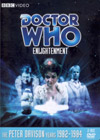
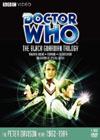
International Titles:Deutsch: (Erleuchtung)Magyar: "Megvilágosodás"Français: (Illumination)Русский: "Просвещение"This story is available on DVD as the final adventure of the Black Guardian Trilogy. Click on the Amazon symbol for the location nearest you for pricing and availability:
Comments on this article are welcome. You may contact the author from this page:
|