Original DVD Extras include:
Post production was once again a huge sore point for various reasons. After finalizing a four-part version for posterity and worldwide sales, the BBC then paired the episodes together so that British audiences would first see the story as two 45-minute episodes. Eric Saward is on the original DVD extras quite rightly nixing British fans' interpretation that such a holy event should cast the story's "proper" format in stone. No, it was designed and shot as a four-parter, and works better that way, with episode one's cliffhanger being too unique for a combined version to do the moment justice.
First ImpressionsWe Canadians were luckier in getting the proper four-part version during its first-run broadcast here in the mid-1980's. I had only seen Daleks in the Peter Cushing films prior to this, and it was super exciting to finally see them reappear on the TV show itself. Dave Chapman did very cool work upgrading the Daleks' extermination beam from what had been seen previously in "Genesis of the Daleks" (story no. 78) and "Destiny of the Daleks" (story no. 104), and though the exterminators' gas weapons in the Cushing movies were cool and somehow very appropriate, good lasers like this were more what I looked forward to.
Getting Post-Production Finishes Out of the Way....Apparently some versions of this story went out without some of the music / sound effects / (visual effects?) that were in the final BBC versions. But even on the "correct" versions, laser effects on the story still seemed half-finished. All the futuristic humanoid characters were left pointing flashlights at each other, and looking hammy while getting hit by absolutely nothing. Obviously, they were meant to have lasers too, and either time or budget or ability had dried up yet again. As before, excessive movement by actors on some shots, in addition to some blocking that would have placed moving actors in front of added beams, contributed to creating far more work for Dave Chapman had he tackled this than was feasible for this show's schedule.But, this story was too important to be left in such an unfinished state, or so I thought in the late eighties. As had been the case previously with "Warriors of the Deep" (story no. 131), it was time to experiment with laser upgrades during VHS video dubbing again. Noting that characters changed weapons in the story, careful attention was paid to using red beams whenever Lytton's troopers' rifles were fired, versus green beams for the station crew's toy-like firearms. By the time Mercer's final shootout came along, it seems the sound effects dubbers had not been as careful. And although the Daleks' effects were awesome each time they scored a plot-important hit, there were plenty of opportunities to add a few extra cyan beams for them here or there whenever they scored misses - often there were great sound effects already in the mix to indicate these. With so many of the current DVD releases sporting optional new CGI effects, I'm often baffled at the choice of which stories the "Restoration Team" decides to add these to. While they have made some impressive improvements on adventures that didn't really need it, many of those that need it most, like "Resurrection of the Daleks", get ignored. It baffles me how they think that the plain flashlights are okay. Even without the massive script re-structuring to involve the Doctor in more plot-lines, I thought the post-production editing itself, particularly in part one, was unnecessarily messy and cutting back and forth between unrelated settings too often. Early TARDIS interior scenes felt far too short, shaken up, confusing, and unrelated to any neighbouring scenes to make an acceptable introduction to the three regulars, but all this seemed easily fixable by tacking the final cliffhanger scene from "Frontios" (the previous story), onto the beginning of this tale as a pre-title "hook". It properly introduced the regulars and the challenge facing them through their first few scenes in the TARDIS, it didn't give away anything of the previous story's plot, and it went a long way to helping the upcoming adventure seem "big." "We're being pulled towards the middle of the universe..."Disappointingly, the so-called middle of the universe turns out to be London apparently. How quaint. But somehow not surprising. At least the outer-space setting for the other half of the adventure (vaguely specified only as being "remote") managed to make up for this. It could be Earth orbit for all we know, but all things considered, it's more likely and makes better sense to be some far flung nowhere.One of the most confusing things about part one is its failure to adequately establish its over-packed cast of characters, and the fact that in the outer space sections, they are actually supposed to be in two very different locations. Indeed, by the time part one's credits rolled, I found myself looking at lists of unfamiliar character names, played by unfamiliar actors' names. Who was who? Something was obviously missing from dialogue. Not only was the Doctor and/or his companions not meeting most of these people and becoming involved with them as should be happening, but dialogue also clumsily neglected to have the characters refer to each other by name, or on the few occasions when it did, left it unclear or unemphasized. Most characters in this tale are lucky to have their character names used once across all four episodes combined, and you have to dig to find them. The most notorious example I can think of is the name "Styles", mentioned only once in its ultra-awkward possessive when she is nowhere around in part three: "Davros is using Styles's laboratory." The audience must both catch that and think back to the episode that aired two weeks previously, when Styles had her one scene of being in command of that set, to make the connection. Many other character names never get mentioned on screen at all. This did seem to be the wrong way to write a story. The Dalek cruiser gets an awesome establishing shot to begin with, but sadly the ship doesn't really show up on screen very effectively after that. By the time the very quick, static establishing shot of the space station flips on and off of the screen, one may very easily assume it is the same place. Additionally, after Lytton has demonstrated such a strong visual commanding presence, all the dialogue of the space station crew discussing the character of their unseen captain I thought on first viewing was describing and referring to Lytton. The commentary even points out the similarity of the hats worn by the station crew and Lytton's gang when not in battle. An obvious remedy seems to be to combine a lot of separate scenes from a location together, especially during part one, to let one beat continue through from start to finish without interrupting it with another. Although extra establishing shots and space/vortex exteriors would be useful all through parts one and four, I have found that one of the most important juxtapositions that can be made is to go from Lytton's second scene on the Dalek ship, commanding "All troopers to battle stations. Battle speed!", to an exterior of the ship to remind viewers what it looked like (now doing the equivalent of Star Trek's warp speed with stars / space dust streaking by), and to make a hard cut to the clearly different space station sitting motionless, and let that flow into Styles and Mercer's first scene. Many of the scenes of the station crew's early reactions to the cruiser also work much better when intercut with new exterior optical effects footage to show the multi-ship outer space battles that are otherwise only talked about on the original version. It plays out so much better than cutting to unrelated scenes on Earth.
"The Doctor and his TARDIS. Perfect!"Another important juxtaposition is to go from Stien watching the arrival of the Earth soldiers at the warehouse, to the police box landing on the docks, continuing to the regulars' scene exiting the TARDIS interior, and cutting directly to them exiting the police box on location. A simple and obvious sequence to make the TARDIS clear for any viewers getting their first taste of watching Doctor Who, particularly if it's a fan showing it to them and proclaiming that "this is a good one!"
The Excellence ArrivesIt is important to acknowledge the things this story gets right. The Daleks' presence in the story isn't exactly a surprise, with the story's title giving that away, so we can be thankful that they aren't held back all throughout the first half-hour episode as Terry Nation had often done. Even if it doesn't quite seem logical for them to not be in the control room during Lytton's first scene there, they get a spectacular and worthy entrance placed appropriately in the middle of part one. A lot of things work so well here. Not only are they mysterious and threatening as they move forward out of the smoke attacking the station crew, they seem equally dangerous and possibly more scary in retreat, thanks in large part to the intense panic in their loud and very alien voices, superbly performed this time by Brian Miller and Royce Mills - very good casting by director Matthew Robinson here. The confused and shocked reactions of Jim Findley's Mercer and Rula Lenska's Styles also help sell the idea that perhaps what they just did to the Daleks wasn't the wisest move after all. The very next scene with Lytton and the two leading Daleks in the control room has a very effective mysterious, edgy atmosphere, rounding out a superb entrance sequence for the story's guest star creatures.And if this story does justice to any one character, it is Davros. One can almost excuse the fact that all of episode one's exciting futuristic action doesn't involve the Doctor, his companions, or anyone he is actively trying to help, by the fact that it all builds up so well to reveal that Davros is the "McGuffin" at the center of the entire thing, and it has all revolved around him. His reveal is also very nicely timed to be the first half of a double-cliffhanger. Having absolutely no idea who or what Davros was on my first viewing, I can tell you his image alone looked suitably intriguing and Dalek-related to fuel a huge sense of mystery and anticipation for learning more about him the following week. And the second half of the cliffhanger is exquisite, with the tracked-in close up of Peter Davison's Doctor as he caught his first glimpse of his adversaries for this tale, and the Dalek continuing to screech "exterminate!" even after the cut to the credits. I pity the British audience that didn't get to see it that way on their first broadcast. Davros proceeds to be the most interesting element of part two, if not the rest of the entire story. His scenes opposite Lytton and Kiston work really well, as they dig into each others' recent history and neatly fill the audience in on who they are, what their interests and motivations are, and what's been happening to Davros and the Daleks since their last appearance in "Destiny of the Daleks" (story no. 104). Great stuff, succeeding nicely in bringing me up to speed on this character during my first viewing, and whetting my appetite for "Genesis of the Daleks" (story no. 78) to no end. Davros also gets to demonstrate his devious side, something only "Genesis" has managed to do greater justice to yet. The Dalek ship is curiously different to most of the other spacecraft designs we have seen them using before. Although most of it has a nice "sterile" look to it that falls in line with their need to exterminate all other forms of life in the universe, the interiors look a bit more reminiscent of Movellan ship interiors from "Destiny of the Daleks" (story no. 104). Is this a ship they stole in one of their skirmishes in the backstory of the Movellan war? Equally, it might be more a ship that belonged to Lytton's group before they joined the Daleks. Externally, it just seems so much more square and "blocky" than the round saucers the Daleks seem to use in every other story that sees them traveling through space.
Enthusiastic director Matthew Robinson keeps up a tremendous pace and energy throughout the story, particularly in the first and last episodes, using both this and the cutting between short scenes to help disguise the holes in character motivation, helping the audience forget what each character may be trying to do, and helping them focus on simply what happens. This helps when both the Doctor and Tegan are stuck in separate instances of the prisoner dynamic throughout episode three. Strange that so much expensive location film was spent on completely irrelevant padding of Tegan's plot there.
Characterization Gone SourEarly sections of episode four are the most problematic in terms of character. Complete misunderstanding of how noble aims like peaceful negotiations or heroic actions work has led Saward to give Peter Davison's Doctor nothing greater than the most obvious example yet of the passive-aggressive syndrome routine to play out in his confrontation with Davros, with Davison appearing to be "stuck" on the passive side of things. Although the Doctor appears clever in conniving his way to Davros under his own power and proactivity, and has a few good lines debating philosophy with him, the only actions Saward gives him to contemplate actually doing are the ones he has just argued against. If he kills Davros, he'll be a hypocrite, and at this stage actually doing the Supreme Dalek's dirty work for him.Most important of all are the lack of stakes here. Who is the Doctor attempting to help in this tale? Exactly what is he trying to accomplish with Davros's death? Who is it going to save? You have to get very hypothetical to get an answer to that question. It's a huge contrast from where he was at the climax of "Earthshock". The Cyber Leader had clearly invaded the Doctor's space in the TARDIS, and was threatening the future of the Earth on the large scale, and his companions on the personal scale. He was completely justified in that story. Here, he's been too uninvolved with most of the people in the story, particularly those in the futuristic half of it. Why would he even seek Davros out? Putting an end to the Supreme Dalek's duplication plans would have been a more appropriate priority. Not that we fans wouldn't want a confrontation with Davros more. We just want it to make sense when it happens, and let the Doctor stay true to his principles.
Reversals of the JediAnother interesting comparison is that between the Doctor in this story and Luke Skywalker in "Return of the Jedi", especially as "Jedi" came out a few months before this was made. In the final confrontations, Luke is very proactive in going to meet Darth Vader, and spends almost all of his proactive energy trying to convince his father back to his side. Anytime he is seen to violently bring out his lightsaber, he is being emotionally reactive to the villains' taunts. As Luke regains his composure, his lightsaber is put away. Contrast that with the Doctor in "Resurrection", who attempts to use his proactivity to be violent, while his emotional reactivity shuts him down. Saward definitely got an important element reversed here. Indeed, while both "Jedi" and "Resurrection" feature a villain making a surprise turn to the good to conclude major plot lines, both after having been convinced and worked on by the main protagonist of the story, Luke's scenes with his father had been the confrontations that audiences had built up anticipation to see, and Luke proactively seeks them out. The Doctor's scenes with Stien, though quite good and rewarding, are something that he is unexpectedly forced into and trapped in, coming about reactively, and are overshadowed by the anticipation and greater perceived importance of the Doctor's meeting with Davros. Ending episode three with the "convince Stien" beat at its unresolved climax seems logical, but really makes the resolving fix of this beat in Part Four's reprise quite predictable, and the whole thing probably occurs too soon. "Jedi" smartly delayed its resolution until the climax of Luke's final confrontation with the villains.A problem with both "Jedi" and "Resurrection" is that, although the main protagonist's abilities to convince others to their side is a good thing, those others wind up using violent means to resolve the plot anyway, making the protagonists appear to simply have shifted their responsibilities to someone else. In that sense, surprisingly, Davros is the one that hits the philosophical nail on the head here, and with Peter Davison's Doctor unable to counter his arguments effectively, especially whenever he has the weapon raised, Davros has clearly been the more effective of the two in debating the issue. Is the Doctor lacking in action and courage? Here, I would say yes, mostly because he hasn't found a worthy action to courageously follow through on, and he spends way too much time neglecting to recognize this. I'd rather have the Doctor waltz in proactively, Tom-Baker-esque, cracking jokes, offering jelly babies, embodying and exuding a positive attitude towards life that makes his philosophical arguments for it effective, while cleverly crossing a few wires and pushing a few buttons to bring the violent plans of Davros and/or the Daleks to a crashing halt. That's a key part of this show's charm, I think, which Saward and Nathan-Turner and many others undervalued. This is also sci-fi, so it shouldn't be too hard to come up with devices for making this plausible even in the face of the serious danger and likely responses that Davros, the Daleks, and Lytton's troopers should make. And I think we only have to look at the previous story, "Frontios", to see that it is still possible and effective with Peter Davison's Doctor, and shows him at his best. It all boils down to Saward being unable to write, if not recognize, the true opposite to the active violence of Daleks and most other villainous forces in Doctor Who. Instead of proactive peace and positiveness, he is stuck on inactive passivity.... hence the constant return to passive-aggressive syndrome each time Davros wins his argument in Saward's head. One almost gets the sense that Davros here is expressing one of Saward's philosophical hang-ups, one that Saward himself doesn't know how to get past.
Unenlightened PainWhile important villains like Davros, the Daleks, Lytton, and to some degree Stien are fairly well written in this story, the collection of supposedly sympathetic characters that the Doctor should want to help, particularly in the futuristic half, are decidedly not well written. The end of their excessive whining and bickering whenever villains put them out of their misery is almost relieving instead - a very dangerous habit that Saward began to settle into. Indeed, as over-complicated as this story's motivational elements may be, it seems that everyone panics into cutting their losses in the final episode, resulting in a frenzied bloodbath that leaves only the minimal core group of regulars predictably unscathed in the end.Saward's only attempt to moderate this level of violence is to show how painful it is, how much it hurts. This is an absolutely daft philosophical direction, eating deep into the story's repeat-viewing value. We end up with far more excessive screams and sounds of pain in this story than is tasteful or appropriate, with Chloe Ashcroft's contributions being particularly ugly. It is interesting to note also how extended flashbacks of clips from the series' long history had become popular since John Nathan-Turner took over as producer, with at least one big one featuring favourably each year. Tom Baker had received two at the climax of "Logopolis" (story no. 116) giving viewers a nostalgic tour of the villains he had faced and the companions who had traveled with him. The flashback for the Brigadier's experiences in "Mawdryn Undead" had worked both in terms of nostalgia and also in introducing the character to an audience who may not have remembered him or seen him before. Both of those had very nice pieces of music coming to the fore in the soundtrack. The flashback of Cybermen encounters in "Earthshock" was probably the one that integrated best into the narrative of the story, and featured important dialogue over an atmospheric background sound loop. In "Resurrection of the Daleks", we get the most ineffective and gratuitous flashback sequence yet. There doesn't seem to be any reason for it, other than the fact that the production team knows such things have been popular with audiences who didn't yet have libraries of 1960's and 1970's Doctor Who videos on their shelves. The images get so distorted near the end of this, that you can hardly tell what you're looking at. Worst of all, the soundtrack is a horrendous load of painful screaming from the Doctor, over which we get a moronic batch of yelling out of Stien. As a climactic moment of bringing Stien over to the Doctor's side, this is disappointingly lame, distasteful, and poor.
Why you should never "light up a fag" in the Whoniverse:It is rare to see people smoking on Doctor Who, yet this story indulges in such things often. It does feel really out of place here, particularly in space where air has to be recycled and purified constantly, and should be at a premium. Perhaps even more interesting is the fact that just about any character who ever smoked on Doctor Who is also seen to die at the hands of the Daleks or other beings in their employ. The most notable exception to this is when the Doctor himself snuck around a corner to secretly light a pipe in "An Unearthly Child" (story no. 1), and promptly got clubbed on the head by a caveman. At least he seemed to have learned his lesson, and has never tried to smoke since. Perhaps this story makes some significant back-hand contribution to giving us a society of clean air?This story earns back a few points in retrospect after we learn that the character Lytton recurs in a future Doctor Who story. This generates more interest in him here, and adds to the mythology being advanced. Good stuff. Maurice Colbourne does a good job playing the part, and definitely deserved the encore that he later got.
Finalizing the FixPerhaps it is best that the Doctor / Davros confrontation comes early in episode four, in that it leaves time for the Doctor to do other things as well. He does finally get into a good bit of an action sequence in the second half. After having sent Tegan and Turlough ahead of him in the TARDIS to collect some extra armament for him, he gets to use the time corridor under his own power, very effectively use Dalekanium to fight his way into the TARDIS during some very well done single-camera work in the studios, and unleash the virus thus bringing an end to the warehouse battles and apparently the Daleks' plans. Not bad. It's also good that he gets a scene confronting the Supreme Dalek, but too bad there's only time for it to take place over the videophone on the TARDIS scanner screen - and has the feeling of being tacked on to an overpacked script at the last minute. Still, some good stuff. The final moment goes to Stien, is made quite dramatic, and works fairly well in terms of being satisfactory. Not the best ending ever, but it will do.Still, despite the considerable excitement and action and energy of the story, it all ends on a particularly depressing note. Every single guest star who was on a sympathetic side is dead at the end, repeating one of the idiotic mistakes of "Warriors of the Deep" (story no. 131), or "Horror of Fang Rock" (story no. 92) for that matter. Mercer would have been a good character to save, but hard to do while both the station and the cruiser blow up together. Colonel Archer and Sgt. Calder also looked like they were worthy of making it through the story, and were knocked out way too early. Tegan and Professor Laird's story beats were less interesting without Archer and Calder to continue rooting for. Again, we're eating into both the feel-good aspect of the tale (which "Resurrection" has almost totally thrown away), and its repeat-viewing potential. And for what? Even if the message of "Warriors of the Deep" is worth saying once, repeating it ad nauseum must mean the writer really hasn't listened to it himself. In case you missed it, Tegan draws much attention to the pain and suffering and horror of this story in the aftermath, using it as the reason for her exit. Can't say I blamed her one bit. The scene isn't bad, but so many other companion exits were more moving, and dwelt on better subjects. And on first viewing, I thought it was another bogus exit for Tegan anyway, as she had already had at the end of "Time-Flight" (story no. 123). At this point, I had somehow heard about a story called "The Five Doctors" (story no. 130) which hadn't aired in TVOntario's run yet, and I knew that Peter Davison's Doctor, Turlough, and Tegan were meant to be the "current" line-up in it. So I was sure that Tegan would be back. It's curious how the Doctor appears to forget what he's doing in this scene. He starts out declaring that he's on his way to talk to Earth authorities, then after Tegan interrupts with her departure, he pops off in the TARDIS with Turlough instead. Bizarre.
"It seems I must mend my ways."A noble final line from the Doctor, but sad in retrospect since much of the time of his next four incarnations is spent showing his philosophies unraveling further instead of being on the mend.
Deny EverythingIt's a bit disgusting to see John Nathan-Turner on the extras trying to defend the show as not being violent, reminding me of the government conspiracists on the X-Files operating under mantras like "Deny Everything". There are a lot of things that I like about this story, to the point where I may have been the first and hopefully not the last to painstakingly attempt to put in all the "missing" laser beams for the show, but let's face the facts. This story is violent. Far more so than the infamous "The Seeds of Doom" (story no. 85). And it is violent in a manner and to a degree that this devoted fan is embarrassed of. I would have preferred a better way to be much more prominently showcased. Saward makes a bizarre comment that everyone in his story does what they do in order to survive. Huh? It seems quite clear that their first concern is to wipe out their enemies, to the point where they'll commit suicide to do it. It's the opposite of survive, as far as I'm concerned. "Resurrection" is likely the most violent four half-hours of Doctor Who in existence. As I said previously in my review of "The Brain of Morbius" (story no. 84), "movies and TV shows (not to mention video games) do put ideas in people's heads, and people recall those ideas when they are faced with problems and challenges and they need to come up with solutions." If they've been fed nothing but a diet of violent solutions from entertainment, to news programs, to their personal social environment, it's no wonder they can think of nothing else when they themselves are challenged. That's why I think it's so important to include the idealistic in our stories, and to be as practical about it as possible. Each piece of work is a stone dropped in a pond creating ripples and contributing to far reaching results it could not have anticipated. "Snakedance" (story no. 125) helped lead me to some amazing places in my life that I could not predict or appreciate when I first saw it. "Resurrection" by contrast has too loudly emphasized unimportant aspects of the fifth Doctor and his era that did not do them credit.
International Titles:Deutsch: "Die Auferstehung der Daleks"Magyar: "A dalekok feltámadása"Français: (Résurrection des Daleks)Русский: "Воскрешение далеков"This story has become available on DVD and VHS video. Original release:
Comments on this article are welcome. You may contact the author from this page:
|
|||||||||||||||||||||||||||||||||||||||||||||||||


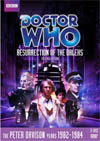

 in the U.S.
 in Canada
 for the U.K.