The Seeds of Doom
 |
 |
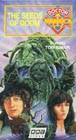 |
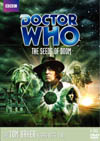
DVD NTSC
Region 1


|
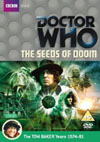
DVD PAL
Region 2


|
VHS Video
NTSC
A

NTSC
B

NTSC

PAL

|
|
(Doctor Who Story No. 85, starring Tom Baker)
- written by Robert Banks Stewart
- directed by Douglas Camfield
- produced by Philip Hinchcliffe
- music by Geoffrey Burgon
- 6 episodes @ 25 minutes each
|
Story: When a dormant alien plant pod
is discovered in the Antarctic, it attracts both
the Doctor and Sarah from UNIT, and agents
of the plant-fanatic millionaire Harrison Chase.
What unknown creature will be awakened from the
pod in more human temperatures? Will the Doctor
be too late to save the planet from the age of
the plant?
|
|
DVD Extras include:
- Audio commentary by Tom Baker (The Doctor),
John Challis (Scorby),
Kenneth Gilbert (Dunbar),
Michael McStay (Derek Moberley),
writer Robert Banks Stewart,
designer Roger Murray-Leach,
producer Philip Hinchcliffe,
and the late director's son Joggs Camfield.
- "Podshock" making of featurette (37 min.), with
Challis, Gilbert, Banks Stewart, Hinchcliffe,
production assistant Graeme Harper,
composer Geoffrey Burgon,
actor Ian Fairbairn (Dr. Chester),
designer Jeremy Bear,
design assistant Jan Spoczynski, and
visual effects designer Richard Conway.
- "Now and Then" location featurette (9 min.)
- Production Assistant / Unit Manager featurette
with Graeme Harper (14 min.)
- Interview of composer Geoffrey Burgon (10 min.)
- Isolated music score by Geoffrey Burgon
- Pop-up Production Note Subtitles
- Photo Gallery (5 min.)
- Comic strip featurette for the fourth Doctor (20 min.)
- Director Douglas Camfield's notes for a
compilation edit of the story in DVD ROM .PDF format
In-Depth Analysis Review
by Martin Izsak
|
|
WARNING: This review contains "SPOILERS", and is intended for
those who have already seen the program. To avoid the spoilers,
read the Buyers' Guide version instead.
|
Once more, we find the Hinchcliffe era team doing a UNIT story
half-heartedly, with their focus too much in the horror department
yet again. The monster of the week this time is a plant from space.
It sounds unique at first, but it ends up acting so much like the
Wirrn and the Axons that the plot becomes a predictable re-run.
But on the plus side, Douglas Camfield leads a great crew as the
director, and works his magic in bringing this extended re-run
to life.
Front-Loaded Excellence
I do enjoy the opening episodes in particular. Every character
and setting is expertly introduced, with deliciously atmospheric
establishing shots where necessary. The Doctor is somewhat reduced
to the eccentric scientific advisor of UNIT, introduced only on those
grounds, without Sarah or the TARDIS even slightly mentioned. It isn't
terribly important to know anything else about him, until the question
comes up of how he knows so much about alien plants like the Krynoid.
The Antarctic segments work well, as the setting is realised
very believably, and the Doctor and Sarah are occupied by joining
forces with an investigative team at the base, resulting in an
intelligent plot. Hubert Rees of
"Fury From the Deep" (story no. 42) and
"The War Games" (story no. 50)
also returns to bless the solid cast with a familiar, likeable face.
And at this point in the story, there are enough unknowns surrounding
the Krynoid to keep the creature fresh.
Episode three remains interesting while gradually following a string
of logic back from Antarctica to England, making the Doctor and Sarah
work through some intrigue to find the country house of lead human
villain Harrison Chase. The pair never do get anything worthwhile to
do at the house though. The plot there is far too primitive, alternating
between either making the Doctor and Sarah run and hide from guards and
monster, or forcing them to play prisoner. Yawn and snore. Episode
Four is particularly stagnant for the Doctor, who has to spend nearly
the whole episode tied up and having a staring contest with a compost
shredder, occasionally trading polite threats and insults with the villains.
It goes on for way too long. Literally, all of the interest is on
the villains, and during the fourth episode particularly on Keeler's
transformation. Mark Jones does some excellent acting work to make
the event as disturbing as possible.
Do some people really consider this the most violent Doctor Who
story ever? It hasn't got anywhere near the huge body-count of many
later 1980's stories, but perhaps the few there are here are particularly
tense and gruesome. After all, Douglas Camfield does have another
future suspense-master director as his production assistant: Graeme Harper.
I don't want to complain that the action in this story is too violent,
rather it gets too repetitively primitive and thus boring before it's
all over. The script isn't delivering challenges that the Doctor and
UNIT can sink their teeth into. Instead the solutions are simple,
and wouldn't require much interaction with the villains, therefore
the story is padded to keep the Doctor and Sarah trapped on the scene,
while UNIT is kept off the scene until the end.
No Brigadier, no Benton, no Harry. Just the influence of the
organization, and a few replacements today. UNIT gets more action here than
in "The Android Invasion" (story no. 83),
which is one improvement at least.
The laser gun is an obviously disappointing effect, with a silly
blob of light replacing a decent line-of-fire beam. That said,
Camfield directs the laser gun sequence clearly and gets a maximum
of energy out of it, making it emotionally satisfying at least.
Saving Sergeant Henderson
Near the end, the Doctor nearly explodes in a panic of anger
when he suspects that Sarah is in danger and he rushes off to do
something about it. Well big deal for the audience, most of whom don't
expect that the producers will allow Sarah to get bumped off. It
would have been far more gripping to see the Doctor care as much
to set himself the task of saving Sergeant Henderson instead, as
it is far easier to keep the audience guessing his fate until the
end. Alas, such wisdom does not occur in this script.
The conclusion of the story is somewhat anti-climactic, without
any real surprises or even possible surprises to sustain the tension.
Even "The Invasion" (story no. 46)
fared better through a similar flaw.
Acting performances are superb by all. John Challis and Tony
Beckley have to carry most of the weight to make the rather outlandishly
written villains Scorby and millionaire Harrison Chase work believably
off the page, and both do about as good as one could hope for. Even though
the villains do depart somewhat, all the characters are solidly based in
reality, rendering them easily understandable to the audience.
|
Geoffrey Burgon returns once more to give the Doctor Who audience
some variety from the usual Dudley Simpson fare. The score is quite
good, but sounds a little too much like
"Terror of the Zygons" (story no. 80) without
being quite as interesting. By far, the best new bit is Amelia Ducat's
theme, and as such, it's a great pity that Camfield's team didn't have
the foresight to cue the pure version of it during her first scene
and thus make all the variations on it during later cues more
appreciable. As it stands, without the pure version heard anywhere
in the story in its entirety, the Ducat theme can be very easily
overlooked.
|
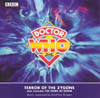
Music by Geoffrey Burgon
The original score features on:
|
|
In the end, I think
"Pyramids of Mars" (story no. 82)
still fares slightly
better than this story. It really is chiefly the country house
portions that drag this story down. The characters in this story are
a little better than those of "Pyramids of Mars" but not enough to
shift the balance into their favour. It is a well-told tale of a
horrific and not terribly interesting event.
International Titles:
Magyar: "A végzet magjai"
Français: (Les graines de la malédiction)
Русский: "Семена судьбы"
Español:
|
(Spain, Mexico): "Las Semillas del Mal"
(Chile): "Las Semillas de la Ruina" o "Semillas de Maldad"
|
Season Thirteen Rankings:
Best Story:
- Terror of the Zygons
- Planet of Evil
- Pyramids of Mars
- The Seeds of Doom
- The Android Invasion
- The Brain of Morbius
Best Writer:
- Robert Banks Stewart
- Louis Marks
- Robert Holmes & Lewis Greifer
- Terry Nation
- "Robin Bland"
|
|
Best Director:
- Douglas Camfield
- David Maloney
- Paddy Russell
- Barry Letts
- Christopher Barry
Best Music:
- Dudley Simpson - Planet of Evil
- Geoffrey Burgon - Terror of the Zygons
- Dudley Simpson - Pyramids of Mars
- Dudley Simpson - The Brain of Morbius
- Geoffrey Burgon - The Seeds of Doom
- Dudley Simpson - The Android Invasion
|
This story is available on DVD and VHS video:
|
|
|
DVD NTSC Region 1
for the North American market:
in the U.S.
in Canada
|
DVD PAL Region 2
for the U.K.
|
VHS Video
NTSC
A
in the U.S.
NTSC
B
in the U.S.
NTSC
in Canada
PAL
for the U.K.
|
Comments on this article are welcome. You may contact
the author from this page:
Contact page
|