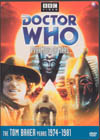
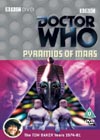
DVD Extras include:
Character FlawWhat we see of the guest characters during their time on screen makes them seem quite a boring bunch. Many of them are little more than fingers and toes for Sutekh, who is constantly discussed and yet still never gains a greater depth of character exposition than: "Oh, I want to be evil and destroy everything because that's good to me." Lots. Not as believable as a character should be. Sutekh and his followers constantly spout insults and threats with religious fervour, which in itself is quite boring, and although the Doctor manages to have a small bit of verbal fun now and then, it's not enough to make the drama entertaining all the way through.The opening footage of pyramids in Egypt starts the story off right, and the real Marcus Scarman's only scene in the tomb is enjoyable, up until the point where he gets killed by absolutely nothing. (VERY reminiscent of the beginning of the previous story!) Nice footage; it just needs a video effect to complete itself. The TARDIS gets a useful exterior establishing shot, and satisfyingly liberal use of the interior, a welcome rarity for the Hinchcliffe era. The Doctor and Sarah are both introduced exceptionally well, both with opening visual shots and with all the right exposition in the content of their dialogue, but unfortunately the Doctor's mood is rather foul, so perhaps it isn't well to introduce new viewers to the show through this story after all. Then, not only is the TARDIS materialization skimped on, but the police box is completely neglected in the storage room in which it is supposed to have landed throughout the first two episodes. Visual literacy gone awry. The final two episodes do the police box justice in this room; too bad no one had the quick thinking to bring some of those shots forward into the first two episodes to make them more complete. The Doctor does surprisingly little real investigation in this story; instead he follows the villains around and hides while they throw their religious curses and threats around, then he doubles back to a safe place with his friends and proceeds to spout answers off the top of his head as if all the details of Sutekh's history and technology were common knowledge across the galaxy. If that were true, there'd probably be more Sutekh imitators than one could count. This running back and forth between morbid eavesdropping and exposition in a safe place accomplishes very little for our heroes and makes a boring plot. It is overdone here, and re-used formulaically in more stories than I can count.
Music and Energy
"Every point in time has its alternative...."Sarah brings up an excellent idea in episode two, to use the TARDIS to navigate back to the 1980 that she knows. Of course we can't expect the Doctor to admit that he doesn't know how to do that by TARDIS navigation alone, even if he does accept the notion that Sarah's 1980 and the alternative one destroyed by Sutekh are co-existing simultaneously. So far, the only way he knows of accessing Sarah's 1980 is by going through the motions of defeating Sutekh, and then going forward in time with the TARDIS. In fact, I'll bet it was his foul mood that guided him to this deadly version of 1911 in the first place.The scene is a lovely use of the TARDIS interior, and the CSO revealing the desolate landscape is brilliant - quite a rarely used style of doing the TARDIS doors. If only Harry Sullivan had had as good a scene in the interior at the beginning of the Tom Baker era as Laurence Scarman does here, the series might have been much easier to follow for general audiences and made a better first impression on North American viewers.
CastingMichael Sheard stands out among the guest actors, giving quite an endearing performance for Laurence Scarman. Gabriel Woolf, whose performance is necessarily based almost solely on vocal characteristics, succeeds in creating a chilling presence for Sutekh despite the melodramatic dialogue given by the script. The rest of the actors do adequate work, but can't quite rise above the script that has most of their characters bogged down in an unpleasant quagmire of drowsiness and morbidity. Ernie Clements in particular seems to be a less interesting re-working of Holmes' Sam Seeley character from "Spearhead From Space" (story no. 51).
Design HighlightsIan Scoones, Christine Ruscoe, and Paddy Russell also deserve due credit for making the story such a successful visual treat. We get lots of ornate Egyptian artifacts and wall decorations, plus lavish English mansions, followed by a trip inside a Martian Pyramid. Then there are outstanding colourful effects like the space/time tunnel, not to mention the ripples of light on the sarcophagus itself as Sutekh speaks.And Tom Baker gets what must be the most definitive coat of his era - a magnificently rich brown with slightly golden highlights. It's perfect.
The Best of the Four EpisodesEpisode Three boasts the strengths of the story's plot, as it revolves almost entirely around the Doctor's efforts to thwart Sutekh's pyramid shaped "rocket". The story beats are all logical and escalate in a satisfying manner. They still come off a trifle slow, but they are solid, and work much better than many other season thirteen offerings. This episode also shows off the best of the location work around the house. The robot mummies are a unique sight, particularly on location, and somehow they seem to be at their most appropriate outdoors around the pyramid "rocket".Episode Four should be the most interesting of all, as we get to go to Mars to explore a pyramid there. The visuals are certainly fascinating, but the characters (what few of them are left by this point) are at their dullest. The Doctor himself is tortured and drained of most of his charm after a little possession by Sutekh during the journey to Mars. Paddy Russell gets a star for including the one perfect shot of the TARDIS interior that we need during that sequence, with the added bonus of seeing the room full of Egyptian artefacts through the TARDIS exterior doors. The sequences of the Doctor and Sarah following Marcus Scarman and his mummy through all the door puzzles offers little of interest to the older, more sophisticated members of the audience. The Doctor ultimately has no need to follow Scarman at this point, and because he is following, doing the puzzles second, his efforts to solve them really don't carry much relevance at all. In "Death to the Daleks" (story no. 72), the city of the Exxilons looked far more boring, but the story was better structured, with the Doctor hitting the puzzles first, and needing to complete them quickly before the Daleks caught up to him. Here, the puzzles become more padding than anything else. Presumably the rocket would have bypassed them by destroying the entire pyramid. Would that have worked, or did Horus have a booby-trap ready for that contingency? Horus doesn't actually seem that smart.
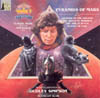
International Titles:Deutsch: (Die Pyramiden von Mars)Magyar: "A Mars piramisai"Français: (Les pyramides de Mars)Русский: "Пирамиды Марса"Italiano: "Le piramidi di Marte"Español: "Las Pirámides de Marte"This story has become available on DVD and VHS video:
Comments on this article are welcome. You may contact the author from this page:
|