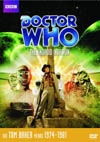
The Android Invasion
 |
 |
 |
DVD NTSC
Region 1


|
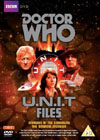
DVD PAL
Region 2
U.N.I.T. Files
Box Set


|
VHS Video
NTSC
A

NTSC
B

NTSC

PAL

|
|
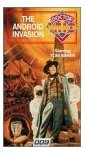
(Doctor Who Story No. 83, starring Tom Baker)
- written by Terry Nation
- directed by Barry Letts
- produced by Philip Hinchcliffe
- music by Dudley Simpson
- 4 episodes @ 25 minutes each
|
Story: The TARDIS abandons the
Doctor and Sarah in a silent empty English village,
suddenly filled with people who switch on and off
like clockwork, and guarded by blank-faced androids.
Who is pulling the strings of this secret project
from behind the scenes? Can their old friends
Harry Sullivan and Sgt. Benton still be trusted?
And how does a famous returned astronaut fit into
the puzzle?
|
|
DVD Extras include:
- Audio commentary by
producer Philip Hinchcliffe,
actors Milton Johns (Crayford) and
Martin Friend (Styggron), and
production assistant Marion McDougall.
Moderated by Toby Hadoke.
- "The Village That Came to Life" making-of featurette (31 min.) with
Hinchcliffe, Johns, Friend, and
director Barry Letts.
- "Life After Who" Philip Hinchcliffe career retrospective featurette (30 min.)
- Photo Gallery
- Pop-up Production Note Subtitles
- Easter Egg
In-Depth Analysis Review
by Martin Izsak
|
|
WARNING: This review contains "SPOILERS", and is intended for
those who have already seen the program. To avoid the spoilers,
read the Buyers' Guide version instead.
|
This somewhat obscure story contains some ironies for the
production crew. Producer Philip Hinchcliffe has stated how
keen he always was to move away from Earth-based UNIT stories
and get back into outer space, yet one of the reasons I prefer
the later Graham Williams era is that Hinchcliffe did too many
stories stuck on present day Earth, with situations that attempt
to involve UNIT and can't pull it off in a satisfying manner,
instead of making a good clean break.
You have to wonder why Holmes threaded so many stories together
by having Sarah always asking to go home (often not seriously wanting
to), and the Doctor always
promising to take her. Even when we are enjoying a good space adventure,
our desire to return to the UNIT gang is thus rekindled, putting a
monkey-wrench into Hinchcliffe's plans.
And poor Terry Nation, a writer who has proved his talent on
classic Dalek stories and in his Blake's 7 series, makes his
first attempt at writing for UNIT only to have Nicholas Courtney
refuse to do the Brigadier. Even the presence of UNIT era
producer Barry Letts coming back to direct this story isn't
enough to give it the right UNIT feel.
What the story does give us is a lot of formulaic sci-fi
and horror elements: people being replaced by zombies, gullible
souls being used by ruthless beings, radiation apocalypses,
capture and escape routines being used too often in one script,
arguments over whether or not to kill the protagonists, and
unbelievably overcomplicated ways of going about it. If
Terry Nation hasn't used a particular element many times before,
Robert Holmes has between himself and the writers he as script
editor employs, and these elements are usually done better elsewhere.
|
Dudley Simpson does an adequate and enjoyable job on the score,
weaving in his relatively new Fourth Doctor's Theme as usual. The music
remains a typical example of his good quality work without standing out
as anything too special this time around. The police box makes
a solid showing, with an extra movement near the beginning of the story;
the TARDIS interior is ignored as usual. There are a few laser shots
fired in the story; the effect disappointingly lacks superimposed
visual beams again, although it is better than the blobs used in
"The Sontaran Experiment" (story no. 77)
and the lighter artillery in
"The Ark in Space" (story no. 76).
Tom Baker gets yet another brand new coat for this story,
even though his previous one had only appeared in one story. And there
must be at least two of the new ones off the bat so that his doppelganger
stunt double can have one as well. The speckled grey coat is nice
for variety, but is my least favourite in Tom's Doctor's wardrobe.
I don't mind so much seeing it dragged through the dirt in episode two.
The Kraals are not a bad design at all - the stooped rhinoceros/
triceratops look is achieved with good jaw movement and expressiveness
in the eyes. It works for a villain with many lines of dialogue.
Still, somehow the insect look that Terry Nation originally
envisioned seems to fit the stealthy, android-building character of
the villains better. Whether insects would be as believable with all
that dialogue is another matter.
|
A suite of music from
Parts 3 & 4 of this story (6:32)
is available on:
|
A longer music suite from
Parts 3 & 4 (9:04)
was released on:
 |
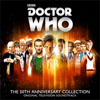
Audio CD -
Doctor Who:
The 50th Anniversary Collection
11-disc version (2014)
More info
|
|
|
This story is also paced quite slowly, and it shows most when
the Doctor and Sarah observe and confront the village full of zombies.
Simpson leaves many of these sequences silent, which is what the
story calls for, but in the wake of similarly dead characters from
"Pyramids of Mars" (story no. 82),
it encourages me to sleep. It takes two episodes for
the Doctor and Sarah to figure out what's going on, but at least
the Doctor apologizes several times for not being on the ball.
Things look like they will get moving in episode three, what
with one setting being traded in for another, and anticipation for
further travel coming from the dialogue, but this episode keeps the
Doctor locked in a cycle of silly capture and death-defying-escape
routines, and by the time the cliffhanger comes along, it hasn't
a hope of outdoing them. And then episode four effectively doubles
back on itself, and we see more of the same old setting that we
thought we were in before.
At least Harry and Benton are in this story.... barely. Really,
they are completely absent from episode one, and only appear briefly
in the next two episodes, and then only in their boring zombie android
forms. Only in the final episode do we see the real characters, along
with the Brigadier's replacement Col. Faraday and a host of new personnel
at the space control centre. The UNIT atmosphere begins to gel, for
about half an episode, and then androids take over and we're back where
we started again. The story does finally move well in this episode,
and the crisis is concluded satisfactorily. Perhaps because I don't
remember this story in as much detail as many others, it retains the
ability to surprise me. The location filming is particularly enjoyable
throughout. I also like Max Faulkner's new UNIT character, Corporal
Adams, who gets excellent exposure in this story and has a chance to
do several stunt "deaths" as per his forté.
"The Android Invasion" is a fairly solid Doctor Who adventure
of minor importance in the grand scheme of things, and not my particular
cup of tea. I still rank it second last in the season, without
placing the season itself on too high a pedestal either.
International Titles:
Magyar: "Az android invázió"
Français: (L'invasion des Androïdes)
Русский: "Вторжение андроидов"
Español: "La Invasión de los Androides"
This story is available on DVD and VHS video.
Click on the Amazon symbol for the location nearest you
for pricing and availability:
|
|
|
DVD NTSC Region 1
for the North American market:
in the U.S.
in Canada
|
DVD PAL Region 2
U.N.I.T. Files
Box Set
for the U.K.
|
VHS Video
NTSC
A
NTSC
B
NTSC
PAL
|
Comments on this article are welcome. You may contact
the author from this page:
Contact page
|