Silence in The Library
 |
 |
 |
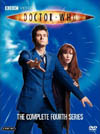
DVD NTSC
Region 1
14-episode
box set


|
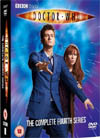
DVD PAL
Region 2
14-episode
box set


|
DVD PAL
Region 2
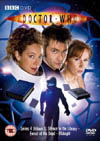
3-episode volume

|
|
(Doctor Who Story No. 200, starring David Tennant)
- written by Steven Moffat
- directed by Euros Lyn
- produced by Phil Collinson
- music by Murray Gold
- 2 episodes @ 45 minutes each:
- Silence in The Library
- Forest of the Dead
|
Story: The Doctor and Donna arrive on The Library planet,
its skyscrapers and halls of books and records strangely
empty and silent. Teaming up with an expedition sent to find
out what happened to all the people, the Doctor meets for the
first time Professor River Song, who has encountered the
time-traveler's future self countless times. What deadly force
is hiding in the multiple moving shadows of The Library's halls?
What is the connection to a little girl who knows The Library
to be all in her mind? And what secrets does Song know about
her future relationship with the Doctor?
|
|
DVD Extras (box sets only) include:
- Episode One audio commentary by
surprise-preserving writer Steven Moffat
vs. spoiler-queen executive producer Julie Gardner,
with referee actor David Tennant (The Doctor).
- Episode Two audio commentary by director Euros Lyn,
script editor Helen Raynor,
and costume designer Louise Page.
- Doctor Who Confidential featurette: Shadow Play (14 min.) with
Moffat, Tennant, Lyn,
Catherine Tate (Donna Noble),
O-T Fagbenle (Other Dave),
Harry Peacock (Proper Dave),
director of photography Rory Taylor,
choreographer Ailsa Berk,
executive producer Russell T. Davies, and
producer Phil Collinson.
- Doctor Who Confidential featurette: River Runs Deep (12 min.) with
Tennant, Tate, Moffat, Lyn, Davies, Collinson,
Alex Kingston (Professor River Song), and
Colin Salmon (Dr. Moon).
- Deleted Scene (1 min.) - introduced by Davies
- Trailers & Promos
In-Depth Analysis Review
by Martin Izsak
|
|
WARNING: This review contains "SPOILERS", and is intended for
those who have
already seen the program. To avoid the spoilers,
read the Buyers' Guide version instead.
|
At last the new Doctor Who team crafts a story good enough to rival
Season 28's
"The Impossible Planet" (story no. 178) and
"Rise of the Cybermen" (story no. 176),
and as those stories did previously, earn the mantle of epic classic.
Excellent. Steven Moffat turns in his best writing yet on the series,
making brilliant use of the coveted late-central two-part slot
for the season that always seems to rank well critically.
The setting is superb, the season's third new planet so far, and what
looks to be its most interesting one yet. While this isn't the first
massive alien Library setting in sci-fi, it is surprising that it is
so rare on popular sci-fi shows. I seem to remember a particularly
impressive one in an issue of Doctor Who Comics from Marvel, causing
me to think that this was exactly the kind of highly civilized
alien planet settings we should be getting on the show. The original
Star Trek series also took a good stab at an alien library in the episode
"All Our Yesterdays" (production #78) albeit on their limited budget.
Now finally free to do something with CGI, official TV Doctor Who produces
a beautiful and grand spectacle here. Nice one.
Of course, when it comes
to the year, Steven Moffat chooses his favourite futuristic time period,
the 51st century. Not sure what that fixation is all about, but I think
the 51st century makes its best showing yet on the series, and is better
than the round 100 000's and billions that Russell T. Davies seems to
favour, although the "-slash-apple" on the end of some of those dates
added a nice bit of strangeness.
I have only two serious complaints about this story, and regular
readers of my reviews can probably guess the first one. For no good reason
that I can see, Moffat and director Euros Lyn leave out any exterior shots
of the TARDIS coming or going, when a good materialization to start the
story off right seems like obvious easy extra points. It is really, really
sad to see how often this staple effect is being skipped all throughout
David Tennant's otherwise superb era, especially in the stories immediately
surrounding this one. I hope they're not all saying, "well, the next &
previous story probably did this, so we don't have to", because meanwhile,
all stories seem to be collectively dropping the ball. Felgercarp!
A bigger problem concerns the internal logic of the Vashta Nerada
and the shadows. While Moffat and co. get great mileage and entertainment
value out of each scene that tackles shadow problems and their
associated villains, nicely interspersed amongst scenes that tackle
other equally interesting subjects, I continually come away from individual
scenes and the story as a whole not really understanding the mechanics
of the danger or the remedies used to combat it. Staying out of the shadows,
ANY shadow, seems to be good common advice for the whole adventure, yet
characters often stand in or run through odd shadows all the time when
the script has no intention of drawing attention to such things, indicating
that the director and his lighting technicians weren't able to control such
things as ideally as they might. Perhaps asking for this on a television
schedule was asking too much, so too bad the whole threat in the story
hinges on lighting so much.
But that's not the only unexplained part of it. Exactly how should it
help to put one's space helmet on? Especially after seeing how it doesn't
really help the first person who does it? What good does it do to stand
still after you know you've got "more than one shadow", which by the way
is not uncommon when there is more than one source of light in a room,
as there usually is in this story. And ultimately, does this Library
ever become safe for use again? The final situation with the shadow
forces is left a little unclear and unsatisfying when all is said and done.
The story really excels with character relationships, and all the other
fascinating ideas it manages to explore, and after weaving all that in
between segments of the shadow plot, it creates such a rich tapestry that
the remaining plot holes with the shadows are easier to miss.
|
Having definitively reached the second half of the season,
Murray Gold explodes with a batch of wonderful new compositions,
mostly with deeper and richer levels of emotional expression than what
we got in the first half of the season. Some of the pieces more famous
for later episodes make their debut here, making "Silence in the Library"
probably the best musical experience of the year as well.
There are too many good ideas properly explored in this for me to go
through them all, and in the end I think I'd only be "spoiling them"
anyway by talking about them here. One curious thing is the quantity
of what looks like ordinary present day Earth that we get in the second
instalment "Forest of the Dead", which Moffat and co. completely get away
with by embedding it within an alien planet story. Is it the present,
or the 51st century, or some time in between? The viewer can decide
for themselves.
One of the unique elements of this story that it really excels in
is the relationship between the Doctor and Professor River Song, which
has them both experiencing their visits with each other in different
sequences. Brilliant. This is such an obvious logical extension of
having someone travel through time as much as the Doctor does, you wonder
why we haven't seen more of it before on the show, particularly in the
Doctor's relationships with the Brigadier, or the Master. We get a bit
of it in
"The Five Doctors" (story no. 130),
with Sarah Jane's reunion
with the Jon Pertwee Doctor being out of sequence by necessity,
and had the Brigadier attempted to really converse with the First Doctor
(and it's not at all likely that he'd be so inclined with more familiar
Doctors present),
we might have had a similar situation to what is presented here. Mind you,
there are too many characters in "The Five Doctors" to do justice to every
possibility in 90 minutes, so it is better to do an idea like this where
River Song and one Doctor can focus on each other.
|
Music by Murray Gold
"The Girl with No Name", "The Song of Song",
"Silence in the Library", "Midnight",
"A Pressing Need to Save the World",
"All in the Mind", "Turn Left",
"The Greatest Story Never Told", and
"The Doctor's Theme Series Four"
are available on:
|
An alternate version of "Donna's Theme"
is available on:
|
|
Acting is of a high calibre by all participants, with lots of juicy
moments for most of the major characters in the tale. Donna has a lot of
great moments in this story, really defining her character and nicely
setting her apart from the romantic mould of Rose, Martha, and
retroactively Sarah Jane, without resorting to the "Oh, we're not
a couple gag" found in so many other stories this season. All the more
space to wonder what exactly is in store between the Doctor and
River Song, which is excellent. As a character, Song is loads more
interesting than Rose could ever hope to be, and outdoing Martha and
many other companions and companion possibilities as well, and an obvious
candidate for the
guest-star-better-suited-for-the-Doctor-than-his-actual-companion phenomenon
found so frequently this decade. It's still a bit of a stretch to go as
far as love-of-his-life while only seeing her during a bizarre-hair-day
in a gender-obscuring space suit. Let's not pass judgment though, just
reserve it for later....
Another brilliant stroke was having a relatively small group of
people in which two of them have the same first name, around which develops
a fun way of telling them apart. A nice echo of real life, going against
cinematic convention. Three cheers for Other Dave and Proper Dave!
Well, I needn't say too much more about this one. Just know that this
is one to look forward to and thoroughly enjoy. Though it does receive
strong competition from the upcoming finale, I am prepared to say
that this story tops Season 30, and makes excellent repeat viewing
again and again. Outstanding!
International Titles:
Deutsch:
- Tödliche Stille
- Wald der Toten
Magyar: "A kihalt könyvtár"
- A kihalt könyvtár (első rész)
- Holtak erdeje (második rész)
Français: "Bibliothèque des ombres"
- Bibliothèque des ombres, 1re partie
- Bibliothèque des ombres, 2e partie
Русский: "Тишина в библиотеке"
- Тишина в библиотеке
- Лес мертвецов
Italiano: "Frammenti di memoria"
- Le ombre assassine
- Frammenti di memoria
Well, my title-translating friends, avoid the word "library" at your own peril for
this particular story. The Italians changed titles on both episodes and
actually did better with the second episode I think. "Fragments of Memory"
is a cool title, but then it could apply to half or more of Steven Moffat's
stories now, couldn't it? But I think I like the French title best:
"Library of Shadows", which they nicely put on BOTH episodes. Sweet.
This story has become available on DVD.
Click on the Amazon symbol for the location nearest you
for pricing and availability:
|
|
|
DVD NTSC Region 1
14-episode boxed set
for the North American market:
in the U.S.
in Canada
|
DVD PAL Region 2
14-episode boxed set
for the U.K.
|
DVD PAL Region 2
3-episode volume
U.K. format only
|
Note: The full season sets
contain commentaries, behind-the-scenes
featurettes, and other extras.
The smaller volumes only feature the plain episodes.
Comments on this article are welcome. You may contact
the author from this page:
Contact page
LYRATEK.COM
|
Read the In-depth Analysis Review for the next story:
"Midnight"

|
|