STAR TREK:
- The Original Series (TOS)
- The Animated Series
- The Movies
- The Next Generation (TNG)
- Deep Space Nine (DS9)
- Voyager
- Enterprise

THE ORIGINAL SERIES:
- Season One
- Season Two
- Season Three
- "Season Four"
Season Three:
-56: "Spectre of the Gun"
-57: "Elaan of Troyius"
-58: "The Paradise Syndrome"
-63: "The Empath"
-65: "For the World is Hollow
& I Have Touched the Sky"
-78: "All Our Yesterdays"
-79: "Turnabout Intruder"
-Season 3 Rankings
SCIENCE FICTION:
- Doctor Who
- Sliders
- The Matrix
- Main Index
- Site Map
|
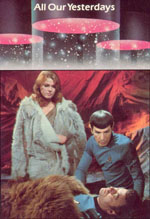
All Our Yesterdays
(Star Trek story #78 in production order)
- written by Jean Lisette Aroeste
- directed by Marvin Chomsky
|
|
|

All Our Yesterdays
|
Star Trek's third season actually has some really fascinating
episodes to offer at the very end of its run, not least of all is
the original series' best time travel adventure yet.
"All Our Yesterdays" keeps its nose clean with regard to healthy
time travel theory, unlike
"The City on the Edge of Forever"
which messed up its temporal theory disastrously, and then
made that theory more important than any of the more worthy
philosophical principles that Star Trek wants to be proud of.
"All Our Yesterdays" also stays way ahead of
"Assignment: Earth",
by not only keeping actual events in line with good temporal theory,
but by also keeping dialogue and speculation in line as well,
AND delivering an interesting dramatic adventure to boot.
Mr. Spock gets some fascinating character development in this one,
along with some unique, tense scenes.
There is much variety and entertainment value amongst the story's
various settings. The futuristic library is something that usually
works well in science fiction, yet shows up all too rarely on
the big or small screens. This one is kept lively thanks to
a wonderful character creation - Mr. Atoz. Nice. The dialogue
for his interaction with the crew feels a tad contrived to
skirt around the hot porridge and keep the main premise of the story
a mystery until the first act is complete, but this is done
very entertainingly and with its own subtler surprise turns as well.
|
Kirk's sub-plot in a pseudo "Salem" town is the least successful
of the three locations,
winding down into all-too-predictable capture-and-escape routines
after some initial good stuff investigating the time travel
phenomenon with his subordinates.
At least Hodgkin's Law of Parallel Planet Development
seems to have some validity here.
But this part is not without
interesting characters and clues, and its larger guest cast does
help balance out the loneliness of the other two settings.
Thankfully, Kirk trades the setting back in early on to go
and have some more fun with Mr. Atoz.
The Ice Age territory that Spock and McCoy explore turns out
to be only slightly less interesting than the library, yet
compensates for this by having the richest character development
for Spock, offering something that no other story has done
before or since. Worth the price of admission alone.
Zarabeth's story of having only the bare essentials for
survival is undermined by the fact that her hair and make-up
have been so meticulously done, and she's had her legs waxed
quite recently. Bizarre.
But one of this story's nicer points is the fact that we're
not traveling into Earth's past. This is the alien planet
Sarpeidon.
There's no threat of altering the known history of Salem,
it's brand new territory. Equally, Sarpeidon women like
Zarabeth may not need to wax their legs. This territory
has space for total creative freedom. Excellent.
Go with it.
The main premise is still a bit weird - a whole society
disappearing into their own past. It's a bit depressing
that they've given up all hope of their collective future,
instead chasing their tails and disappearing like the
infamous oozalum bird. But somehow it seems appropriate
as original Star Trek winds down, and begins airing in
a continuous loop in syndication, with most viewers having
no clue what came first or where the start of Star Trek was.
But then again, if you believe each journey from the past
to the future must branch out differently according to
each person's choice, how can they not now have a second
chance to develop space flight and save themselves another
way when the time eventually comes again?
Spock's character twist seems a bit at odds with the idea
of the atavacron changing people to fit in with the time
they enter. One is tempted to think it would have to
have been used on Spock to get the result we see....
and perhaps it was in earlier versions of the script.
Strange that no one else seems to be suffering their
own version of this effect. Then again, McCoy seems
a bit too uncharacteristically antagonistic and physical
himself now doesn't he?
Perhaps Spock's bit is better explained as some kind of telepathic
link he unconsciously has with all the rest of his race,
which picks up different signals from them depending on the
time period he is in. You see? Science fiction always
has an explanation. :-) And I stood there pleased as punch
with myself.
So there you have it. Season Three proves yet again that
it's still got the Star Trek magic. You haven't appreciated
the full range of Spock until you've seen this episode.
"All Our Yesterdays" - the best Star Trek time travel story yet.
Enjoy!
Read the next Star Trek review:
"Turnabout Intruder"
These Season Three time travel stories
are available on DVD and Blu-Ray.
Click on the Amazon symbol for the desired disc format
and location nearest you for pricing and availability:
Star Trek Season Three "Purist" Standard DVD Box Set:
|

|
Watch the legend mature to the end of its original run.
Set contains all 24 episodes from the third season
in their original wacky broadcast order,
plus new bonus features including a specially restored version
of the original pilot "The Cage".
As someone interested in researching how the episodes
actually looked and sounded originally, and when and
exactly how certain musical cues first debuted,
this was the DVD set for me, and it remains the most
untampered-with full-season collection of Star Trek
out there. Unique extras include pure text commentaries
on select episodes.
Sadly, these sets are starting to
become rare, and prices are now rising as these
become collectors' items....
|
DVD U.S.


| DVD Canada


| DVD U.K.


|
Standard DVD Extras include:
- To Boldly Go... Season Three featurette (22 min.)
- Life Beyond Trek: Walter Koenig (11 min.)
- Chief Engineer's Log (6 min.)
- Memoir from Mr. Sulu (9 min.)
- Star Trek's Impact (9 min.)
- Original Prop recreation featurette (7 min.)
- Text Commentaries on
"The Savage Curtain" and
"Turnabout Intruder"
- "Red Shirt Logs" Easter Eggs (19 min. total)
- Production Art (still menus)
- Original Trailers for every season 3 episode (1 min. each)
- "The Cage" (all colour, 63 min.)
- "The Cage" (BW/colour mix + Gene's intro, 71 min.)
|
|
|
|
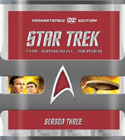
The Original Series Remastered Sets
The re-mastered Star Trek set for season three,
like that of season two, seems destined to be obsolete
in very short order. Its content is easily surpassed
by the more respectful presentation on Blu-ray, and unlike
the "purist" DVD release listed above, appears to have none
of its own exclusive content. Add to that the very gimmicky,
awkward packaging that is prone to damage both during shipping and
with light usage, and I'd have to recommend that all devoted Trekkers
should consider other options for their ideal TOS season three product.
|
|
|
|
|
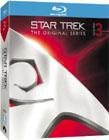
Season Three - Blu Ray
|
|
24 episodes @ 51 minutes, plus pilot episodes...
Star Trek sets are now available on Blu Ray.
Picture and sound quality restoration has gone up yet
another notch since the remastered version, as have the
liberties taken with "upgrading" the episodes.
Once again, even newer CGI effects and optical shots have
replaced many space scenes, matte paintings, and phaser
effects.... but this time the upgrades have the same respect
and user-functionality applied to select
Doctor Who DVD releases since 2002,
as the CGI effects can now be turned off to see the original
effects. Good show. It seems that the music
has still been tampered with too much for my liking though.
|
Blu-ray U.S.


| Blu-ray Canada


| Blu-ray U.K.


|
Blu-ray features include:
- option to watch original or new CGI effects.
- "Where No Man Has Gone Before" (unaired version, HD)
- Captain's Log: Bob Justman (HD, 10 min.)
- Behind-the-scenes 8mm home movies part 3 (HD, 11 min.) from
Billy Blackburn (Lt. Hadley / DeForest Kelley stand-in)
- David Gerrold hosts "2009 Convention Coverage" (HD, 20 min.)
- "The Anthropology of Star Trek" ComiCon Panel 2009 (HD, 4 min.)
- "The World of Rod Roddenberry" ComiCon 2009 (HD, 7 min.)
- BD Live Portal
- main featurettes from previous releases
- "The Cage" pilot versions from previous releases
|
Review written by Martin Izsak.
Comments on this article are welcome. You may contact
the author from this page:
Contact page
|