STAR TREK:
THE NEXT GENERATION:
Season Three:
|

"We seek to better ourselves..."At its heart, the Prime Directive is the highest General Order in Starfleet - an instruction to not interfere in the affairs of less developed civilizations. It is quite specific with regard to civilizations that have not yet acquired warp drive (and thus the capability to come out and mingle with the rest of the galaxy) - absolutely no open contact is allowed at all with such societies. Although conceived with the best of intentions, the Prime Directive is a flawed philosophy, and it is a great pity that this franchise for exploring the human condition seems to have little capacity for successfully challenging its most entrenched policy.
Digging Deeper and Deeper into Trouble"Who Watches the Watchers" opens with the costs of such manipulation about to rise on the planet Mintaka 3. Great place to set a story by the way. Mintaka is a real star, also known as Delta Orionis, one of the stars on the end of Orion's belt. It's probably too big, bright, and hot to allow its third planet to look quite as picturesque as what appears on screen, but then again, with all the rock and scraggly vegetation, and intense sunlight, this might not be too far off. Vulcans like it hot, and the Mintakans are a related species. Nice.Anyway, here we have three Starfleet/Federation anthropologists secretly studying the Mintakans from behind a high-tech "duck blind". In other words, the Federation wants to be there to study and learn, but they feel they must manipulate what the Mintakans see when looking in the Federation's direction. A complex holographic screen is in place, hiding the research station, which as Geordi points out, requires a lot of energy to maintain. This is perfect imagery - manipulation and control always require more energy than trust, allowing, and honesty. And when that energy becomes unsustainable, the manipulation and control must give way. Early sections of this story show Federation manipulation falling further and further apart. First, the lie of their holograms gives out, and one of the anthropologists named Palmer is ejected into Mintakan society. This untended panic of Federation contact then causes a Mintakan male, Liko, to injure himself - but not to worry too much there, because Dr. Crusher is alert and quick to the rescue. Hats off to her, putting her healer's oath first and helping those in need, whether the law says she needs to remain invisible to them or not. Nice. Picard orders her to manipulate the Mintakan's memory, yet another grand failure on Starfleet's part, especially when it doesn't work. Ugliest of all are Riker and Troi, whose manipulations begin with their own features, continue with their attire, and reach a low point as their characters' interactions with the Mintakans boil over with ridiculous lies, ruses, arguments that directly grate against their own values idiotically, and ultimately culminate in assault against an elderly Mintakan. All done to maintain a lie about who they and Palmer are. Noble on a higher level? I don't think so. Troi is caught, and even if the Mintakans don't use the excuse of their God's unknown wishes to punish her, they would probably be well within their rights wanting to protect their village from lying, unpredictable, violent rogue elements such as herself and Riker. What is good about this episode is the natural way that Starfleet's attempts to clean up their mess with manipulation only serve to make the mess bigger. Sweet.
The Better ChoiceThe crisis point appears to come in the scene in the Enterprise conference room between Picard, Riker, and the lead anthropologist. What is so very bizarre is the anthropologist's assertion that their next manipulative tactic should play into the God-like image of Picard that the Mintakans have created and set down some grand "Commandments" for them. It's such an over-the-top suggestion, it makes you wonder how this guy ever got the job of lead anthropologist in the first place. His lazy suggestion only serves to trigger Picard into a rant of how precious their Prime Directive is, which isn't a very convincing argument either, quite frankly. Both sides put too much faith into their assumptions of how the Mintakans will respond, and anthropomorphize those Mintakan responses to be more Human than Vulcan, which shouldn't be the case. And neither side of their argument contains the sense of rising above more manipulation.But just when you think they might all get stuck pushing for more silly methods of extricating themselves, Picard chooses a brilliant solution. He decides to be honest with the Mintakans, allow the consequences of honesty to take shape, and trust that their development can continue to be what it most needs to be. Those of you who are familiar with the assertion that our species is now transforming from third to fourth density may recognize that Picard has here chosen three principles of fourth density over their third density counterparts: secrecy, manipulation, and the need to control.
So, give the thinking-man's Captain a star for excellence. Picard's choice finally allows Starfleet to truly rise above the manipulation that the Prime Directive intended to avoid, but note that he has to go against the letter of the Prime Directive law to achieve it. A clear indication that much is wrong with the Directive itself.
Consequences and PersistenceThe second half of this story contains much of its true beauty, and remains dramatic by naturally showing that you can't fix several days of manipulation by a singular hour of honesty. You have to keep working on it, until your communication is complete. This is exemplified in the scene in which Picard thinks he has the Mintakans' leader Nuria convinced of the truth about himself and his people, and she then begs him to bring six dead Mintakans back to life. His disappointment is palpable, and so very real. Yes, this is the very kind of challenge the Prime Directive was designed to dodge. There is never any guarantee that another person will believe what you say, or see a situation or set of possibilities or relationships the same way as you do. Two people or two cultures may never recognize the same set of limits. That's life. Deal with it.And Picard continues to deal with it, sticks with his honesty, and strives to make his communication more complete. He never had truly discussed the limits of his science with Nuria in previous scenes, which is critical to her understanding. Thankfully, she is someone who can get it quickly and with little difficulty. That wasn't so hard now, was it? Even had Picard failed to convince her, there is a point where he would have to step back, and not try to manipulate the other party into being convinced. His duty should be merely to present himself honestly and completely. There are thousands of different ways that Nuria and the Mintakans might choose to respond to what he presents, and if he truly values them as equals and not an inferior species, then he must leave the responsibility for their choices and the consequences of their choices in their hands, and allow their development to naturally follow their choices. It is a refreshing moment to see Picard walk into the village to rescue Troi, sporting his own natural features, wearing his own day-to-day uniform, and presenting himself as his true, honest self. Liko doesn't want to give up his beliefs in his new-found God so easily, and Picard probably has some apologizing to do on Troi and Riker's behalf. It is at this point that Picard demonstrates his trust in the truth. A great gesture, but not with the most pleasant of results this time around. Last Minute FumbleThis climactic scene is not written with the most effective dialogue possible for Picard, daring Liko to indulge in drama to prove his point so that Picard can get the non-superstitious Mintakan response that he wants, so it isn't too surprising that the result isn't ideal for him personally either. Not quite the selfless act of allowing the Mintakans to be responsible for their own choices, as one might have hoped for. The flavour of trust and allowing consequences that is trying to be achieved here would turn out so much better in a similar scene in the season six episode "Tapestry", when Patrick Stewart literally gets to act his heart out with perfect elegant subtlety.The story's coda continues a good vein of interaction between Starfleet and the Mintakans, even though things get a little trite by this stage. Picard attempts to return to the letter of the Prime Directive as much as possible, and the Mintakans are bizarrely understanding and supportive of the idea. You can sense here the Star Trek franchise artificially trying to maintain what it had set-up previously instead of taking a courageous new step to further improve its future society. (In the Star Trek universe, the origins of the Prime Directive are likely highly Vulcan anyway, so it's understandable that it would appeal to the very similar Mintakan mind.) Liko seems to have been miraculously convinced. Then again, perhaps he now secretly views the Prime Directive as the first grand Commandment from his God. Impossible to say. Hopefully there will be fewer and fewer Star Trek fans and writers afraid to think beyond it and make up their own minds as well.
~ Mahatma Gandhi, 20th century Indian spiritual & political leader
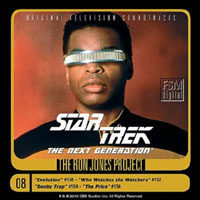
"Who Watches the Watchers" is the fourth episode in the third season of Star Trek: TNG, now available on DVD and Blu-ray:
To question mark or not?It seems there is a lot of inconsistency floating about, as to whether or not this story's title has a question mark at the end of it or not. Here are the details.The title printed on screen at the beginning of the show does NOT have a question mark in it. Printed on the physical DVD disc, the title also has no question. The onscreen DVD menus DO have a question in the title, on at least 2 different menu screens. So it could be argued either way, but I think the originally broadcast onscreen title holds the greatest weight for swaying my mind. No question mark.
Article & reviews written by Martin Izsak. Comments are welcome. You may contact the author from this page:
|
|||||||||||||||||||||||||||||||||||||||||
|
| ||||||||||||||||||||||||||||||||||||||||||
LYRATEK.COM |
|
|||||||||||||||||||||||||||||||||||||||||





 (regular)



