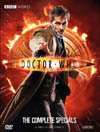
DVD Extras include:
Christmas is gotten out of the way fairly quickly in this tale, with a melancholy opening that emphasizes the prayerful side of the holiday. Apart from a gift exchange scene later on, the sci-fi story itself takes center stage so successfully afterward that Christmas merely becomes background, as it should be. The Doctor certainly starts this story off VERY right, with a solid materialization for the TARDIS on a half-decent alien planet. As Ood Sigma fulfills the traditional role of the Doctor's companion through a few critical set-up scenes, we learn that the Doctor's travels between this story and the last one have been quite numerous. This is EXCELLENT. This is space for audience imagination, fan fiction, spinoff audio projects, official novels, Steven Moffat's referenced encounters with Professor River Song, and later multi-Doctor appearances of David Tennant to be squeezed into his known chronology in a manner easily accepted by all fans. This is so much better than the compressed continuity links of dreadful prophecy that plagued the last two stories, not to mention its all-too-early introduction in "Planet of the Ood" (story no. 196). The only thing missing for perfection would have been to make David Tennant up as a much older man, to indicate that the Tenth Doctor had had a full life of something like 150 years of traveling and exploring before needing to regenerate into yet another, younger form. As for reports of his age, Davies and co. remain blissfully ignorant of where he was at previously during the Sylvester McCoy era: 953 years old. Anything less than 1000 years of age now seems very wrong. No attempt is made to hold back on the Master's involvement in this story, allowing one to market his presence in the tale without really giving away any spoilers. Early on, Davies needs to tidy up the mess he last left the Master in during his last adventure, and it's not any particular improvement in quality or believability than much of what occurred during that tale. However, once past that mandatory bit, we get to see John Simm's Master at his best so far. He still leans towards the mad side, but doesn't seem to be as over-the-top with it as before. I think a lot of that is simply down to the way other characters are written to respond to him - in this story you can easily believe it. The plot remains successful in its simplicity early on, allowing its two obvious opposition forces to clash like superheroes against a vast and cinematic urban backdrop - a section of the story that is very effectively directed and executed. Nice stuff. Davies tends to enjoy focusing on the discovery and exploration of as many characters and new sci-fi concepts as possible while ignoring the "goals vs. obstacles" stratagems that many action stories require. This story successfully avoids pigeon-holing any of its characters into good or evil stereotypes, which helps play down the requirements for opposing stratagems and boosts the importance of conversation and investigation into character and motivation. While on this safer ground, Davies turns out a cracking good tale while playing more towards his own writing interests and strengths. Nice one. Bernard Cribbins is always wonderful as Wilfred Mott, and here his role is expanded until he becomes the de facto companion for the adventure. EXCELLENT move. Cribbins hasn't had this much importance and screen time since "Daleks' Invasion Earth 2150" back in the sixties. Donna's mum is back as well, and gets to showcase her comic timing - possibly her most enjoyable appearance in the show yet. The TARDIS remains quite busy in this story, getting to showcase its usual trick dissolves on several occasions, as well as the relationship between interior and exterior. Sadly still absent without explanation is the Master's TARDIS, although that isn't too surprising considering the situation his last adventure left him in. Davies continues to indulge his obsession with Earth governments. This time President Obama holds a press conference, on Christmas Day don't forget, to announce that he's ending the recession. !!?!! Are you havin' a laugh? I don't think there's a major politician alive both smart enough and gutsy enough to recreate their currency in a transparent and value-based manner that frees taxpayers from the debts governments owe to bankers. If there was enough value-based currency in the system, we could all trade goods and services with each other abundantly - and that is the definition of a healthy, thriving economy. If Davies wanted to make such a statement, he fell far short. Without articulating the real crux of the issue, it feels like so much idle wishful thinking, having a whole world waiting for a public hero to solve their problems. Just as naff as having characters waiting for the Doctor to show up and save the day. A good plot does brew up after a while, all building to a spectacular cliffhanger. Oh yes.
Timothy Dalton is great casting as well, giving us the strongest and most commanding presence any Lord President has ever had. Nice one. Though the exploration of ideas and character are once more the strongest focus, we do get a very lively action sequence building towards the final confrontation in this story with excellent strategic countering in place - one of Davies' finest moments. Figuring out who to root for does become problematic though, as the story progresses. This isn't too bad, as it's partly a story point. But once again, it feels like too much mythological history has taken place amongst the Time Lords between the end of the classic Doctor Who show and the beginning of the New Millennium version, and the television audience is not being given enough of it to be able to wrap their hearts around it. Perhaps it's in the novelizations and/or extra audio CD stories. It certainly has crystallized in Russell T. Davies' head. Too much is still being left out for me to agree with his current take on it though. Sure, various High Council members and other Time Lords may always be getting corrupted - a great source of mystery and conspiracy plot lines. I just think we should always keep the planet in an accessible location, and honour the healthy smattering of good Gallifreyans occupying the place. Surely most of them are still noble at heart.
Additionally bizarre is this story's lengthy coda. Davies' indulgent parade of favourite characters and actors from seasons past felt like it was dragging on far too long on first viewing, and implausibly too with the Doctor's fatal wound not bothering him at all for hours or days or however long it was for him. Let's get to the eleventh Doctor already, I thought..... On subsequent viewing I was much more lenient, and enjoyed most of it. Captain Jack's scene could still be left out, as it's far from his character's best moment. Great to see Mickey and Sarah Jane again, as well as the mysterious woman at the bookstore.... And though I'm never all that keen to see more of Rose, I think Billie Piper makes her best exit yet on the show in these final moments. Nice one. David Tennant's final moments are well done, and anguishing. I don't want him to go either. Ah well, the baton's been passed yet again. A jarring music cue doesn't help our first impression of Matt Smith, but of course, it's usually a mistake to judge any new Doctor until he's well past the unnecessary regeneration trauma crisis that writers usually throw his way. I think he's got potential.... But perhaps most promising of all is the TARDIS interior falling apart as it crashes - maybe we'll get a new interior more reminiscent of the glorious white one we had in seasons 15 through 25, itself quite reminiscent of the very first one we started out with in season 1 in 1963? One lives in hope. I hope the TARDIS isn't crashing into Earth though; we've just left it, and we do still have trouble setting an entire story properly outside of its orbit. We'll want to pick up a companion of course, but how about an alien one, like Nyssa or Romana or Turlough? One lives in hope.... Let's see the galaxy!
And Doctor Who continues.... Onwards!
International Titles:Deutsch: "Das Ende der Zeit"Magyar: "Az idő végzete"Français: "La Prophétie de Noël"Русский: "Конец времени"Italiano: "La fine del tempo""The Complete Specials" Rankings:
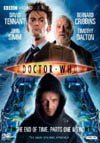
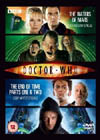
"The End of Time" has become available on DVD and Blu-Ray. Click on the Amazon symbol for the location nearest you for pricing and availability:
Comments on this article are welcome. You may contact the author from this page:
|
|||||||||||||||||||||||||||||||||||||||||||||||