DVD Extras (box sets only) include:
Here, we'll take a moment to honour six additional scenes that went far and above the teaser concept. In fact, these ones are like complete short stories unto themselves and turn out to be more enjoyable and deal with better subject matter than many of the actual upcoming episodes.....
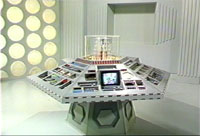
"Space" & "Time"This is a fun little escalating conundrum that doesn't seem too original at first glance. Long-term fans may well have imagined similar things in their sleep, and even without being a spectacular story, the series' regulars are fun to watch in this one, keeping it very entertaining.Director Richard Senior thinks they're making history landing the TARDIS inside itself here. Careful....! Very similar things have already happened in "The Time Monster" (story no. 64), "The Keeper of Traken" (story no. 115) and especially "Logopolis" (story no. 116). It all boils down to exactly how technical you want to get regarding this event. Two ideas are worth noting in these scenes here. The first is that Moffat has lost the point of origin for some of the ideas in his loops of time, with Amy's explanatory speech and the Doctor figuring out the correct lever. Have these ideas slid sideways from parallel/branching universes? This problem seems to be a habitual one for Steven Moffat, as he did the same thing back in Time Crash. For a more detailed explanation of what I'm talking about, see that review, while I refrain from repeating myself here. The second idea is a bit more new. As the Doctor insists that they should honour the sequence of previous established events, what's actually interesting is his comment that if they don't, they'll end up with two Amy's on board, which Rory thinks he wouldn't have a problem with. Personally, I think this is a very good dissertation of the stakes: not necessarily disastrous, but leading to other complications that one may prefer to not have to deal with. Good show. But just remember that exchange when we get to "The Girl Who Waited" (story no. 226) later this season.....
"Bad Night" & "Good Night"Now for some more fun.... One thing I really liked most about these little segments is that they crystallize an idea for which evidence has been floating about for a long, long time. It finally asks the question of how much sleep a Gallifreyan needs each day - remembering of course that we've never had the length of a Gallifreyan day, or year, defined on screen in the 32 years that this show has been running. How different are the natural cycles of this planet that we should know so many more basic things about?We do know that the Doctor's habits have been more elusive than those of his companions from day one. As far back as "The Edge of Destruction" (story no. 3), we've seen him wandering around at night acting mischievous while his granddaughter and human friends find beds to sleep in. Early 1980's stories often showed that his fellow travelers have comfortable, nicely furnished bedrooms, but NEVER have we seen that he has a similar room for himself. One would assume that he does. Of course, we have seen the Doctor unconscious from many a strange illness, and one mustn't forget how often Jon Pertwee's Doctor became the "Man of Sleep" during his adventures. But I think it is a very nice touch to finally define here that, under normal conditions, Gallifreyans do not require to be asleep for 1/3 of their lives as humans do. Perhaps 1/10th is a more natural ratio for them. Cool! Finally, some mind-stretching bio-cultural tidbits. I like it. And what else would the Doctor do with that time other than a few side adventures, dangerous experiments, and other forms of all the usual trouble? Nice.
Holographic Memory?"Good Night" may also be the most profound of all the "Night and the Doctor" segments, as Amy expertly pulls at the threads of Moffat's less-than-brilliant theories of time, uncovering its silver lining and true purpose.Perhaps this additional scene and Moffat's own interviews best say something that I suspected last year. Moffat's real concern is with untrustworthy memories, which is cool, and worthy of exploration, and I'm right there for it. In fact, I think the explanations offered on screen here successfully challenge the way we view our past and our memories, hinting at new metaphysical concepts that we humans will need to grow accustomed to dealing with as we advance into fourth density consciousness, which is an absolutely super thing to do on a science fiction soapbox like Doctor Who. But the expression is still a bit too clumsy here. Blaming alternate memories on the idea of time re-writing isn't going to cut it - best to reveal that as a red herring one day. I'll give you the theory that I'd believe. All versions of time occur, and a person's doubles in each separate branch of time live through those various versions of their lives. Normally, they each only remember the one they've experienced. A person's soul, however, remembers ALL of the different possible outcomes as having happened. Presently, not too many of us humans know how to communicate with our souls on purpose, but if memories from your double's life bled through the common interface of the soul, you would start to "remember" multiple versions of events, and multiple versions of your lives. Maybe some of that is going on here. I'll easily buy that, especially if a person gets to see something of each different parallel/branching universe, as Amy often does. I just think it's a totally unnecessary hang-up to think that one version ceases to exist if you witness or create or move into one of the other versions. Wiser minds know they all continue to co-exist, and you can avoid trick questions and make better choices when you know it. In the end, I'm very glad we have this little piece, to focus on Moffat's key temporal idea so neatly and exclusively, and give it as much focus as it deserves for both scrutiny and praise.
"First Night" & "Last Night"Finally we come to what is essentially a River Song short story. Of course, her whole path in the series is a conundrum in itself, and a mystery to be unraveled. This little excerpt fills in more of the pieces and details, and so keeps audience interest high and earns its place. Plus, Matt Smith and Alex Kingston are just so much fun to watch as they play these scenes. Two thumbs up; I am suitably entertained and intrigued once more.It is chiefly these River Song segments that make me think that the entire "Night and the Doctor" scene collection is best placed after the "Vultures Circle" Hitler episode (and before "The God Complex")... and it is a bit bizarre that the DVD set puts them on an earlier disc. Oh well.....
Am I Missing One?Sharp-eyed viewers will notice that I've left out an additional scene called "Up All Night" that claims to be part of the "Night and the Doctor" line-up. I'm forced to ask myself if there really is a justifiable reason why it claims to belong to the "Night and the Doctor" collection. It wasn't shot as part of Richard Senior's in-TARDIS mini episodes. It's shot at a different time, in a different setting, with a different cast, a different director, a different writer - and as some fans have pointed out the writing credit was messed up and it should credit Toby Whithouse as writer. Perhaps the title was messed up as well, and never really should have had "Night and the Doctor" applied to it, much like the infamous "Doctor Who: Doctor Who and the Silurians" title on story no. 52. More to the point - look at the scene. Night is without the Doctor here. It's little more than a teaser prequel scene for the "Closing Time" episode. Mind you, James Corden and Daisy Haggard are still entertaining in it, and the teasers have their rightful place and function. But that's another story....
This story has become available on DVD and Blu-ray. Click on the Amazon symbol for the location nearest you for pricing and availability:
Note: The full season sets contain commentaries, behind-the-scenes featurettes, and other extras. The smaller volumes feature little more than the plain episodes. Comments on this article are welcome. You may contact the author from this page:
|
||||||||||||||||||||||||||||||||||||||||






 in the U.S.

 in Canada