Original DVD Extras include:
Special Edition DVD Features add:
FIRST IMPRESSIONS:The opening of this story is terrific. A quaint musical cue by Paddy Kingsland helps establish the olde English setting, while the special effects team delivers an enjoyable stellar spectacle. We then get an interesting discussion between the members of a local family, four interesting characters who are very well portrayed and introduced. They soon make solid efforts to deal with things beyond their experience, as some of the best lasers we've ever witnessed on Doctor Who initiate an exciting action beat. At this point, on my first viewing as a teenager, I was thinking to myself that Eric Saward was the best writer I'd ever remembered seeing on Doctor Who (the others having been Robert Holmes, Douglas Adams, and David Fisher, whose names I couldn't remember, and Chris Bidmead, Terence Dudley, and Chris Bailey, whose credits I'd recently caught on videotape).However, the remainder of episode one is rather quiet and at many times pretty aimless. Our four regulars are introduced at a leisurely pace which works, although the Doctor and Adric seem a bit too argumentative, and Tegan's long-sentenced recall of the previous adventure is better suited for the written page than the spoken word. Luckily, Tegan's confrontation with the Doctor about their landing location is several degrees more interesting, and she has a good "buddy moment" with Nyssa in the corridor, proving that there's more to eighties relationships in the TARDIS than just whining and arguing. Once more during the early Davison years the TARDIS misses out on a good opportunity to demonstrate materialization to new audiences, but makes good on showing the relationship between the interior and exterior, and thanks to the scene in Tegan and Nyssa's room, we get to see that the interior is bigger than just the console room.
PlotApart from a half-hearted scuffle in the woods for a bit of additional action, Part One attempts to sustain itself primarily with exploration and investigation. It isn't as successful as many previous stories such as Terry Nation or Robert Holmes might write, and one major cause may be the fact that our protagonists don't really uncover anything significant that the audience didn't already gather from the opening sequence.Part One ends with one of the most non-existent cliffhangers ever produced on the show, leaving a very anti-climactic aftertaste with viewers for a week. Little can they suspect how much more fascinating Part Two becomes the instant it goes past the cliffhanger moment. The investigation continues, now suddenly full of new information that the audience didn't already get from Part One's opening sequence, and each revelation being accompanied by enjoyable visual effects to boot. All this leads up to and through an excellent action beat with the android, then a split beat where Adric and Tegan encounter the alien while the Doctor and co. investigate the alien's escape pod. Some of the best parts of the story for sure, earning it many positive points. Things begin to drag again though near the end of the episode, as the Doctor wastes time in an extremely boring beat with the villagers, a section of the story that fails to become infused with any interesting level of character interaction, be it in dialogue or action. Episode Three also begins a stretch of the old ugly clichéd prisoner dynamic for the Doctor and Mace, which carries on for an episode and a half. This is way too long, and the story must lose some points for this lack of imagination. The story still gives us some good bits while the Doctor is in this predicament, most notably his confrontation with the lead enemy, and later the slightly increased freedom he gains while the Miller is in charge. The writer and producer also wanted to curb the near-magical overuse of the sonic screwdriver, which was a noble goal. Destroying it all together is, however, illogical. For one thing, the Doctor could easily build another as Romana did in "The Horns of Nimon" (story no. 108), or purchase one at the next galactic bazaar (as ultimately he must have before Season 27 began). In fact, this more easily creates a burning desire on the part of fans and writers alike to bring back that which was unfairly destroyed. But remember also, if the destruction of the sonic screwdriver is only going to stretch out dull challenges like opening locked doors to escape the prisoner dynamic, we'd be better off having it and skipping past such boring, "filler" story beats. Being resourceful in opening locks with everyday objects can easily end up setting bad examples for youngsters that they can actually follow. As I've often advocated, have the endearing gadgets of the series like K9 and the sonic screwdriver, but limit their abilities so they don't become magical solutions to all problems, and the Doctor can still demonstrate incredible resourcefulness with everyday objects. That balance is your best course.
CharactersThe roster of guest characters is rather unusual, wandering off-format in a way that doesn't work particularly well. The four excellent characters from the opening of the story are nowhere to be found during the remainder of the tale. Most of the rest of the locals that we meet are bland, very easily forgettable, and lack any kind of motivation that most audiences would care to sympathize with. Attempts at dialogue often feel artificially reduced to moronic levels or are cut off completely to facilitate later attempts at action which the writer is obviously more interested in. The resulting characters are left without an ability to resonate with the audience.The one obvious exception to this is the character of Richard Mace, who is in a sense over-dramatized as much as all the others are under-dramatized. It is helpful to understand that Mace was already an established success in several of Saward's radio plays, and that "The Visitation" was Saward's first television script, thus Mace thrives on his own rich, flowery dialogue far more than any natural character would. Michael Robbins, whom I'd previously enjoyed enormously from the sitcom "On the Buses", brings the role to life in a very enjoyable fashion anyway. With the production order recording this as Peter Davison's second story, it seems he is only just settling in from the general character he previously played in "Four to Doomsday" (story no. 118), and finding his own Doctor from here on. He excellently carves out the manner of interaction he will enjoy both with his companions and with the adversaries that he encounters. Where his Doctor still seems rough around the edges are in his encounters with the bland local characters, and opposite Richard Mace the delivery of his lines sometimes can't resist being pulled over the top and sounding a bit silly. The Terileptil is perhaps the best character Saward has created for the story, but it is interesting to note that it works primarily due to the dialogue and strong vocal qualities that Michael Melia is able to bring to the role - things which naturally work well on radio. The visuals and limited animatronics of the Terileptil are okay, particularly for a minor character with little dialogue, but for the main adversary it is a bit disappointing. Despite some very strong scenes between the Doctor and the Terileptil in Part Three, the image of the "talking fish" does not help the story earn positive points. Interestingly, many of the Terileptil's speeches feature shots of only his hands, or his listeners, a technique which was thankfully helpful in keeping the believability level from falling too far. Despite arriving in this adventure with three companions, the Doctor gradually loses them all to their own varying adventures until Richard Mace becomes his sole companion by default. Mace does an enjoyable job of fulfilling the typical functions of the role. Adric has often been labeled the least useful companion, and even "the idiot", but I don't think he ever really fitted that description until Saward wrote for him in this story. He is certainly off to a bad start in Part One, taking the Doctor's flak for the previous adventure, dropping his homing device, and tripping over absolutely nothing in the path in the woods. He also runs needlessly out to get caught in Part Three, and is often seen attacking technology with brute force with little result. But notice also that the freedoms many of the others enjoy and use to educate and arm themselves against their adversaries are a result of Adric's fruitless attacks distracting the bad guys long enough for them to get away. And in the end only Adric knows how to pilot the TARDIS well enough to rescue the Doctor from his overly lengthy prisoner story beat. By comparison, Tegan has far fewer critical things to do. Chiefly being a feisty damsel in distress in this one, she spends even more time locked in the prisoner dynamic, and is less interesting for it in the end. Nyssa lucks out in getting a really important and heroic role in this story, and neatly avoids the prisoner dynamic altogether. Excellent. Despite spending most of the second half of the story in the TARDIS, she is well served there, using her inventiveness and seeing some of the most significant action of the story's conclusion. Adric pretty much functions as her companion during much of this, as she functions as his during his piloting of the TARDIS.
FinalePart Four delivers some great stuff during the final confrontation with the android, and with all the extra, satisfying movement of the TARDIS. However, it all leads up to a somewhat anti-climactic confrontation with the chief adversaries themselves. The great philosophical debate the Doctor had with them is a thing of the past episode, and the anticipation of a good sci-fi laser fire fight evaporates when wrestling and gunshots are delivered instead. The result is both morbid and disappointing, and Davison's character seems quite out of place in the midst of it.Davison's Doctor often exudes a sense of calm spirituality during an adventure, a trait which is perhaps his best, yet many remember him as a violent Doctor, which stems more from the conclusions of each adventure than anything else, and feels like a butchering of his character each time it occurs. There is a quote from Eric Saward in the documentary "More Than 30 Years in the TARDIS" which I believe holds the key to why he seemed to have so much trouble writing and/or controlling appropriate concluding action for Peter Davison's Doctor. Saward says:
     The Doctor is involved in adventures with violent people,
     and sometimes the only way you can deal with violence
     is to become violent yourself.
To me, this is a clear revelation of both lack of imagination and,
again, a lack of recognition of the social consequence to violence that
makes violence unviable as an actual solution to problems.
And of all the Doctors, Peter's seems to me to be the least suited to using
the violent solution. Yet time and again, Saward can think of nothing
else to give him, if indeed he really ever wanted to search for something.
I often wonder if he was frustrated with the specific Doctor he inherited,
and in particular the character brief that came along with him. While both
Davison's Doctor and Saward's writing instinct have many, many qualities
to recommend them, I often wonder if they were a good match for each other,
and I'd be keen to see what Davison might have done under a different
script editor.
Paddy Kingsland produces a thoroughly enjoyable score for this story, with highlights including the exploration of the pod, part two's encounter with the android, and the theme for Nyssa's industrious sequences in the TARDIS, in addition to the very memorable opening sequence. The final ending is not as brilliant as some would say. On first viewing as a teen, I could tell that the name "Pudding Lane" must have some significance, but the story had failed to set it up properly for me. I had to go and ask someone to have it explained, and by then it had lost all its impact. As with the middle episodes of "The Chase" (story no. 16), it can easily be a mistake to hold back the identity of a location until after the TARDIS crew leaves the scene. Overall though, "The Visitation" works much better than "The Chase" thanks to having an interesting, solid, full blown story to occupy the TARDIS crew and the viewers even without the location being anything special.
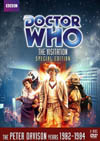
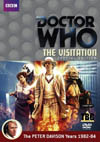
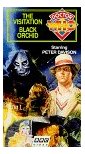
International Titles:Deutsch: "Die Heimsuchung"Magyar: "A látogatás"Français: (La Visite)Русский: "Кара"This story has become available on DVD and VHS video.
Comments on this article are welcome. You may contact the author from this page:
|
|||||||||||||||||||||||||||||||||||||||||||||||


 in the U.S.
 in Canada