Special Edition and Region 2 DVD Extras include:
Lift OffWriters Baker & Martin aim slightly towards dialogue gags in their early exposition, but in a more tasteful and restrained way than usual. And because this is used to enhance the thematic strand of the story, it actually works quite well.Princess Astra gets nearly all of her best "normal" scenes early in the first episode, as she must necessarily vanish from the Doctor's immediate proximity before he arrives and remain out of the way for most of the story. Her first position in her introductory shot is sadly ridiculous, standing idly at the back of the room on top of the technicians' consoles and under the Atrios logo, with nothing to do, nor any royal throne or half-decent chair to sit on while she passes the time and idly listens to the war. Doesn't seem like any way to treat royalty to me. Once allowed to move and act, Lalla Ward shines in the role and makes Astra the most interesting thing on the planet prior to the Doctor's explorations. Episode one also focuses on action, with the Doctor and the Marshal squaring off first in space and then in the Atrian underground corridors. This becomes an exciting way to continue to introduce viewers to Atrios, its situation, and some of the astronomical mysteries surrounding it and its twin Zeos. The space sequence in particular is great for introducing the TARDIS to anyone who may not be familiar with it, and the first episode comes complete with two perfect and satisfying materializations for the police box. "The Armageddon Factor" is also blessed with some of the best dialogue ever to come from a Bob Baker & Dave Martin script. Gone are the awkward muddling lines from characters who can't hope to grasp the new scientific concepts of the story. From ever-ingenious Gallifreyan companion Romana to the entire speaking guest population, everyone is technologically and socially adept enough to understanding everything, given enough clarification. Thankfully, the writers have also abandoned the catch-phrase craze of their last three scripts.
A New Stratosphere of StrengthsEpisode two works in a similar fashion to all of the simple base-defense stories that graced seasons four and five. The camera stays in the Atrian war room for the most part, as the large cast inside it all work together to counter the attacks and threats from the planet Zeos. This story improves on that old formula though, by keeping dozens of intriguing questions alive between and surrounding the characters, and by making the exchanges between the Doctor and the Marshal some of the most believably humorous and entertaining that the series has seen in some time.Notice also that, unlike Troughton's Doctor who often advocated fighting the evil enemy in similar situations, Tom Baker's Doctor here is focused on temporary defensive forcefields and, in a more permanent way, peace. Baker and Martin continue to display their knack for scripting the Doctor's character at his very best and most admirable.
The thematic heart of "The Armageddon Factor" overlaps episodes three and four, and although it may make less sense without there being any passionate, similarly humanoid Zeons on Zeos, it becomes more memorable, creepy, symbolic, and worthy of sci-fi exploration when played out in front of the mindless Mentalis computer and its most excellent atmospheric background sound effects. It is also a wonderful change to see K9 take such an important explorative, first-contact role, as he is sadly more often used to support & trail behind either the Doctor or some other character in most other scripts.
"Your Silliness is Noted"At around this point, when hand-to-hand shootouts begin to become more frequent, the production must take a few criticisms. While Dave Chapman gives good visual beam weapons to K9 and Mentalis, he reverts to silly round blobs for the handheld guns of the Atrians and the Mutes, which I find disappointing as usual, along with the wobbly sound effect which seems too playful and jokey. More effort might have been put there, instead of trying to superimpose anything on top of people during the transmat process. A simple dissolve, with a crescendo of studio lighting on the raw footage, is all you really need.Davyd Harries has a wonderfully comic manner, which he holds in check just enough to play Shapp sympathetically and believably for the most part, with some entertaining humorous moments sprinkled throughout. However, he goes over the top when hit during a shootout, and once more the action in a Michael Hayes film becomes hard to take seriously. Might this footage work better with a new beam effect for Harries to play off of? Incoming script editor Douglas Adams has cited how frustrating he found it when the entire production seemed to want to work extra laughs out of the script in moments when taking the drama seriously was paramount. Perhaps the music also plays too often along the humorous veins instead of darkening and deepening the drama of the action as much as it should. This particular Dudley Simpson score seems to excel best on Princess Astra's themes, varying from light & fanciful to despondent, and even managing a sour parody of the self-important brass Atrian anthem shifted onto Astra's usual instrumentation when she becomes critical of the Marshal's machinations. Music over the Shadow's ceremonious parade in episode six and his final demise is also of note. As the outtake from the Zeon recording block might indicate, Tom Baker seems to be in an unnaturally foul mood without due motivation when uttering a line about beestings, an unfortunate moment marring an otherwise thoroughly enjoyable performance.
The Battle for Concluding QualityThe plot, however, holds episode four together, as both situational and thematic exposition come to a close, threats mount, and actions lead to more and more escalations until the Key to Time itself is roped into the ever-complicating ball of yarn as well. The stakes have never been raised to such a grand level in Doctor Who so well, as far as I'm concerned. Having used the previous five stories to set this up has also added to its weight. The liberal use of the TARDIS interior in later episodes is also an enjoyable touch, as are the TARDIS's short hops between Zeos and the third planet.With the tracer tied up, Princess Astra is set loose on the Doctor and company, and interestingly Lalla Ward does seem taken with Tom Baker during their first scene together. Luckily the script needs her subverted character to be more interested in the Doctor and his possessions than in her "lover" Merak at this point, of whom she is noticeably dismissive. As the Doctor and Romana immediately notice, quite odd. The pace begins to noticeably drop as our protagonists arrive on the third planet, partly because it is unclear what they aim to achieve beyond getting into trouble. The corridor-sized image of the Shadow's face is wonderful, while most of the other illusions are mildly amusing. It is chiefly the revelation of Drax and the exploration of his character that save episode five. Barry Jackson gives an unforgettably entertaining performance, and provides episode five with the most riveting cliffhanger of the entire story.
A lot of build-up is put into the moment where it appears that the villains will win the struggle. Even though the Shadow is a patient character, he appears to be holding his victory back, waiting, even hoping, that the heroes will hurry up and stop him. The Doctor's surprise entrance is directed to be so painstakingly deliberate, it is hard to believe that it could have worked. Too much time is taken to show every visual effect at its full length, instead of shortening a few, and moving others outside of the critical "surprise" sequence of events. Then a few climactic shootout battles are left off screen to equally disappointing effect. But once past this, resolutions for a wide variety of philosophical arguments and plot action come thick and fast, keeping the Doctor busy and heroic. Finally and most enjoyable of all is the appearance of Valentine Dyall as the Black Guardian, his confrontation with Tom Baker's Doctor being hinted at and anticipated throughout the season. His introductory shot is a wonderful layering of concluding story and effects that few other Doctor Who tales have done so well.
International Titles:Magyar: "Az Armageddon faktor"Français: (Le facteur armageddon)Русский: "Фактор Армагеддона"
Season Sixteen Rankings:
This story is the 6th and final adventure in season 16's Key To Time quest. It has become available on DVD and VHS video. Single Story versions:
Comments on this article are welcome. You may contact the author from this page:
|
||||||||||||||||||||||||||||||||||||||||||||||||||||
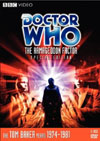
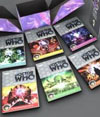


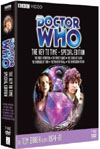


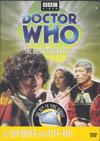
 in the U.S.
 in Canada
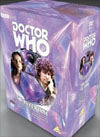


 in the U.S.
 in Canada