DVD Extras include:
There is a potent character issue here for the Doctor as well, an issue that everything hinges on, an important warning in fact, but the framing that the story puts around this obscures the heart of it, and may lead people to be warned about the wrong thing. It's not about laws, either in physics or socio-politics. Arrogance comes up, but this is just the second half of a knee-jerk symptom, not the core root cause. The real heart of this tale's issues is inequality, and it flies under the radar, poisoning the two lead characters' beliefs about their roles in society, and receiving no highlight or examination or in-depth probe.... until this revised review.
The Red PlanetThis story is refreshing in some ways, putting in a lot of the essential small touches that had needlessly been left out of recent previous adventures, and choosing a superb setting for itself. The good points begin to pile on quickly during the story's opening. The exterior of Mars is very, VERY nicely realized in this adventure, on par with anything seen in recent feature films like Brian dePalma's "Mission to Mars". In the midst of this impressive vista, our favourite police box gives us a proper decent materialization effect, something all too rare for the David Tennant era. The vehicle is taking us properly to appropriate places for once here. NICE!As the Doctor comes out wearing the space suit he acquired in "The Impossible Planet" (story no. 178), [....or is it the one from "42" (story no. 188)?] another of the long-term design problems with the new millennium TARDIS starts to beg for a fix that it never gets in this tale. Namely, we could really do with an airlock between the interior and the exterior of the TARDIS today. Go back and have a good look at "Four to Doomsday" (story no. 118), and you'll see how the previous design neatly incorporated an airlock into itself, perhaps by accident, but it worked so well. I miss it. Perhaps it's ingrained as deeply into me as it is because "Four to Doomsday" was only the fifth Doctor Who story I ever saw. The interior of the Mars base is not quite as cool as what other Martian films (or Doctor Who base-defense bottle stories) have given us. The bright white control areas seem out of place for the red planet, but worse are those massive corridors. Much is made about how much easier it would be to bicycle the length of them than run or walk, but bikes would have cost too much in fuel to be brought in from Earth. Well, what about all the fuel it took to cart in all those massive walls and ceilings to build such a friggin' tall, wide, LOOOONG corridor that does nothing but connect one dome to another? If you can afford the fuel for that, you can throw in a dozen bikes easy! And since this adventure reportedly takes place after "the oil apocalypse", you'd think they might have turned to anti-gravity propulsion or something instead. Without some such alternative, a Mars mission might easily not get off the ground at all.
Bottled WaterEarly on, this story clearly and solidly crafts its most external "A"-plot by using the well-established formula for a horrific base-defense bottle story, which, although often carted into Doctor Who as a last minute replacement for other ideas whose scripts didn't work out, usually turn out to be amongst the best stories of whatever season they appear in. As with the best of those stories, victimized members of the base's crew join the ranks of the antagonists, increasing the dangers as the story goes on. Good. This tale is probably unique in the ranks of this sub-genre for having those antagonists use water the way they do. Interesting.But the tale's creativity seems to dry up there. These stories typically receive a stronger line of investigation into the causes of such take-over phenomena, often not so much on a scientific basis, but more importantly in terms of character logic, to determine the wants and needs of the antagonists, what must happen for them to continue taking people over... usually in aid of the protagonists stopping the process, or in the best of cases, to reverse it. The effort here in this story focuses so strongly and exclusively on running away from the phenomenon, that it can't help but be one of the weaker examples of this sci-fi subgenre. This eats into the story's points and ranking big time. Too many questions surrounding the phenomenon rise up in the viewer's mind, while we have to suffer beat after beat watching today's characters run away and operate on the lower values of protection and self-preservation. Quite uninspiring. These "bottle-story" types of tales also often thrive on a fairly large cast of semi-interesting decently developed characters (who of course gradually get whittled down to just a few near the end). Perhaps due to the fact that this story is little more than half as long as the average movie or full-length Doctor Who story, and the fact that it gets distracted from formula by a less worthy idea, most of the guest characters in this story never really come alive as interesting three-dimensional people... which makes it hard to root very deeply for them. Expanding this tale to somewhere between 100 and 120 minutes might have allowed space to remedy this and several other of the story's omissions. But even then, something seems to be off. Ed Gold, the second-in-command of this base, clearly has some kind of character-twist issue going on, which somehow seems to go off colour every time it is expressed. I have a hard time figuring out what his problem really was, and find myself especially disengaged with that particular performance. Steffi Ehrlich also seems a bit too unnatural at many points in the story. And the narrative resorts to sledge-hammer emotional tactics to try to makes us care about these people in the end. Lindsay Duncan's base-leader character of Adelaide Brooke is really the only guest character who gets a decent level of characterization, necessary of course to facilitate the other main idea of the piece, but she does stand out amongst all the other guest characters because of it. But even then, there isn't really much there for her outside of the biggest misguided sledge-hammer tactic of them all.
Warriors of Water and IceOf course, Doctor Who has been going on for so long now, Mars has not been able to escape having some mythology of its own within the show. "Pyramids of Mars" (story no. 082) may have been the only previous story that actually went to the red planet, but perhaps more significantly the race of the Ice Warriors laid claim to the place as their planet of origin, and returned so often to Doctor Who that they developed a significant cultural presence within the show. Curiously, they were only ever seen mostly hidden inside a kind of space armour, yet the almost reptilian make-up effects around the mouths of those who get taken over in this story begin to resemble the only portions of the Ice Warriors that represented their true organic selves.Were we witnessing the genesis of the Ice Warriors in this story? Nothing remotely so cool. Would the Ice Warriors play some significant role in the tale? Again, the story is somewhat disappointing in that regard. They do at least gain a good mention, as the Doctor speculates on their past involvement. Curiously, he puts their civilization in the past, when all their stories take place in Earth's spacefaring future. The Ice Warrior civilization is due for a resurrection, I think, and would make a more interesting story than what we get here. One of the best parts of the story are the few lines that the Doctor speaks in "Ancient North Martian", which David Tennant pulls off brilliantly with a little help from a very creepy look of recognition from the water creature. A glimmering of culture at last, and to hell with the TARDIS's translation circuits. Excellent! Perhaps the saddest part of not getting to see Ice Warriors in a story taking place on their planet and with something speculated to be a part of their concern, is the fact that they are upstaged by a Dalek cameo, as Russell T. Davies once more needlessly dredges up and relives the impact of yet another of his previous Earth-bound stories. Oh yawn and snore. We've seen too much Dalek recently already. Emphasis in the wrong place yet again.
All Level Three Histories are Created EqualThis story levels the playing field across time, treating a futuristic story like a historical one to an extent probably not seen since "The Tenth Planet" (story no. 29) back in 1966. But all is not good. Beyond the usual silly scares, the bulk of the remaining drama dredges up anti-heroic time travel foolishness that hasn't been this silly since the Christopher Eccleston era, or prior to that, the worst of the William Hartnell era.Ultimately, a lot of this story's limited screen time is wasted on an old conundrum that should have been definitively put to rest by now. No amount of future knowledge should ever prevent the Doctor from playing hero. Ever. Why? Come on now Russell Davies, say it with me, as you wrote it: "Every single decision we make creates a parallel existence, a different dimension..." That includes decisions to save Martian colonies after having seen future obituaries of them. These decision-spawned histories are now commonly called Level Three parallel/alternate universes in scientific circles. Check out the theories and the science behind them. You'll find good info on the "E-Space - Fact or Fiction" DVD extra for "Full Circle" (story no. 112), plus Fred Alan Wolfe credits the work of Dr. David Deutch for bringing it to his attention on What the Bleep Do We Know - Down the Rabbit Hole Edition. Physicists discuss it again on documentaries like "The Universe" season three episode "Parallel Universes". It's everywhere now.
Debunking Sacrifice with "Win-Win"So why do sci-fi writers still keep trying to remake Star Trek's "The City on the Edge of Forever"? Perhaps even more deeply, why do people at large still swoon over the concept of sacrifice? To the point where we stop trying to think our way logically to a better solution? We know sacrifice is the "Lose-Win" type of outcome. We know Dr. Stephen Covey recommends committing ourselves to the pursuit of "Win-Win" solutions instead as his fourth habit of highly effective people. We know the Doctor is usually very good at achieving those solutions in spades. In a typical Bob Baker and Dave Martin script ("The Claws of Axos" (story no. 57), "The Mutants" (story no. 63), "The Armageddon Factor" (story no. 103) to name a few), he'll stay on the ball aiming for nothing less. And yet people choose time and again to get so emotional and worked up over the sacrifice that they will plan it and praise it without stopping to think their way through to better solutions. And the better solutions to aim for are so obvious to me in "The Waters of Mars" it makes it a viscerally painful experience to sit through....One of the core examples of inequality at work here surrounds the rubbish of "fixed points in time", created because today's drama with its time travel non-interference conundrum is so deeply in contradiction with what usually (and thankfully) happens in most other Doctor Who stories that the writers need to spend a lot of effort and time trying to qualify it: most little things can be changed, but big ones can't, yada yada yada. And this seems to do a disservice to Adelaide Brooke's character exposition - normally a welcome necessity for the bottle story formula, it now feels contrived to try to make this uninspiring conundrum work. "What Happens Here Must Always Happen."Unnatural temporal manipulation usually begins with declarations of what MUST be, indicating a mind that can only tolerate one version of history, when all are available to choose from. What if instead we pursued the faith that one can be one's true honest self (in the Doctor's case - the hero), and allow the consequences to take shape, and trust that everything will be what it needs to be? Now that I might find inspiring. "Your death creates the future."Another area in which many time conundrums fail is in trying to establish a believable chain of cause and effect, and "The Waters of Mars" is a particularly dismal failure at establishing what its drama wants to pivot on: a supremely inspiring benefit that can only come from sacrifice. Lots. That brand of illogic is so full of holes already, it becomes easy target practice for a thinking human. By the time this adventure starts, Adelaide Brooke and her team have pretty much accomplished everything they need to do to inspire humanity to reach out even further for the stars. Since no one ever learnt of the threat they contained on Mars, their highly mysterious deaths could only have aroused speculations regarding failures and fears, slowing down Humanity's space program with difficult reassessment. Should Brooks and crew survive, and therefore be able to report what happened, the heroics involved become known, the space program has better data to grow from, and inspiration levels are higher. I know which side of the survival decision I'd put my hopes on. Brooke's life created the future. Her death created nothing. And possibly more to the point, it isn't even the events themselves that matter. It's the interpretation and spin that future generations put on those events that is reported to be so important. Those who are determined can put a positive spin on anything. Insisting on creating a tragedy merely to manipulate interpretation and spin is one of the great evils plaguing our mass media and politics today, and the illogic of it deserves to be cracked wide open. "You wondered all your life why that Dalek spared you? I think it knew."Lots again. This is a great, great lapse in character motivational logic. Lest we forget, the Daleks in "The Stolen Earth" (story no. 203) had no reason to care or respect any specific line of history, since their whole aim in that story was to wipe out all matter across all of time and space in all parallel universes. That is slightly incompatible with having Adelaide live another 50 years to nuke herself on Mars. The Dalek probably just got a call from its section leader, radioed back "I obey", and went off to follow a more urgent order. This is evidence of the main dichotomy of this piece: the actions aren't really the problem, but it's the characters' interpretations after the fact that are way off, misleading, damaging, and ultimately never balanced or challenged by proper, healthy, uplifting ideas.
The Passive-Aggressive Trap of a Time Lord vs. His LawsSome of the most key character material here is for the series' central figure himself, but it ultimately takes so long to reveal and define itself, that there isn't time to explore it properly, much less resolve it. We have to wallow through a lot of footage of the Doctor going from one wrong emotional extreme to its polar opposite, tainting essentially good action with a needlessly reckless emotional framing. He also manages to convince Adelaide to flip from one extreme to another as well, such that whatever position he takes on survival vs. sacrifice, she always seems to espouse the opposite. In the end, I can't say that her character has any sense either. Just as with passive-aggressive issues, neither side of the overly-dramatic flip contains the answer to aim for. The answer is a more sensible, confident middle ground that completely eludes this story.
"No One Should Have That Much Power..."This line comes closer than any other to expressing the story's core inequality, but does so with a blatantly false statement. Under the more elegant model of time, EVERYONE already HAS that much power, to choose their way into the version of the universe that reflects what they need most for their own spiritual growth, and they use that power everyday whether they realize it or not. They can NEVER STOP using that power while they are alive in this physical form. This is a real power that is distributed equally among us all. The actual issue at stake here is that no one should claim exclusive rights to that power over others - Time Lords don't get to consider themselves superior to the rest of us, nor is the Doctor somehow more deserving than any other Time Lord to exercise that power. He has gone too far there, but only there. He too can never stop exercising this power. None of us can. He should just stop freaking out over it, and get himself emotionally centered again like he usually is in most of his other adventures.But let's go really deep, into character, where the freedom exists for a fictional being to get stuff like this wrong. Bizarrely, today's unnecessary tackling of this age-old, long since resolved time travel conundrum has brought out an arrogant side of the Doctor here. His actions didn't go too far - in fact I think his actions didn't go far enough. But, his arrogance IS going too far, and it all stems from the comparatives concerning who is big and who is small, who is powerful enough to make changes or laws about changes and who isn't. Equality is also sorely missing from this supposed history's interpretation of Adelaide Brooke, specifically with the assumption that her sacrifice held the future of Mankind's exploration in its grip. It's particularly idiotic in the version of the future before the Doctor's influence, where no one survives to inform Mankind that the sacrifice actually saved the Earth's population from an infection by an unknown virus. Really, exploration is such a strong and basic human drive, powering our entire relationship with the rest of the universe and being at the heart of any sci-fi story worth its salt, that the strength of this drive could never depend on who gets the honour of being first, or who inspired whom to compete for the honour of being first. If Adelaide Brooke's granddaughter doesn't feel the excitement to do it, someone else will. The ideas are stronger than the individuals carrying them out. And I think the audience is even more willing to accept that with an adventure set in our future. Do any of us really need to reserve such a role in advance? If we did, it might discourage the actual first pilot to Alpha Centauri from taking the plunge. And let's not pretend either that the disaster of a lost Mars base and the loss of either all or most of her crew is more inspiring than a Mars colony that survives and thrives. Personally, I would have to suspect that the granddaughter felt inspired by Adelaide in spite of the end result of the Mars mission, not because of that end result. What's really chillingly UNinspiring is a Mars base commander who survives a disaster and then shoots herself at home. She'd never have done that if the Doctor hadn't brought up the subject of the idiot time travel conundrum in the first place and filled her head with it. But you still have to wonder what is really going on in her head that would allow her to do something so stupid. I have to wonder if Russell T. Davies and Phil Ford expect the audience to view her decision as a wise one when in fact it's one of the most idiotic things I've ever seen. At least Captain Picard had the good sense to question the integrity of the temporal messenger in "A Matter of Time", and voiced what is perhaps the best philosophy for anyone faced with Adelaide's dilemma. Maybe it's more important to make the absolute best choice for the present moment, without trying to predict and shape and manipulate future interpretations. At best, we might excuse Adelaide for being in shock at having lost most of her crew and having her command brought to such an abrupt and unexpected end, and suddenly finding herself in a completely different environment to the one in which she'd expected to spend the next years of her life. But how can she not do a greater disservice to humanity's inspirations, the integrity of history, or to helping the Doctor resolve his issues by shooting herself? Personally, I'll take my inspiration from Zephram Cochrane in Star Trek 8: First Contact, a much better combination of bottle-story horror and triumphant space exploration. I did find the Doctor's references to his lost home planet finally going somewhere new and interesting with his revelation of his new relationship to their old laws... if only he would have remained humble and confident with it. But you can see him being nervous and brash with it instead, as though he doesn't yet really believe he deserves to be himself in these circumstances... thus he replaces one disaster with another one today. I felt hesitant to pass judgment on this story without seeing where this new character arc of dealing with the lost planet's laws would go, knowing that most Doctors have to deal with their faults and flaws and mistakes in their final stories, and they don't come out unscathed, and knowing also that ultimately, this bizarre time-burp of an arc would only be worthwhile if the Doctor chose his way back into the home universe where Gallifrey has always been and always will be, putting an end to Davies' ridiculousness with its supposed non-existence. Hindsight proves to be less kind on "The Waters of Mars". The issues that it leaves dangling never really receive any more enlightened a follow-up, and this mess never really gets reframed from a healthy viewpoint on the main Doctor Who program itself. Unless perhaps one views "The Day of the Doctor" as Tennant's next story. But even then, I don't think "The Waters of Mars" has added anything of much value to the Doctor's arc, and "Day of the Doctor" can stand equally well on its own. Where "The Fires of Pompeii" (story no. 195) seems to have improved somewhat with time, "The Waters of Mars" has instead rotted its way down in the rankings.
Thankfully, the best was still yet to come....
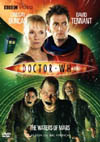
International Titles:Deutsch: "Der rote Garten"Magyar: "A Mars vizei"Français: "La Conquête de Mars"Русский: "Воды Марса"Italiano: "L'acqua di Marte""The Waters of Mars" has become available on DVD and Blu-Ray. Click on the Amazon symbol for the location nearest you for pricing and availability:
Comments on this article are welcome. You may contact the author from this page:
|
||||||||||||||||||||||||||||||||||||||||||||||||||